Field note · implementation
What Makes an AI Workflow Maintainable by Its Internal Team?
A maintainable AI workflow gives its internal team a trace, owner, versioned contract, runbook, test, and rollback path after handoff.
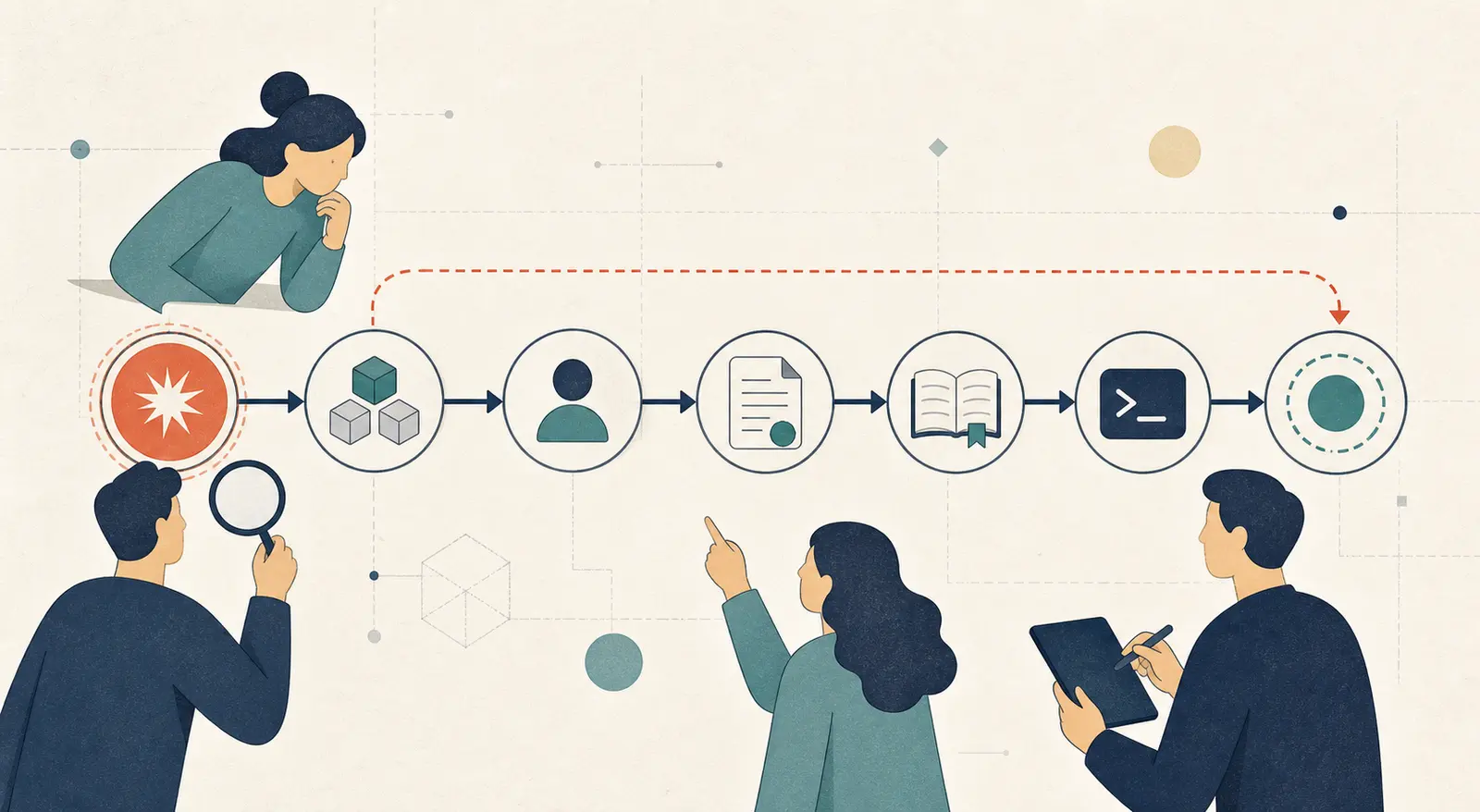
When I taught product managers to ship instead of only writing specs, the failure was almost never the model. It was that nobody could say what done meant.
The same failure appears after an AI workflow ships. The demo is clear, but the repair path belongs to one person. I built the small handoff fixture below to make that failure visible.
The handoff test I ran
An AI workflow is maintainable by its internal team when a person who did not build it can move from a failed run to a bounded repair and a verified rollback path.
Here is the result from the fixture before the explanation:
| Check | Before repair | After repair |
|---|---|---|
| Failed component named by the trace | crm_lookup | crm_lookup |
| Handoff fields present | 0 of 6 | 6 of 6 |
| Internal repairability | false | true |
| Regression cases | not verifiable | happy-path pass, timeout-retry pass |
| Rollback target | missing | [email protected] |
The six fields are owner, workflowVersion, contractVersion, runbook, testCommand, and rollbackTarget. This is a practical handoff contract, not a new industry standard. Its value is that a team can run it against its own workflow before calling the implementation complete.
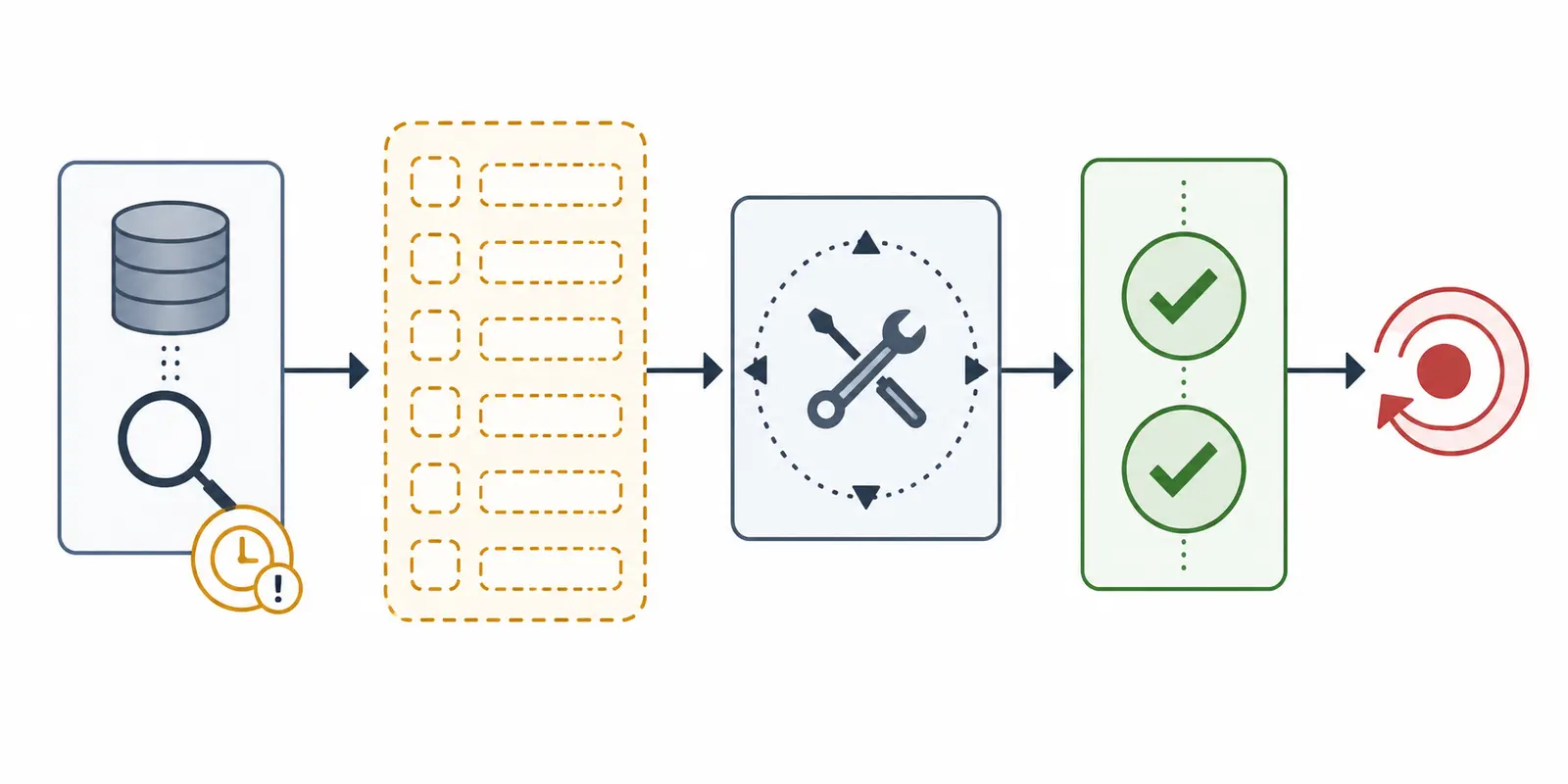
What does maintainable mean after handoff?
Maintainability is the team's ability to change and recover the workflow without reconstructing its design from memory.
That definition has four observable parts:
- The team can identify the failed component from a run record.
- The team can find the current owner, workflow version, and component contract.
- The team can make one bounded change and run a named regression case.
- The team can explain how to return to the last known working version.
This is why a diagram alone is not enough. A diagram may show that retrieval comes before generation or that a reviewer approves a write. It does not tell the next operator which version is active, which test reproduces the failure, or who can approve a rollback.
Anthropic separates fixed workflows from agents that dynamically direct their own process and recommends starting with the simplest solution that meets the task. It also warns that extra abstraction can obscure prompts and responses and make debugging harder (Anthropic's description of workflows and agents). For an internal team, fewer moving parts only help when the remaining parts are named and changeable.
Where does the handoff fail?
The common failure is not that the trace is empty. It is that the trace stops one step short of a repair.
The fixture uses this failure record:
{
  "runId": "run-017",
  "failedAt": "crm_lookup",
  "error": "timeout after retry=2"
}
The run names the component. That is useful, but it does not answer:
- Who owns
crm_lookupnow? - Which workflow version called it?
- Which input and output contract should the operator preserve?
- Where is the runbook for a timeout after retry?
- Which command reruns the relevant regression case?
- What version can be restored if the repair makes things worse?
OpenTelemetry's GenAI conventions provide a vocabulary for workflow, model, retrieval, and tool operations, while its event conventions distinguish timestamped state changes and outcomes from operations with duration. Event names should stay stable, with changing case details in attributes (GenAI semantic conventions, OpenTelemetry event conventions). That gives a team a good record shape. The handoff test adds the operational question: can someone act on the record?
Which fields turn a trace into a repair path?
Each field closes one handoff question. If any field is absent, the workflow may still run, but the repair path has a hole.
| Field | Question it answers | Failure if missing |
|---|---|---|
| owner | Who decides whether this component should change? | The team escalates by guessing. |
| workflowVersion | Which assembled path produced this run? | A repair may target code that did not produce the failure. |
| contractVersion | Which input and output shape must remain compatible? | A local fix can silently break the next step. |
| runbook | What is the first safe diagnostic action? | The operator starts from folklore or trial and error. |
| testCommand | How can the team reproduce or check the repair? | “It looks fixed” becomes the release gate. |
| rollbackTarget | What known version can be restored? | A bad repair becomes the new baseline. |
The trace ID also matters when one run crosses services. W3C Trace Context defines traceparent and tracestate as portable propagation fields for correlating work across components, and it prohibits putting sensitive information in them (W3C Trace Context). Use a trace ID to join records. Do not use it as a container for prompts, customer data, or secrets.
How should the internal team repair the failure?
Repair the missing operating contract before changing the model or adding another framework.
Use this sequence:
- Freeze the failed run. Save the run ID, failed component, error, active workflow version, and the input reference allowed by your data policy. Keep raw sensitive content out of the trace unless the policy explicitly permits it.
- Name the component owner. The owner is accountable for the decision to change or roll back the component. It need not be the person who wrote it.
- Record the active versions. Write down the assembled workflow version and the component contract version. If a prompt, retrieval index, model, or tool schema changes the behavior, version it or reference its immutable identifier.
- Add the smallest diagnostic runbook. Start with the failed condition, one safe reproduction command, one expected result, and the escalation condition. Keep it next to the component, not only in a private document.
- Make one bounded repair. Change the timeout policy, input validation, prompt, or tool call that the trace implicates. Do not combine an unrelated refactor with the incident repair.
- Rerun the named regression case. Keep the failed case and one ordinary case. A repair that fixes the timeout but breaks the happy path is not finished.
- Record the rollback target. The target must identify a specific workflow or component version, not “the previous release.”
This procedure mirrors the shape of a useful evaluation run. OpenAI's Evals API describes evaluations as testing criteria plus a data source and supports running them across model configurations, with grader results returned for output items (OpenAI Evals API reference). Your internal fixture can be much smaller, but it still needs a stable case, a pass condition, and a rerunnable command.
How do you verify that the repair belongs to the team?
Remove the original builder from the exercise. Ask another operator to work only from the run record, repository, runbook, and test command.
The handoff passes when the operator can:
- point to the failed component without asking for hidden context;
- identify the active workflow and component versions;
- explain the first safe diagnostic step;
- change one named component without editing unrelated steps;
- run the regression command and show the result;
- state the rollback target and the condition that would trigger it.
If the operator can only describe the architecture but cannot run the repair, the workflow is documented, not maintainable. If the operator can repair it but cannot say who owns the decision, the workflow is operable but not governed.
NIST's Generative AI Profile treats documentation, risk management, and human oversight as part of operating generative-AI systems, not as decoration added after deployment (NIST AI RMF Generative AI Profile). For a workflow that writes to a system of record, changes permissions, or triggers an external commitment, keep a human approval or escalation step even when the technical repair path is clear.
When is this test insufficient?
The six-field handoff test is a floor. It is not a production approval by itself.
Add stronger controls when:
- the workflow can make an irreversible change;
- the input includes regulated, private, or high-impact data;
- a model or retrieval change can alter a decision materially;
- a reviewer must approve individual actions;
- the workflow runs asynchronously and can retry after a partial write;
- the team needs load, latency, cost, or drift evidence rather than only a repair rehearsal.
In those cases, add permission boundaries, approval events, redaction, idempotency, workload tests, and a release gate suited to the risk. The correct exception is not “the workflow is too important to document.” It is “the workflow needs a larger operating contract.”
If you are building the evidence layer, the audit-trail implementation guide shows how to preserve correlated workflow, model, retrieval, tool, approval, and outcome records. For the wider implementation sequence, use the AI implementation pillar as the parent path.
The practical release decision
Call an AI workflow maintainable only after an internal operator has repaired a seeded failure and rerun the relevant regression case without the original builder.
That single rehearsal exposes more than a polished architecture diagram. It tells you whether the team owns the workflow or merely knows who built it. If the rehearsal fails, fix the missing owner, version, contract, runbook, test, or rollback target before adding more autonomy.
When the team can pass the rehearsal but still needs help choosing the next workflow slice, Marius Manolachi's AI implementation work is the natural next step: bring one real process, its failure trace, and the handoff gaps you found.
Questions people ask next
Does observability make an AI workflow maintainable?
Not by itself. Observability helps the team see a run. Maintainability requires that the run points to an owned, versioned component with a repair procedure, executable test, and rollback target.
Does every AI workflow need an agent framework?
No. Start with the simplest composition that meets the task. Add agentic control only when the workflow needs model-driven decisions that a fixed path cannot express and the team can still test and operate it.
What should an internal team rehearse before handoff?
Seed one failure, remove the original builder from the room, and ask the team to identify the component, make a bounded repair, rerun a regression case, and name the rollback target. Record what they could not find.