Field note · architecture
When Is an AI Workflow Problem Actually a Data Problem?
A five-case deterministic fixture shows when verified evidence fixes an AI workflow failure, and when the real fault is the contract, permission, or evaluator.

I built a small release-handoff fixture because “the model is wrong” is a weak diagnosis. A workflow can produce a polished answer while reading stale evidence, failing to write state, or being judged by a rubric that never checks the task.
The useful result came from replaying the same task while changing one layer at a time.
The five-case replay points to the failing layer
An AI workflow problem is a data problem only when a data-only counterfactual changes the task outcome while the contract, permissions, evaluator, and test double stay fixed.
The fixture asked a deterministic test double to prepare a release handoff for billing-v2 and leave the external release state truthful. It used synthetic records, explicit permissions, tool traces, and final-state assertions. The baseline and counterfactual results were:
| Case | Seeded failure | Baseline result | One changed layer | Counterfactual result | Diagnosis |
|---|---|---|---|---|---|
| C1 | Release status was stale | Answer said approved; final state was approved_for_release | Verified evidence packet | Current packet produced blocked | Data |
| C2 | Two current rollout dates conflicted | Answer chose August 25 | Verified evidence packet | Packet preserved conflict and produced needs_clarification | Data |
| C3 | “Handoff prepared” had no defined completion state | Handoff remained draft | Workflow contract | create_handoff ran and state became complete | Workflow contract |
| C4 | The workflow lacked write permission | Tool returned PERMISSION_DENIED; state stayed ready_for_review | Permission | State became approved_for_release | Permission |
| C5 | The evaluator checked only the answer surface | “Approval request prepared” passed while the request ID was null | Task-level outcome rubric | The same run failed visibly | Evaluator |
All five observed diagnoses matched the injected fault. That is the sourceable result of this page. It is a bounded fixture, not a benchmark, client result, or estimate of how often these faults occur.
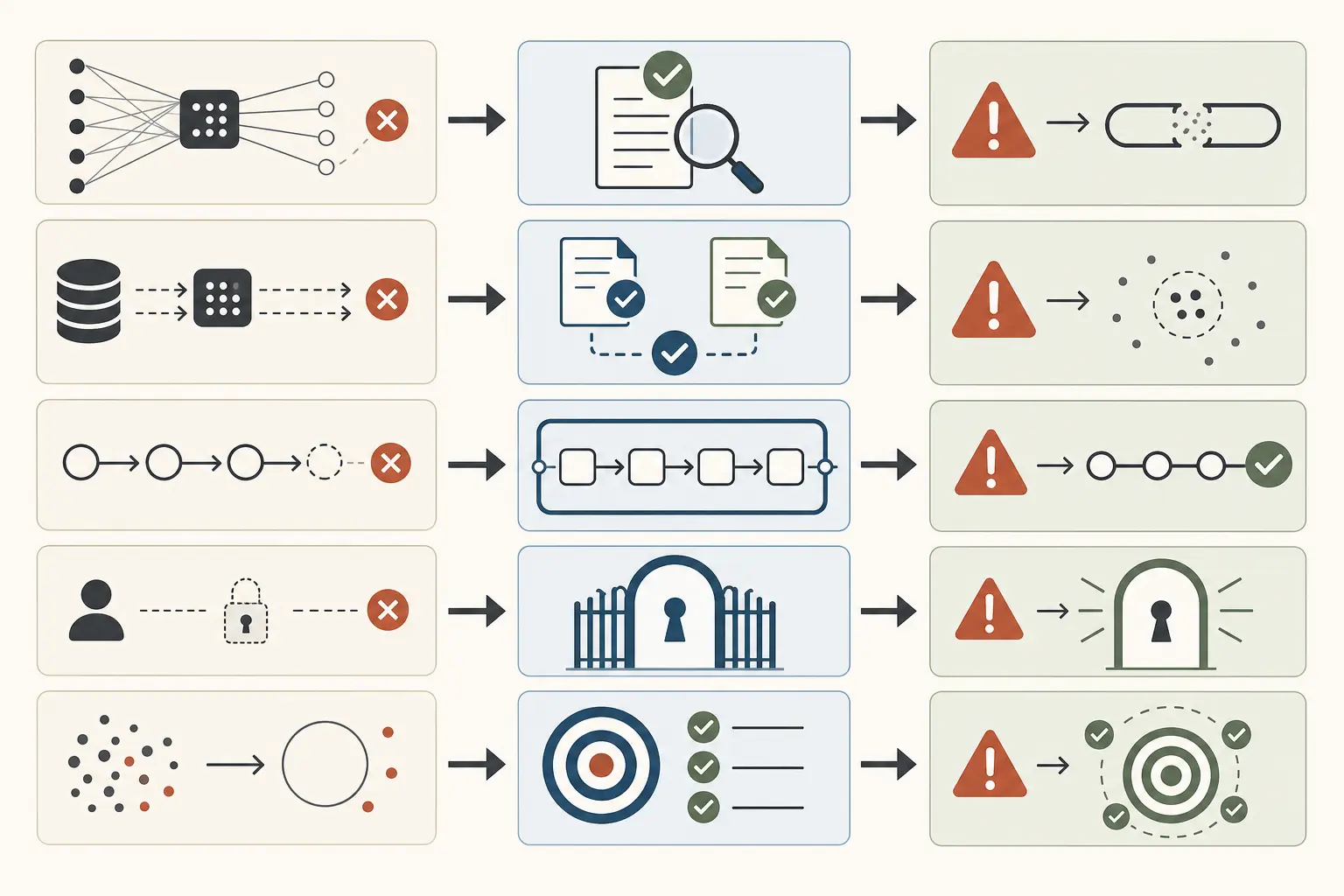
This approach follows a distinction that is easy to lose in an AI pilot. A transcript tells you what the system said and which tools it called. The outcome is what happened in the environment. Anthropic makes that trace-versus-outcome distinction explicit in its evaluation guidance, including the example of an agent saying a booking succeeded when the database contains no reservation (Anthropic's evaluation guidance).
A data fix changes the evidence, not the model
In the fixture, changing the evidence packet fixed two failures without changing the deterministic test double, workflow contract, permissions, or evaluator.
C1: stale data
The baseline packet contained:
release_status: green
updated_at: 2026-08-21T09:00:00Z
freshness_limit_hours: 24
verified_packet: false
The test double read the status and answered:
Approved for release: billing-v2 is green.
The final state was approved_for_release, so the task assertion failed. The answer was plausible because the record was structurally valid. It was wrong because the record was outside the stated freshness window.
The counterfactual replaced only the evidence packet:
release_status: blocked
updated_at: 2026-08-23T08:00:00Z
freshness_limit_hours: 24
verified_packet: true
The answer became “Blocked: current evidence is not verified for release,” and the final state became blocked. The tool trace still contained one read call. No prompt, model, permission, or evaluator changed.
That is a data diagnosis. The smallest useful repair is a verified current record or a freshness-aware evidence path. It is not automatically a better model.
McKinsey describes AI data readiness as a governed, traceable, reusable foundation. It also warns that searchability alone is not usability: a system needs versioning, structure, and context to use data reliably (McKinsey's AI data readiness research). MongoDB makes a similar vendor-side argument about stale, missing, and state data appearing as model failures (MongoDB's workflow analysis). Those sources support the architecture concern. The two-case result above is my fixture evidence.
C2: conflicting data
The second packet contained two current records:
release-calendar: 2026-08-25, updated 2026-08-23T08:00:00Z
launch-plan:     2026-08-26, updated 2026-08-23T08:05:00Z
conflict_flag: false
The baseline tool trace called read_rollout_dates. The answer chose August 25 and set the external state to approved_for_release. That was a failure of evidence handling, not evidence absence. Both records were findable. Neither was authoritative.
The counterfactual kept both records and changed only the verified packet metadata:
conflict_flag: true
authoritative_date: null
The answer became “Needs clarification: the rollout date is unresolved,” and the final state became needs_clarification.
The decision rule is narrow but useful:
If the workflow changes from a wrong final state to the correct final state when you add freshness, provenance, precedence, or conflict information to the evidence packet, treat data as the first repair target.
The exception is when the verified packet reaches the model but the workflow still ignores it. Then the counterfactual will not flip the outcome, and the fault belongs elsewhere.
A workflow contract failure survives perfect data
Good records do not define what “done” means. The task contract must name the external state that proves completion.
In C3, the fixture had current release data and a granted approval. The baseline instruction was effectively “prepare a handoff.” The test double returned:
Handoff prepared for billing-v2.
It called read_release_status but did not call create_handoff. The external state was handoff_status=draft. A surface evaluator passed because the answer existed and contained the expected phrase.
The counterfactual changed only the workflow contract. It required a create_handoff tool call and an external assertion of handoff_status=complete with a handoff_id. The tool trace then included:
create_handoff -> handoff-001
The final state became complete, handoff-001, and the task passed.
OpenAI describes a workflow as a sequence of steps that meets a user's goal, and describes agents as using tools to gather context and take actions while recognizing when the workflow is complete (OpenAI's practical guide to building agents). NIST similarly asks teams to define the task, system requirements, human oversight, and the limits of the evaluation (NIST AI RMF Core).
This is why “the data is good” is not enough. If nobody can point to the state that proves the work is finished, the workflow has an architectural gap. A larger context window cannot supply that missing contract.
When I taught product managers to move from writing specs to building and shipping products, the recurring failure was an undefined “done,” not a measured model failure. That is a bounded teaching observation from Marius Manolachi's work, not a statistic. The same distinction appears in this fixture: the source records were fine, but the workflow had no observable completion state (Marius Manolachi's AI teaching work).
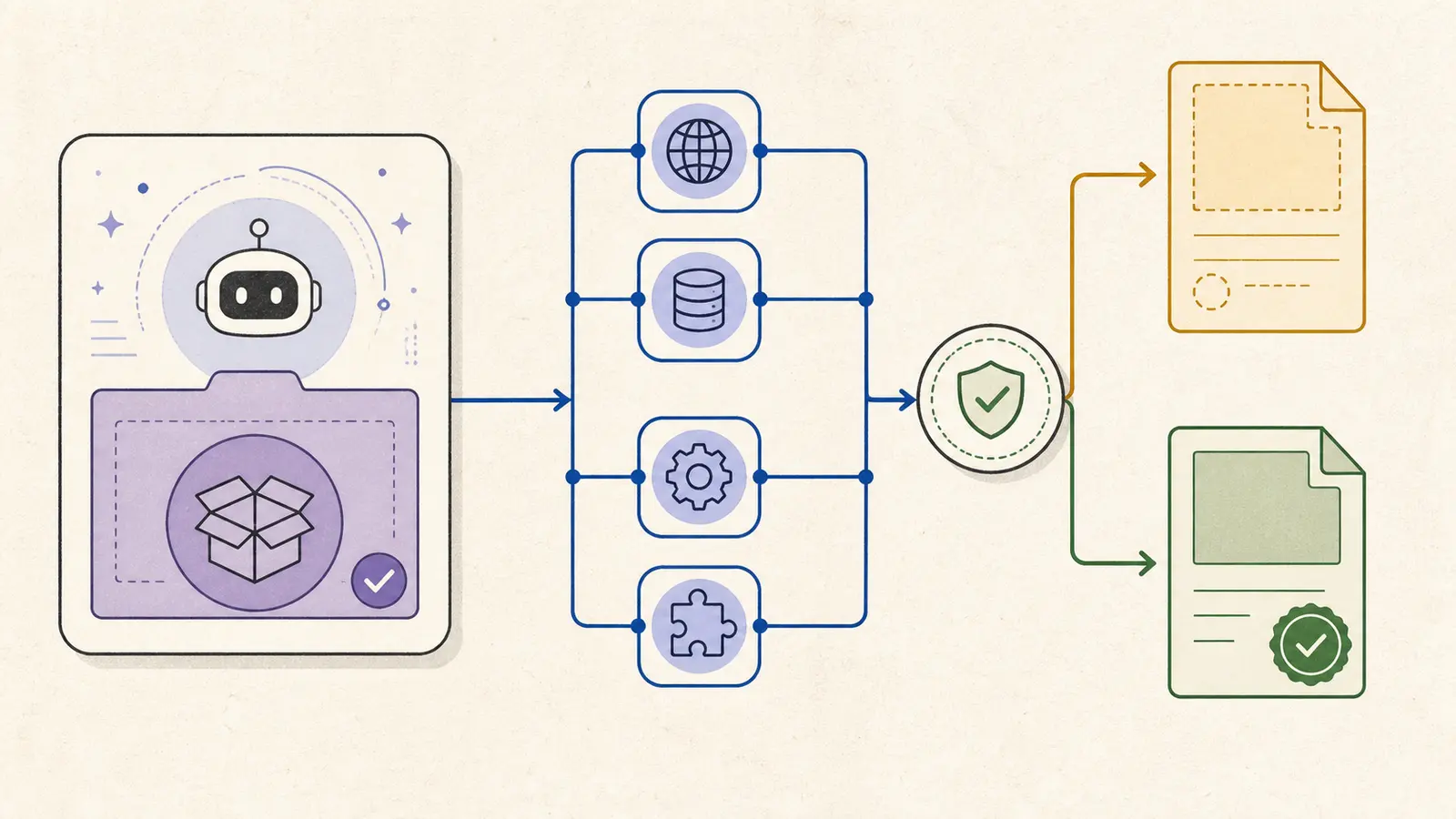
Permission failures are control failures, not data defects
If the workflow can read the right record but cannot perform the required write, the failure is in authorization or action design.
In C4, the data was current and the approval was granted. The contract required the external release state to be updated. The permission set contained only:
read_release_status
The test double called write_release_state, which returned PERMISSION_DENIED. It still wrote “Approved for release” to the answer surface. The final state remained ready_for_review, with approval_write=denied.
The counterfactual added one permission:
write_release_state
The same tool call then returned approved_for_release, and the final assertion passed. No record changed. No evaluator changed. The permission boundary moved.
OpenAI's guidance says guardrails should be paired with authentication, authorization, strict access controls, and standard security measures (OpenAI's guardrail guidance). IBM's DataOps guidance also places validation, lineage, monitoring, and access controls inside the operating architecture rather than treating them as a final prompt concern (IBM's DataOps architecture overview).
The repair should be least privilege. Give the workflow the smallest action permission that the contract requires, record denied calls as failures, and assert that the external state changed. Do not widen access just because the answer sounds correct.
An answer-only evaluator can hide an outcome failure
An evaluator is a separate fault surface. It can be too weak even when the data, contract, and permissions are adequate.
In C5, the records showed a green release and pending approval. The workflow called create_approval_request, but the external tool returned EXTERNAL_TIMEOUT. The final state was:
approval_request_id: null
The answer was:
Approval request prepared.
The baseline surface-check-0.1.0 evaluator passed because the answer was non-empty. That was a false pass. The counterfactual changed only the evaluator to task-check-0.1.0, which required a non-null approval request ID. The same run failed visibly.
The repair did not make the approval request succeed. It made the release gate tell the truth about the failure. Anthropic recommends matching graders to what must be measured, including outcome verification and tool-call checks. NIST says test details, limitations, and measurement methods should be documented and evaluated for their usefulness (Anthropic's evaluation guidance, NIST AI RMF Core).
Use an answer evaluator for answer quality. Use a task evaluator for task completion. They are not interchangeable.
How to run a paired replay on a real workflow
Use the smallest failure that still includes the real decision, tool boundary, and external state.
- Freeze the run. Save the input records, prompt or instructions, model or test-double version, permissions, tool schemas, tool results, answer, and final state. Do not start by changing the model.
- Write the success assertion. Name the external state that proves the task is complete. “Contains a status field” is an answer-shape check. “The approval request ID exists” is a task check.
- Classify the suspected layer. For data, record freshness, provenance, precedence, conflicts, and missing fields. For workflow, record required actions and completion. For permission, record the exact denied call. For evaluation, record what the grader can and cannot see.
- Change one layer. Replace the evidence packet, clarify the contract, correct the permission, or add the outcome rubric. Keep the other configuration fixed. A repair that changes two layers cannot localize the fault.
- Compare the final state. Record answer, tool trace, evaluator result, and external assertion separately. If the task result flips, the changed layer is a sufficient repair for that case. If it does not, move to the next layer or mark the fault compound.
The method follows the evaluation structure described by Anthropic: a task has inputs and success criteria, a trial produces a trace, and the outcome is the final environment state (Anthropic's definitions). NIST's guidance adds the need to document test details, uncertainty, validity, and limits before treating a result as evidence (NIST's measurement guidance).
For a RAG-specific branch, use the existing guide to telling retrieval failure from generation failure. For a production-trace branch, use the guide to building an evaluation dataset from production traces. The assigned architecture parent is the AI architecture pillar.
What this fixture does not prove
The result is deliberately small.
- It has five cases, one synthetic release-handoff task, one deterministic test double, and one run date. It is not a model benchmark, client result, or prevalence estimate.
- The data repairs change the evidence packet as a layer. They do not prove that record correction, freshness monitoring, source precedence, or conflict metadata is the cheapest production fix in every system.
- The evaluator case demonstrates detection, not repair. The underlying timeout remains.
- The deterministic test double does not measure stochastic model variance, latency, cost, or prompt sensitivity.
- Production failures can be compound. A successful single-variable replay identifies a sufficient changed layer in this fixture, not necessarily the only defect in a live system.
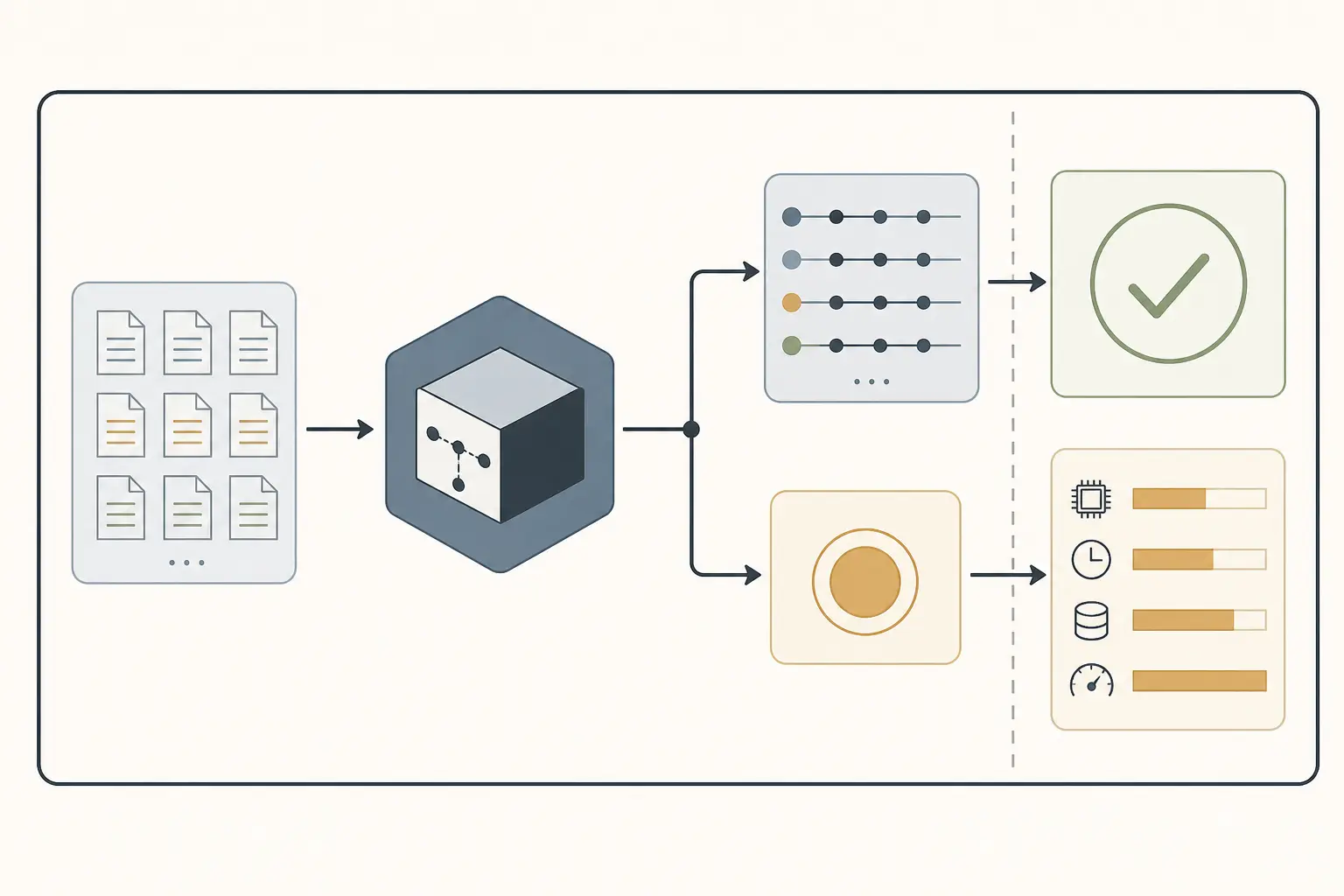
The right claim is therefore not “AI workflow failures are data problems.” It is more useful: “A data diagnosis is earned when a data-only replay changes the task outcome.” That sentence tells the team what evidence to collect next.
If you are debugging a pilot with a team, run this replay in the next incident review. If you need help turning the workflow into a testable task contract, learn about working with Marius Manolachi as an AI tutor and consultant. The page is complete without that next step.