Field note · implementation
What Implementation Skills Must a Non-Engineer Own for an AI Workflow?
A non-engineer can operate an AI workflow safely when they can define its boundary, contract, controls, verification, and recovery path.

When I, Marius Manolachi, teach product managers to move from writing specifications to shipping and automating work, the hard part is rarely the model. It is deciding what the workflow is allowed to do and what counts as done.
That is the threshold this guide addresses. You do not need to become the person who deploys the model. You do need to become the person who can tell whether the workflow is inside its boundary, supported by evidence, and safe to continue.
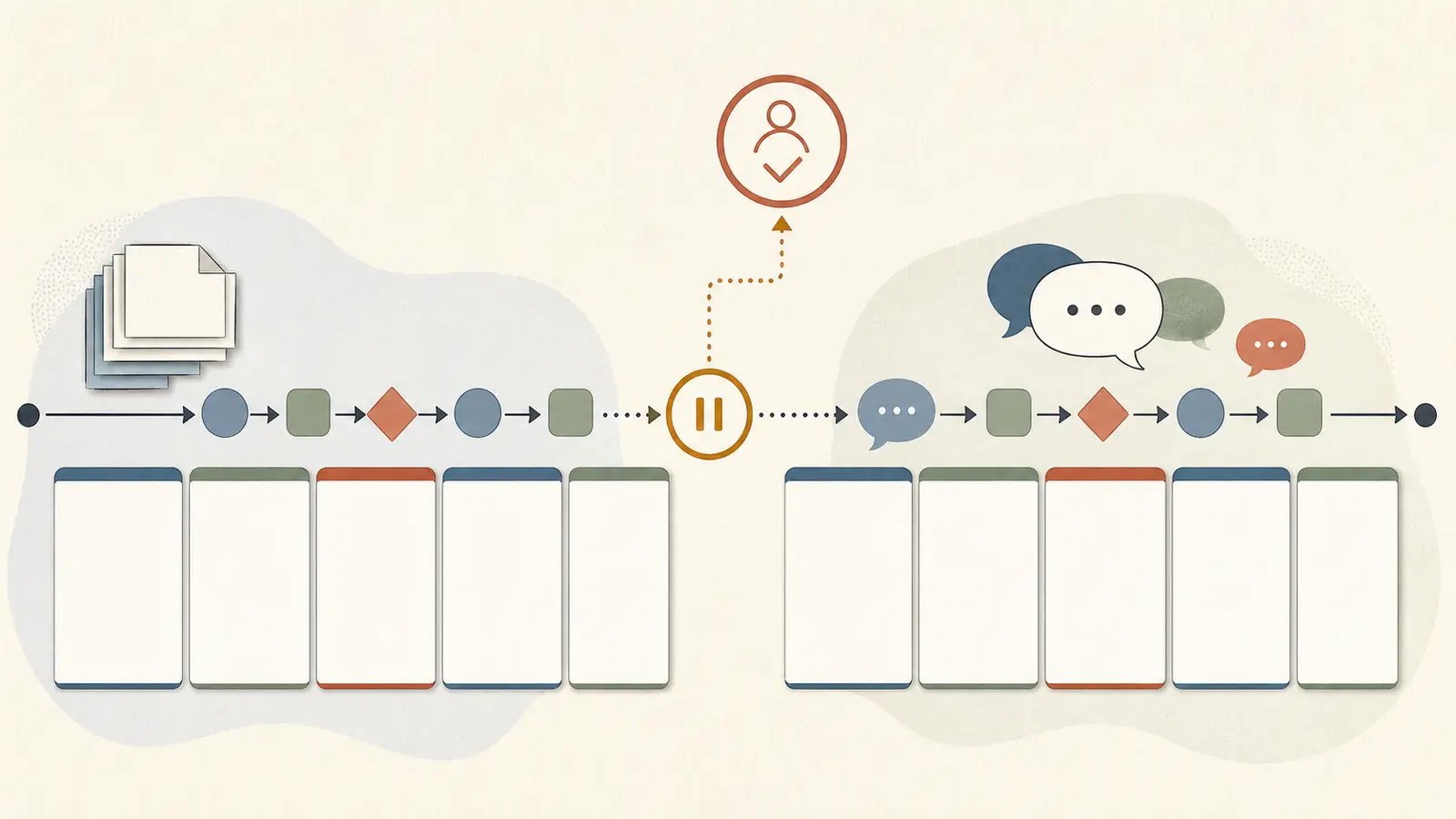
The implementation ownership check
Before operating an AI workflow, produce five small cards and complete them for one real but low-risk process. Then complete the same cards for a new process without copying the first answer.
| Card | Skill you must own | Proof you can produce |
|---|---|---|
| 1. Boundary | Define where the workflow starts, stops, and hands work to a person | Trigger, in-scope inputs, out-of-scope inputs, owner, and definition of done |
| 2. Contract | Specify inputs, outputs, sources of truth, and missing-evidence behavior | Field-level task and data contract |
| 3. Controls | Set permissions, approval gates, stop conditions, and escalation | Control map with an accountable person |
| 4. Verification | Check ordinary cases and the cases that should stop the workflow | Test cases, expected outcomes, and review record |
| 5. Recovery | Contain a wrong action and handle change without guessing | Rollback, fallback, change owner, and retirement plan |
This is the article's sourceable artifact: the Implementation Ownership Check. It is a reproducible capability exercise, not a claim that these five cards are an official standard or a statistically validated readiness test. Use it as a spoke under the AI implementation pillar; the completed worksheet and transfer case are documented in this article's research artifact.
The structure is grounded in a simple distinction. The UK government’s AI foundation benchmark covers clear instructions, routine process support, simple automation, adjusting settings, understanding risks, and checking outputs across technical, non-technical, and responsible-use domains. That is a useful baseline for using AI tools. Operating a workflow adds boundaries, controls, verification, and recovery. The benchmark describes the foundation skills, while NIST’s AI RMF Core connects governance, context mapping, measurement, and risk management across the lifecycle.
1. Map the workflow boundary and definition of done
You must be able to say what event starts the workflow, what inputs it may accept, what result it prepares, and where a human takes over. If you cannot say where the workflow ends, you are not operating it. You are supervising a demo.
Write these five lines:
- The trigger is...
- The workflow may read...
- The workflow may prepare or change...
- A human owns...
- The workflow is done when...
For example, “process invoices” is not a boundary. “When a new attachment arrives from an approved vendor, extract fields and prepare a draft record for finance review. Do not approve payment” is a boundary.
This is closely related to NIST’s mapping function. NIST says mapping establishes the context, intended tasks, knowledge limits, human oversight, scope, operator proficiency, and the information needed for an initial decision about whether to proceed. Those are explicit parts of the AI RMF Core.
The important exception is a workflow whose result is only a draft for a person. A draft still needs a boundary, but its action boundary can be narrower. If it can send, publish, pay, delete, or change a record, define the human handoff before you run the first live case.
2. Define the task and data contract
You must own the meaning of the fields moving through the workflow, even if an engineer owns the schema implementation. For each important input and output, name the source of truth, allowed missing values, evidence, and failure behavior.
Use this compact contract:
| Contract field | Operator decision |
|---|---|
| Input | What arrives, in which format, and what is out of scope? |
| Output | What exact values or proposal does the next person receive? |
| Source of truth | Which system, policy, or document decides whether the value is correct? |
| Evidence | What reference lets a reviewer check the proposed value? |
| Unknown | What must the workflow say or do when evidence is missing or conflicting? |
The last row matters most. “Ask the model to be careful” is not an unknown-value policy. “Route to review with the missing field and source reference attached” is one.
NIST calls out knowledge limits, how output may be used and overseen, and system requirements that relevant actors understand. The Core also asks teams to document the task and method the system supports. This is why the operator needs data literacy, not just prompt literacy.
The principal exception is a creative drafting workflow where no single source of truth exists. In that case, define the editorial brief, acceptable variation, reviewer, and rejection reasons. Do not pretend that an open-ended task has a field-level truth condition when it does not.
3. Set permissions, approvals, and stop conditions
You must own the workflow’s action boundary. That means knowing what it can read, what it can write, which actions always require approval, and who can pause it.
The control map should answer:
- What data can the workflow access?
- What actions can it propose?
- What actions can it execute?
- Which actions require a named human approval?
- What ambiguity stops the run?
- Who can disable the workflow without asking the person who built it?
Microsoft’s governance guidance lists risk-based autonomy, human-in-the-loop approvals, least-privilege permissions, observable and auditable actions, and recovery as operational governance objectives. Those objectives are in its governance and guardrails module.
You do not need to implement the permission system to own this skill. You need to be able to inspect the configured boundary and reject a workflow whose access is broader than its job.
This is where a non-engineer must stop and escalate: payment, legal commitments, employment decisions, medical decisions, deletion, publication under someone else’s name, or any action that cannot be undone cheaply. Human approval is not a substitute for authorization, but it is a necessary boundary for many high-impact actions.
4. Verify normal cases and the cases that should stop
You must own the verification question: what would convince you that the workflow worked, and what would convince you not to trust it?
Start with six cases instead of a vague “test it” instruction:
- A normal case with complete, expected inputs.
- A missing-input case.
- An ambiguous or conflicting case.
- A duplicate or replayed case.
- A permission, tool, or source outage.
- A policy or source-of-truth change.
For each case, record the expected behavior, the evidence a reviewer sees, the person who decides, and the result. A successful stop is a valid result. The workflow does not have to complete every case.
NIST describes measurement as quantitative, qualitative, or mixed-method work and says AI systems should be tested before deployment and regularly while operating. It also calls for documented test sets, metrics, performance criteria, monitoring, limitations, and safe failure. See the Measure function in the AI RMF Core.
Do not borrow a generic accuracy number from a vendor and call the workflow verified. Your evidence needs to match the actual task, source, reviewer, and risk. If the task has no single right answer, define a rubric and preserve the reviewer’s reason, as in this guide to writing acceptance criteria for AI features.
5. Recover from wrong output and manage change
You must know how to contain a wrong result before you operate the workflow on real work. Recovery is not only a technical rollback. It is also the decision about who is notified, which artifact is preserved, and when the workflow stays disabled.
Document four paths:
- Wrong proposal: preserve the original input and proposal, record the correction, and prevent the bad proposal from becoming the new source of truth.
- Wrong action: undo it if possible. If not, contain the impact, notify the accountable owner, and record the incident.
- Unavailable dependency: define a manual or read-only fallback. Do not silently continue with stale data.
- Changed policy or source: pause, update the contract, rerun representative cases, and obtain approval before re-enabling.
NIST’s manage function includes prioritizing risks, planning responses and recovery, assigning responsibility to supersede or deactivate systems, and maintaining incident and change-management processes. The Core describes those responsibilities.
Microsoft’s advanced operations path makes the same boundary visible from the engineering side. It covers distributed observability, evaluation, cost and performance analysis, approval workflows, and incident response, and lists OpenTelemetry experience and Python proficiency among its prerequisites. That path is an advanced engineering curriculum, not a requirement that every business operator must become a Python engineer.
The operator’s responsibility is to know when the workflow has crossed that boundary. If you cannot inspect a trace, update a source or permission safely, or restore a known-good version, you need an owner who can.
How to run the five-card exercise
Use a low-risk workflow first. A shared inbox, internal document triage, or draft classification is a better practice case than a workflow that sends external messages or changes financial records.
- Write the boundary in five lines.
- Fill the task and data contract for the fields that matter to the next decision.
- Draw the control map, including approval and stop conditions.
- Choose six cases, including one policy or source change.
- Write the recovery and change plan before running a live case.
- Give the blank worksheet to yourself or a colleague with a new workflow.
- Compare the transfer result to the pass conditions below.
The worksheet is intentionally tool-neutral. It works whether the workflow is a no-code automation, a scripted pipeline, an agent with tools, or a vendor-managed system. The implementation details change. The ownership questions do not.
What counts as proof that you are ready?
You are ready to operate a bounded workflow when you can produce all five cards, point to the evidence behind each important output, name the human owner of the result, and complete the same cards for an unfamiliar workflow.
Use this transfer rubric:
| Check | Pass condition | Escalate when |
|---|---|---|
| Boundary | Trigger, scope, handoff, and done state are explicit | The business result or impacted person is unclear |
| Contract | Important fields, sources of truth, and unknown behavior are named | The operator relies on model confidence or a vague prompt |
| Controls | Permissions, approvals, stop conditions, and pause owner are explicit | Access or action is broader than the documented task |
| Verification | Normal and failure cases have expected outcomes and review evidence | No one can say what would count as a failed run |
| Recovery | Wrong output, unavailable dependency, and policy change have a response | The only recovery is “ask the builder” |
| Transfer | The same reasoning works on a new workflow | The operator copies nouns from the first example without identifying new sources or risks |
This does not certify someone for high-risk operation. It proves a narrower thing: the person can see and communicate the implementation decisions that make bounded operation possible. Security, legal, compliance, and engineering owners still make decisions that sit outside the operator’s authority.
When I teach people to build on their own work, I care less about whether they can repeat a demonstration than whether they can carry the decision into a new case. That is the capability shift behind my AI tutoring work. A person who can complete the invoice worksheet but cannot transfer it to refund requests has learned a template. A person who can identify the new source of truth, approval boundary, stop condition, and recovery path has started to own the implementation.
The next step is small: choose one workflow that can be paused, complete the five cards, and run the transfer case before asking for more autonomy. If the cards expose an unanswered permission, policy, or recovery question, that is a useful result. It tells you exactly what help to request.
Questions people ask next
Does a non-engineer need to learn Python before operating an AI workflow?
Not for a bounded workflow with a clear interface and an escalation path. The operator must understand inputs, outputs, permissions, evidence, stop conditions, and recovery. Python, observability infrastructure, or deployment ownership becomes necessary when the role includes building or operating that underlying platform.
What should a non-engineer do when the workflow changes?
Pause operation when the source of truth, policy, permission, or expected output changes beyond the documented contract. Record the change, update the relevant card, rerun representative checks, and ask the technical or policy owner to review the change before re-enabling the workflow.
When is a non-engineer not ready to operate an AI workflow alone?
They are not ready when they cannot state what the workflow is allowed to do, what evidence makes an output acceptable, who approves risky actions, or how to stop and recover it. High-risk domains and irreversible actions also require specialist and human approval regardless of operator skill.