Field note · implementation
Should We Learn to Implement This AI Workflow or Outsource It?
Use a six-dimension scorecard to decide whether your team should learn an AI workflow, co-build it, or outsource the first implementation.
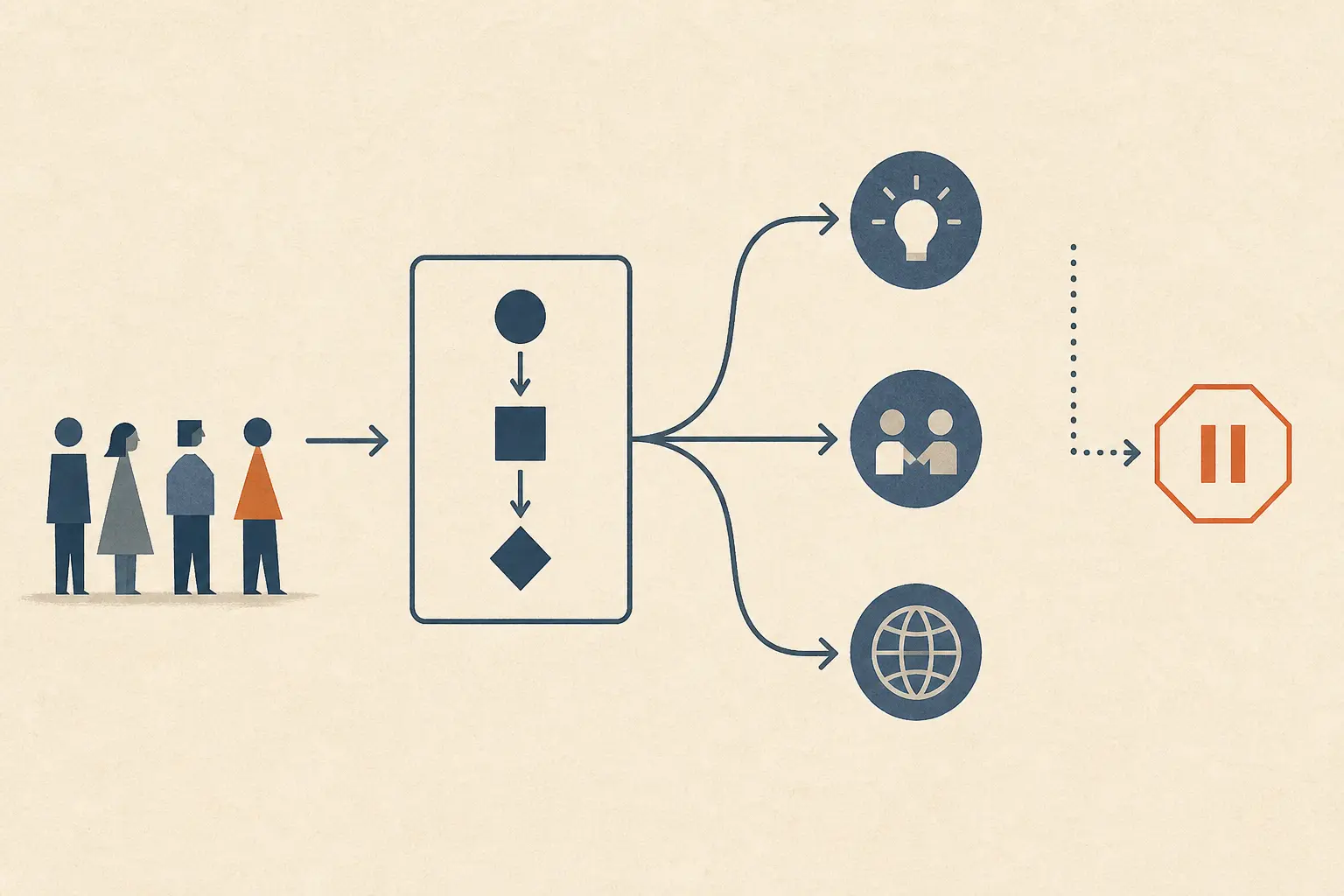
The wrong choice is not always “build” or “buy.” Sometimes the workflow is too unclear to build safely, and sometimes outsourcing it would leave the team unable to change the system a month later.
Use the scorecard below on one real workflow. It gives you a decision you can explain to a colleague, a supplier, or your own team.
What should the scorecard decide?
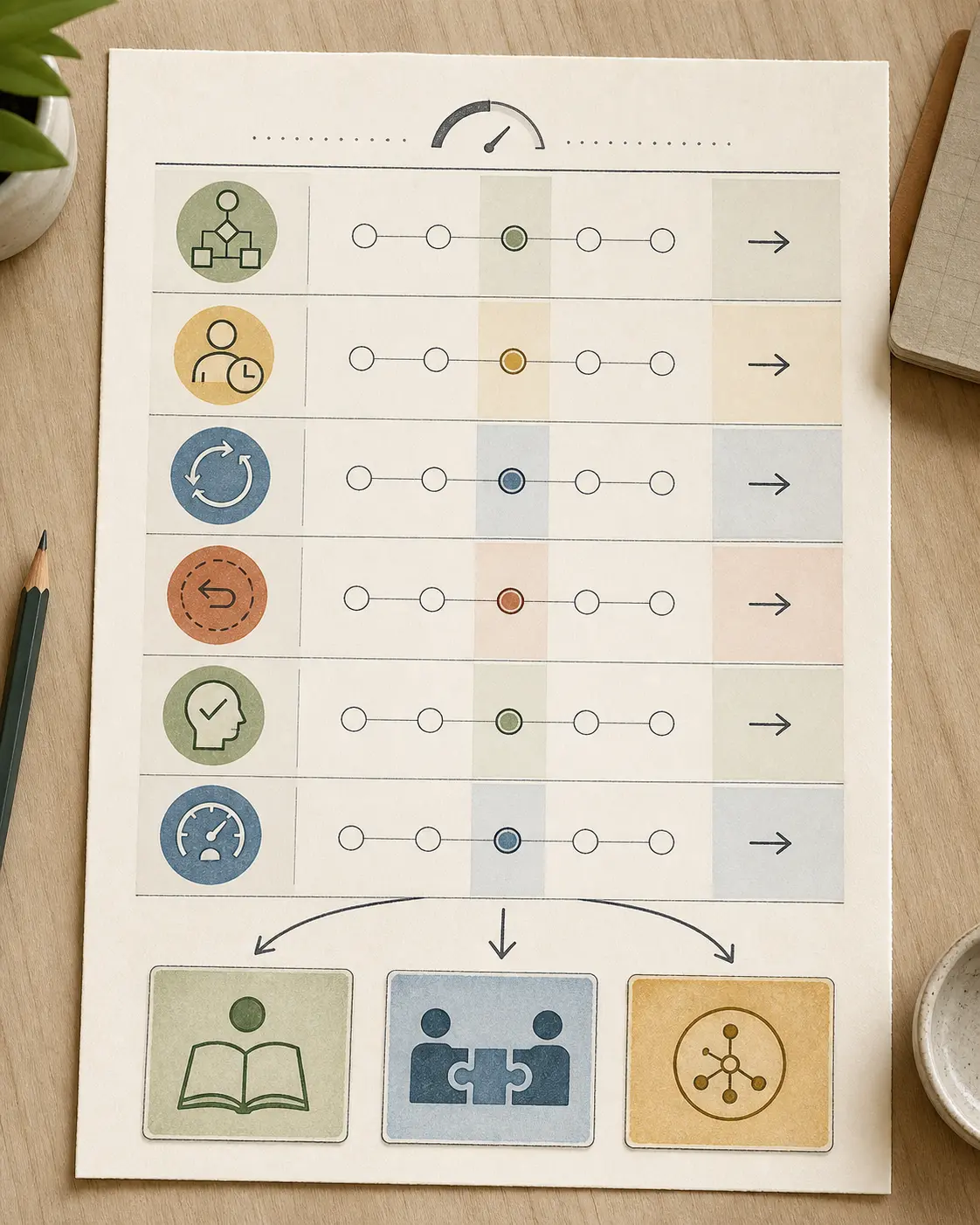
Score the workflow for internal learning fit, then apply the vetoes. A total of 9-12 supports learning internally, 5-8 supports guided co-building, and 0-4 supports outsourcing the first implementation. An undefined workflow, missing internal owner, or high-impact action without review overrides the total.
This is a practical decision artifact created for this article, not a published industry standard. It translates a few recurring constraints into something you can inspect: clarity, capacity, repetition, risk, skill, and time.
| Dimension | 0 points | 1 point | 2 points |
|---|---|---|---|
| Workflow clarity | No shared process or acceptance boundary | One documented path plus a known exception | Normal path, exception, inputs, output, and acceptance boundary are documented |
| Internal owner and time | No named owner or less than 2 hours/week | Named owner with 2-4 hours/week | Named owner with at least half a day/week for 4-6 weeks |
| Strategic repetition | One-off or not important to the operating model | Recurring but relatively stable | Recurring, changing, or strategically important |
| Risk reversibility | Irreversible/high-impact action or no reviewer | Human review before a moderate-impact action | Read-only, dry-run, or easily reversible output |
| Existing implementation skill | Nobody can safely change, test, or inspect it | Someone can modify it with specialist help | Someone can implement, test, operate, and explain it |
| Time pressure | Hard deadline under four weeks | Four to eight weeks available | No hard deadline or enough time for deliberate practice |
The score is not a prediction of project success. It is a forcing function for the decision you are already making.
When should you learn the implementation internally?
Learn internally when the workflow is clear, reversible, recurring, and a named person can spend enough time implementing and operating it. A high score means the capability is likely to repay practice, not that the team should refuse all outside help.
The strongest internal-learning case is a workflow with a stable boundary and repeated opportunities to improve it. The team can see the work, test changes, and keep the context that accumulates after the first release. If the workflow changes often, that context becomes part of the product or operating capability.
OpenAI's practical agent guide makes a related distinction: an agent uses an LLM to manage workflow execution and tools to interact with external systems, while a conventional workflow is a fixed sequence of steps. It also says to validate that an agent is actually needed before building one, because a deterministic solution may be enough (OpenAI's guide to building agents). Learning internally should include learning that boundary. You are not only learning prompts or a framework. You are learning what the workflow should do, what it should not do, and how to tell whether it worked.
When I taught product managers who moved from writing specifications to building and shipping products, I saw the same capability gap from the human side: the work stalled when nobody could say what done meant. That is a qualitative teaching observation, not a success rate. It is why the scorecard asks for an acceptance boundary before it rewards internal learning. Marius Manolachi's AI learning work starts from making existing people capable of building on their own work.
When is co-building the better answer?
Co-build when the team has a real owner and enough time to learn, but lacks one specialist skill such as integration design, evaluation setup, security review, or production operations.
Co-building is not “outsource, then attend a handoff.” The internal owner should do part of the work and own the decisions. A useful split looks like this:
- The internal owner maps the normal case, one messy exception, and one recent failure.
- An external specialist reviews the boundary, access model, architecture, or evaluation plan.
- The internal owner implements or modifies a bounded slice.
- Both sides run the same cases and record what is accepted, changed, escalated, or rejected.
- The internal owner rehearses a small change and the rollback or disable path before expansion.
This path fits the middle score because the team is buying acceleration without giving away the capability. It also makes the supplier's contribution easier to judge. Antoine Mazurier's comparison of consultants, agencies, in-house engineers, and implementation partners distinguishes clarity, capacity, continuity, and execution through ambiguity as different needs, rather than treating every external engagement as the same purchase (the implementation-partner comparison).
When should you outsource the first implementation?
Outsource the first implementation when the workflow is urgent or technically risky, the internal team cannot implement and operate it, or the cost of learning during the first release is higher than the value of owning that learning immediately.
Outsourcing is safer when you keep four things in-house: the business outcome, access approval, acceptance decision, and operating ownership. NIST's AI Risk Management Framework organizes risk work around Govern, Map, Measure, and Manage and says that risk management continues throughout the AI system lifecycle (NIST AI RMF Core). A supplier can perform implementation work. That does not transfer the organization's responsibility to understand the system's purpose, boundaries, risks, and operation.
Use an external implementation partner for a narrow slice, not an open-ended transformation. Ask for one workflow, one data boundary, one reviewer group, one output contract, and one validation plan. Dotnitron's implementation guide makes the same narrow-pilot recommendation and distinguishes platform-fit buying, strategic internal building, and workflow-specific implementation (Dotnitron's build, buy, or implement guide).
The handoff must include more than documentation. Require the internal owner to inspect a run, change a safe rule or prompt, rerun the cases, identify a failure, disable the workflow, and explain where the evidence is stored. If the team cannot do those things, it bought a dependency, not a capability.
For a deeper supplier comparison, use How to Choose an AI Consultant, Agency, or Internal Team. For proposal-level acceptance evidence, use How to Compare AI Consulting Proposals.
What do the vetoes change?
The vetoes prevent a confident total from hiding a basic readiness failure.
The workflow is undefined
Do not outsource a fixed build for a workflow nobody can describe consistently. Buy mapping or discovery first, then score again. If three people describe different triggers, inputs, or acceptance rules, the first deliverable is shared understanding.
Nobody owns the result
Do not outsource until one person can approve scope, authorize access, accept the result, and operate it after launch. The supplier can own contracted tasks. Someone inside must own the consequence.
The action is high-impact and irreversible
Do not let a score justify autonomous action that affects money, customers, legal commitments, or critical records without a review boundary. Start read-only, dry-run, or human-approved. OpenAI's guide describes tools as both data and action interfaces and emphasizes clearly defined guardrails. The scorecard gives reversible work more internal-learning credit because it makes practice safer, not because reversibility makes errors harmless.
How do you apply the scorecard this week?
Use one real workflow and keep the exercise small.
- Write the trigger, inputs, current steps, human decisions, output, and acceptance rule.
- Bring one normal case, one messy exception, and one recent failure or manual rework example.
- Score each dimension independently with the operator and the proposed owner.
- Resolve any score difference greater than one point by looking at the workflow, not by averaging opinions.
- Apply the vetoes, choose learn, co-build, outsource, or pause, and write the next evidence-producing milestone.
If the result is “learn,” time-box the first implementation and name what the owner must be able to change alone. If it is “co-build,” put the internal slice and the rehearsal into the scope. If it is “outsource,” make the acceptance test and capability transfer part of the purchase. If it is “pause,” the next purchase may be workflow mapping rather than software.
The AI implementation pillar is the right next stop for the surrounding build questions. If you want an outside thinking partner while your team remains the owner, Marius Manolachi offers AI consulting and tutoring through Learn AI. The decision should still be yours.