Field note · implementation
Why Does an AI Workflow Create More Work After Automation?
A faster AI step can still slow the workflow. Use this bounded trace to find whether review, exceptions, rework, or queue delay is creating the extra work.
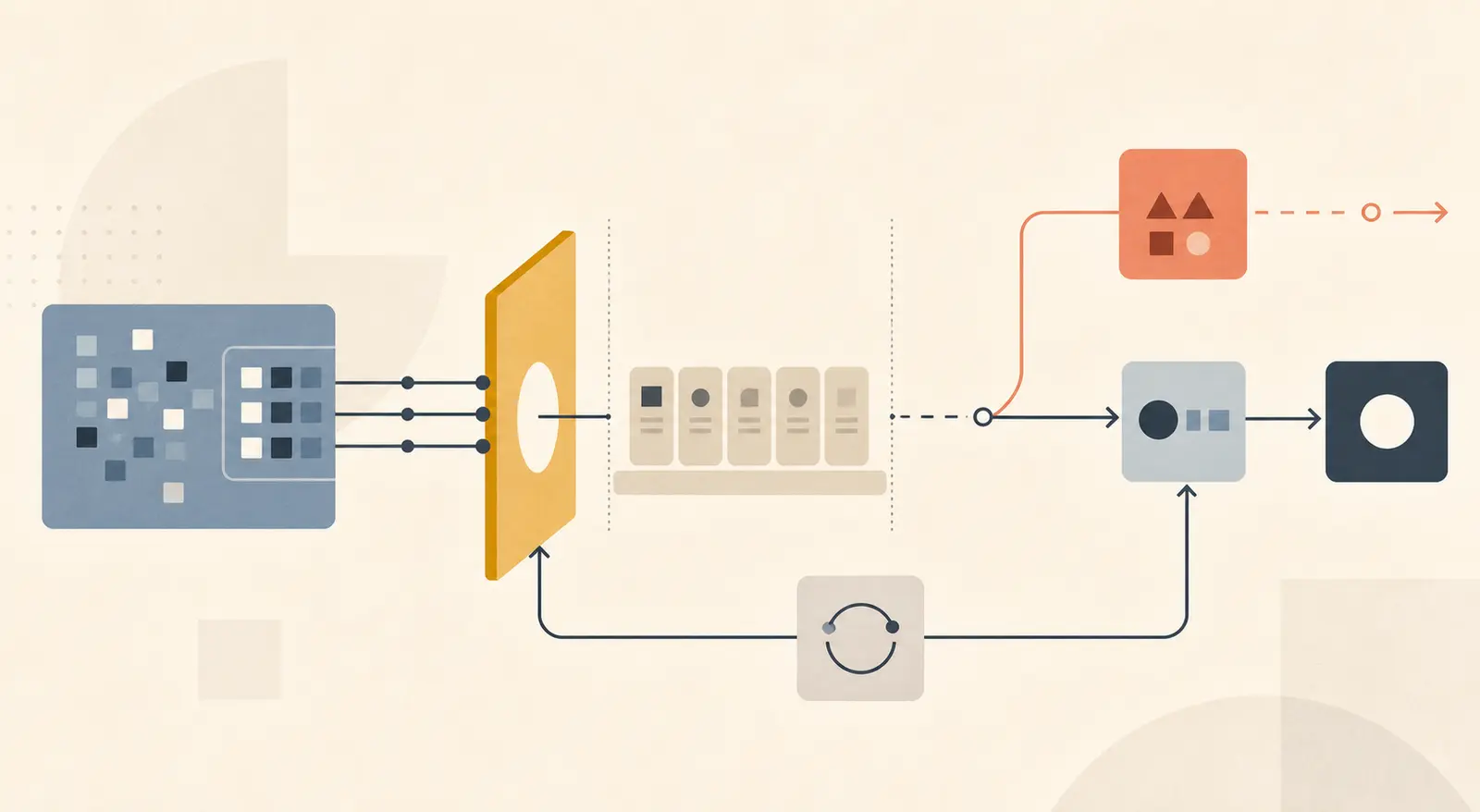
A green demo can hide a red queue. The model returns a draft quickly, but a person still has to inspect it, repair it, answer exceptions, and wait for the next available reviewer.
The useful question is not whether generation got faster. It is where the task now spends its time and attention. This decision tool turns that question into a bounded replay, a diagnosis table, and a repair decision.
Reproduce the failure with a bounded trace
Start with one task class and follow the same task from arrival to completion. Record generation, review, exception handling, rework, queue delay, and the final outcome. If you cannot see those transitions, you have a demo comparison, not a workflow reproduction.
The reusable artifact is this trace:
| Stage | Record | Failure signal |
|---|---|---|
| Arrival | task class, source, and arrival event | the automated path accepts work the manual path would have deferred |
| Generation | model output event and elapsed generation time | output is quick but incomplete, ambiguous, or hard to inspect |
| Review | reviewer decision, correction, and elapsed attention | review takes longer than the avoided manual production |
| Exception | reason for escalation and owner | the normal path has no safe answer for the task |
| Rework | returned output, correction reason, and loop count | an escaped error creates a second task |
| Queue | time waiting for a reviewer, tool, or downstream owner | work is complete in the model but not available to the next owner |
| Completion | accepted result, committed effect, or explicit stop | “done” means only that the model responded |
For a reproduction, use the same task set or a documented representative replay. Do not fill missing fields with averages or estimates. The trace is evidence when another person can inspect the sequence and find the first point where the automated path adds work.
The accounting rule is simple:
extra work = review + exception handling + rework + queue delay
             - manual production avoided
This is a decision artifact, not a claimed measurement. The terms must be populated from the workflow owner’s records. A task can be locally faster at generation and still be slower end to end when the other terms grow.
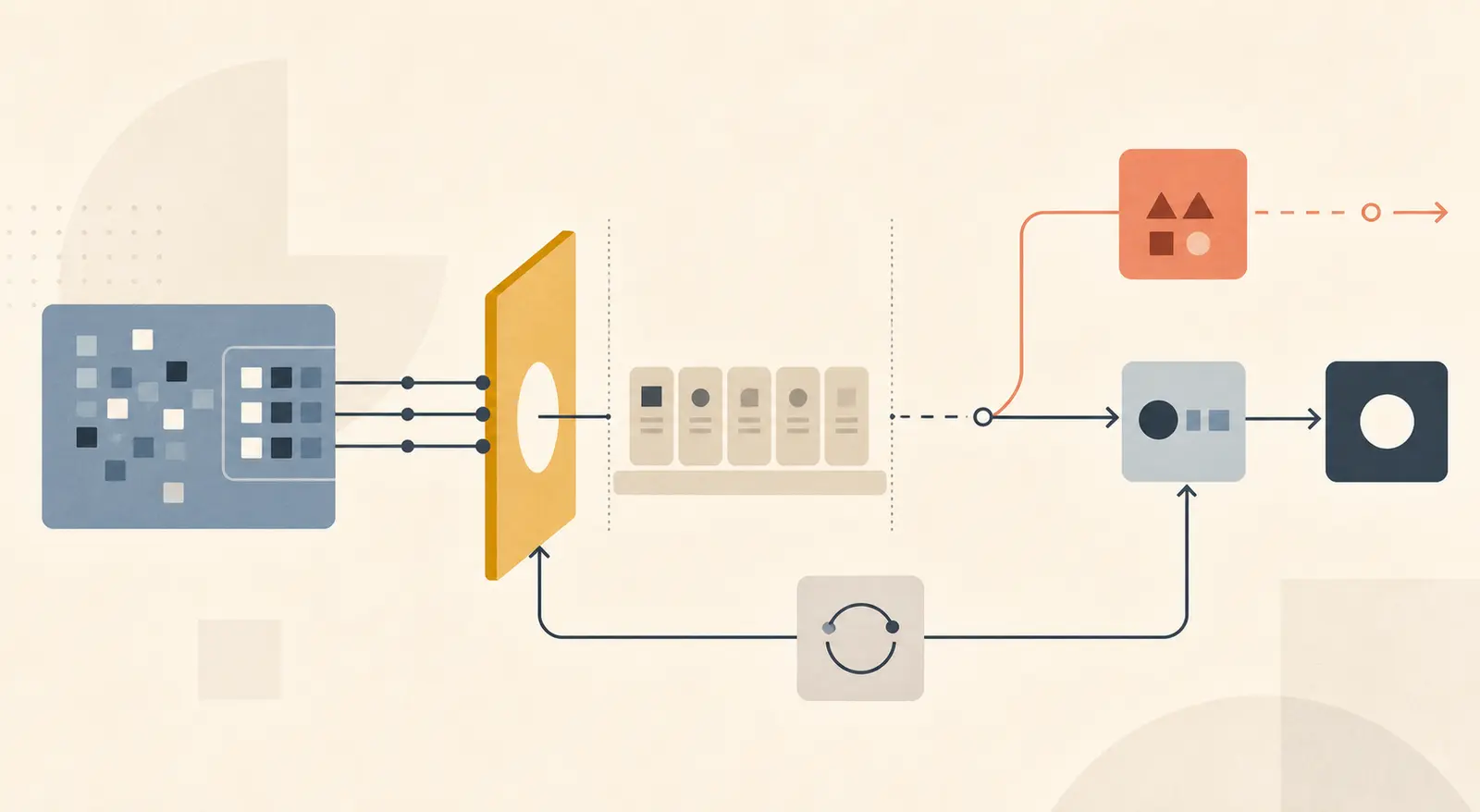
That distinction is consistent with the mechanism described in Queue & AI: local task-speed improvements can coexist with congestion and changing review behavior. A separate study of AI-assisted software work also describes inspection, validation, rework, and cognitive load as part of the human burden rather than as invisible overhead (Human Oversight and Overload). Neither paper is a measurement of your workflow. They explain why the trace needs more than generation time.
Diagnose the stage that created the extra work
Classify the first material increase, not the most visible symptom. A slow queue may be caused by an output that needs too much review, or by an exception policy that sends every uncertain case to the same person.
| First increase | Evidence in the trace | Diagnosis | Reader decision |
|---|---|---|---|
| Generation | the output needs missing context, repeated prompting, or multiple attempts | the automated step is not bounded enough for the task class | narrow the input or return this class to manual handling |
| Review | the reviewer edits, checks, or rejects most outputs | the workflow moved production work into inspection | add a smaller output contract, a stronger pre-check, or less automation |
| Exception handling | unusual cases have no owner or stop rule | the normal path is being used as a policy for abnormal work | define an exception route and an accountable owner |
| Downstream correction | a later owner finds errors after acceptance | the review gate checks the model response, not the business outcome | move verification closer to the consequential effect |
| Queue delay | work waits after generation or review | capacity, not model latency, is the bottleneck | change arrival, capacity, priority, or the approval boundary |
The diagnosis should be stated as a trace claim: “the first added work appeared at review because the reviewer had to reconstruct missing source context.” That is stronger than “the model is unreliable,” and it tells you which repair to test.
NIST’s AI Risk Management Framework treats AI risk as a socio-technical problem, not a model-only property. Its Core organizes work into GOVERN, MAP, MEASURE, and MANAGE. For this failure, MAP means naming the workflow context and affected owners, MEASURE means recording the trace fields, and MANAGE means acting on the diagnosed risk. The framework supplies the structure. Your trace supplies the local evidence.
When I taught product managers who went from writing specs to building and shipping, the recurring failure was usually an undefined “done,” not the model. That is a bounded teaching observation from Marius Manolachi’s work, not a prevalence claim. In this clinic, “done” must name an accepted result, a committed effect, or an explicit stop state outside the model response.
Repair the bottleneck without hiding the failure
Repair the first added-work stage, then keep the rest of the trace visible. Do not respond to a review bottleneck by removing review, or to an exception bottleneck by silently accepting uncertain outputs.
| Diagnosis | Smallest repair to test | Keep manual or stop when |
|---|---|---|
| Generation is the bottleneck | reduce the task class, input size, or permitted output; reject missing context before generation | the reduced class still needs repeated attempts or cannot state a clear completion condition |
| Review is the bottleneck | make the output typed and bounded, add a deterministic pre-check, and show the source context the reviewer needs | the reviewer still reconstructs the task or cannot explain what was checked |
| Exceptions are the bottleneck | add an explicit abstain state, an exception owner, and a route that does not retry the same uncertain prompt | an exception has no owner, no response deadline, or no safe next state |
| Downstream correction is the bottleneck | verify the business effect before acceptance and record the correction reason | the effect is irreversible, high-impact, or not independently verifiable |
| Queue delay is the bottleneck | change arrival pacing, reviewer capacity, priority, or the approval boundary | the queue remains unowned or the repair only hides waiting time |
The repair is successful only if the trace changes at the diagnosed stage without moving the same burden downstream. A shorter reviewer field is not a repair if the next owner now has to perform the missing check.
For a consequential action, prefer draft-only output and explicit human approval. That is not an admission that automation failed. It is a boundary matched to the cost of an incorrect effect. NIST’s AI RMF Core also makes risk treatment continuous across the system lifecycle, which supports revisiting the boundary when the context or effect changes.
This is the modern version of an older automation problem. Lisanne Bainbridge’s Ironies of Automation describes how automation can leave people with abnormal conditions and the work that automation does not handle. The lesson here is narrower: record the work left to people before deciding that the people are the problem.
Verify the repair on the same task set
Rerun the repaired workflow against the same bounded task set, or document exactly why a representative replay is equivalent. Compare the full path, not only generation time.
Use this verification record:
- Freeze the workflow, model, prompt, tool permissions, policy version, and task set.
- Run the baseline trace and the repaired trace with the same completion definition.
- Compare generation, review, exception, rework, queue, and end-to-end fields separately.
- Inspect every changed failure example. Confirm that the repair removed the diagnosed cause rather than moving it to another owner.
- Check the stop rule, approval state, source context, and final business effect.
- Record the result as pass, revise, or return-to-manual, with the evidence for that decision.
The verification evidence is a paired trace. A repair passes when the diagnosed added-work stage improves without an unacceptable increase in escaped errors, unresolved exceptions, reviewer burden, or consequence risk. No universal threshold belongs in this article. The workflow owner must set the acceptable boundary for the task.
If the repaired run cannot be compared with the baseline, say so and keep the workflow in review. A new model version, different task mix, changed reviewer, or changed definition of done can make an apparent improvement uninterpretable.
When should the step return to manual handling?
Return a task class to manual handling when the trace cannot establish a safe completion condition, when exception ownership is missing, or when the automated path adds more correction than it removes. Manual handling is a valid repair, not a failed ambition.
The exception is a reversible, low-consequence step with a clear owner and a bounded review path. That step may remain automated while the team improves the trace and tests a narrower class. An irreversible or high-impact action needs a human approval boundary even when its generated draft is fast.
Do not generalize from one replay. This article provides a reproducible workflow-accounting method, not a rate for how often automation creates extra work. The supplied research supports the mechanisms and the measurement structure. It does not prove an outcome for a workflow the author has not observed.
For the implementation context, start with the AI agent proof-of-concept scoping guide, then compare the queue design in How to build a queue-backed AI workflow and the evidence trail in How to add an audit trail to an AI workflow. If the trace shows that your team cannot define done, the next step is to define that state before tuning the model.
Continue with a related field note
- AI Implementation Estimates Miss Integration and Change-Management Work
- Why Does an AI Workflow Become Slower After Human Review?
- Why Does an AI Workflow Lose Context Between a Person and the System?
- Why Does AI Fail on Portfolio Reporting After the Demo?
- Why AI Fails on Contract Intake After the Demo