Field note · opportunity
Why Does an AI Opportunity Disappear After Workflow Mapping?
A promising AI use case often shrinks after workflow mapping because the pitch omitted an owner, handoff, data boundary, exception path, baseline, or acceptance test.
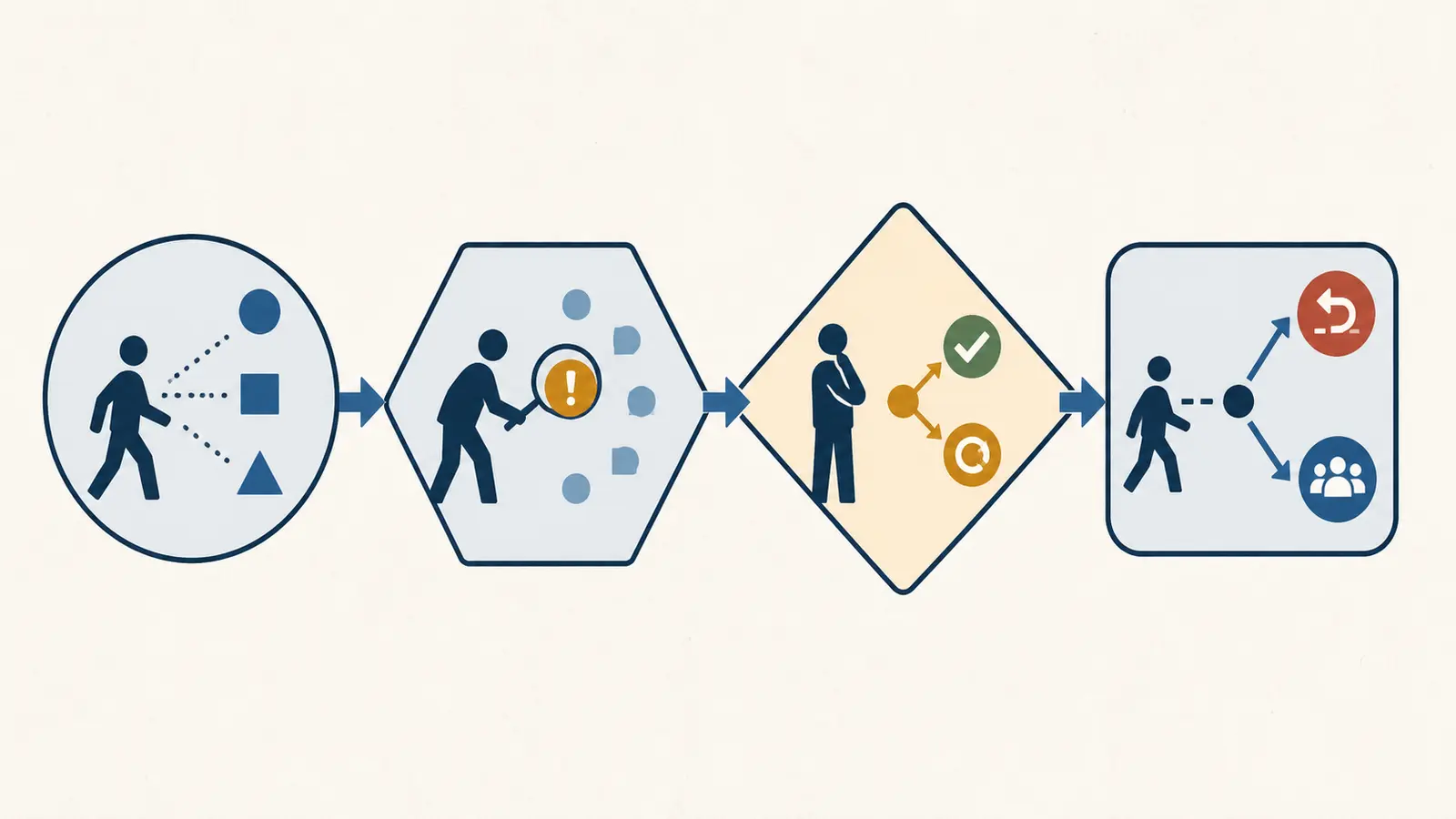
A use case can sound valuable when someone describes a slow task, a queue, or a repeated decision. The promise changes when you follow the work from trigger to outcome. The person who feels the pain may not own the result. The data may arrive late. An approval or exception may carry the real risk.
The guide on how to prioritize AI use cases in a small business is the broader decision context. This article handles the moment when a promising card stops being a build candidate. The artifact below shows what changed and what to do next.
Reproduction and trace: the task pitch is not the workflow
The failure reproduces when a team scores an AI idea before it has written the work that the idea would change. The original card says what sounds painful. The traced card says who acts, what they need, what they hand off, and what counts as done.
Use this deliberately incomplete starting card:
Opportunity: use AI to speed up a recurring review task.
Observed pain: the task takes too long.
Proposed solution: an assistant reads the inputs and recommends the next action.
Expected benefit: faster decisions.
Decision: build a prototype.
That card is easy to approve because every field points toward building. It is also too thin to decide whether the system can be safe, useful, or measurable. The word “review” hides the operator, the source records, the approval authority, the unusual cases, and the consequence of a wrong recommendation.
The worked artifact makes the missing fields visible before any model is selected:
| Field | Starting card | Traced decision card | Why the field changes the route |
|---|---|---|---|
| Owner | “The team” | One person accountable for the outcome and stop decision | Without an owner, nobody can accept, reject, or pause the result. |
| Workflow boundary | “Recurring review task” | Trigger, input, action, handoff, output, and definition of done | A model cannot be evaluated against a task boundary that was never stated. |
| Data boundary | “The inputs” | Approved records, access path, freshness, sensitivity, and missing-data behavior | Data readiness can block the idea before implementation. |
| Exception path | Not recorded | Cases that require clarification, escalation, or a human decision | A fast happy path may still leave the costly or risky work untouched. |
| Baseline | “Faster decisions” | Current business-as-usual result and how it will be checked | A benefit claim without a counterfactual cannot support a release decision. |
| Acceptance test | Not recorded | Evidence required to test, validate, sequence, observe, or park | The route must be tied to proof, not enthusiasm. |
OpenAI Academy's workflow-readiness material separates evidence from assumptions and asks teams to identify the workflow, owner, and recommendation before prioritizing a use case. NIST's AI Risk Management Framework likewise starts with context, intended use, risks, and human oversight, not with a model choice. (OpenAI Academy's workflow readiness resource, NIST AI RMF Core)
This is the reproduction result: the opportunity did not disappear because the task has no value. It disappeared because the card had no evidence that the proposed system could own a meaningful part of the work. That is a preparation failure, not yet a technology verdict.
Diagnosis: the owner and approval boundary are missing
The first diagnosis is an ownership failure. If the card cannot name who accepts the result and who can stop the workflow, the opportunity is not ready for an autonomous action.
Trace the decision with five questions:
- Who performs the current step?
- Who is accountable for the outcome?
- Who can approve the recommendation?
- Who handles a disagreement or missing input?
- Who can pause the system when the evidence is weak?
If the answers are “the team,” “the process owner,” or “someone in operations,” the trace is not finished. The operator and the accountable owner can be different people. The operator knows where the work bends. The owner has the authority to accept the output, fund a change, or stop it.
The repair is to split these roles in the card:
Operator: performs the current review and records the handoff.
Accountable owner: accepts the workflow outcome and can stop the pilot.
Approver: reviews the proposed action before any consequential change.
Escalation route: named person or queue for missing, conflicting, or unsafe cases.
NIST calls for documented roles, responsibilities, human oversight, and knowledge limits in the system context. The OpenAI Academy resource treats an accountable owner as part of deciding whether a use case is ready. The artifact's rule is narrower and operational: no named owner means no build decision, even when the task sounds valuable.
The exception is a genuinely low-consequence read-only experiment. It may be reasonable to test retrieval or drafting without an approval step for an external action. It still needs someone who owns the experiment, a boundary around the data, and a route for a wrong or irrelevant output. “Read-only” reduces the action risk. It does not remove the need for a decision owner.
Diagnosis: hidden handoffs, data dependencies, and exceptions change the route
The second diagnosis is that the visible task is only one segment of the workflow. A recommendation can be technically plausible and still fail because the input is stale, the next system cannot accept the output, or the exception path contains most of the judgment.
Run a trace in this order:
| Trace point | Record | Failure signal |
|---|---|---|
| Trigger | What starts the work and where it is recorded | The trigger is informal, late, or unavailable to the proposed system. |
| Input | Which fields, documents, or events are needed | The data is inaccessible, unapproved, incomplete, or too old. |
| Operator action | What the person actually checks or changes | The action depends on tacit context absent from the source records. |
| Handoff | Where the result goes and who receives it | The proposed output has no receiving owner or system. |
| Exception | What happens when evidence conflicts or is missing | The exception requires judgment that the happy path does not cover. |
| Outcome | What state changes and how it is observed | The result is “faster” but no accepted state or quality check exists. |
Fraunhofer USA's briefing groups reported AI project failures around issues such as misaligned workflow, insufficient data, infrastructure, and problems that are too complex for the chosen approach. It argues for attention to people and process before technology. Umbrex's readiness guidance adds practical checks for data quality, latency, governance, ownership, access, and evidence notes. These sources support the categories. They do not establish a universal failure rate, so this article makes no prevalence claim. (Fraunhofer USA's briefing, Umbrex's feasibility and readiness assessment)
The worked card should therefore record the constraint that changed the recommendation, not just a list of risks. For example:
Observed constraint: the proposed output needs a human approval, but the approval
owner and the source record needed for that approval are not yet defined.
Effect on opportunity: full automation is not supported by the traced workflow.
Narrowed role: prepare a source-linked recommendation for review, if access is approved.
Remaining evidence: owner confirmation, data access, exception examples, and a baseline.
The exception is a stable workflow with a complete input, a clear receiving system, and a small, reversible action boundary. In that case the handoff may not block a pilot. The card should still say why the exception is contained and what happens when the expected input is absent.
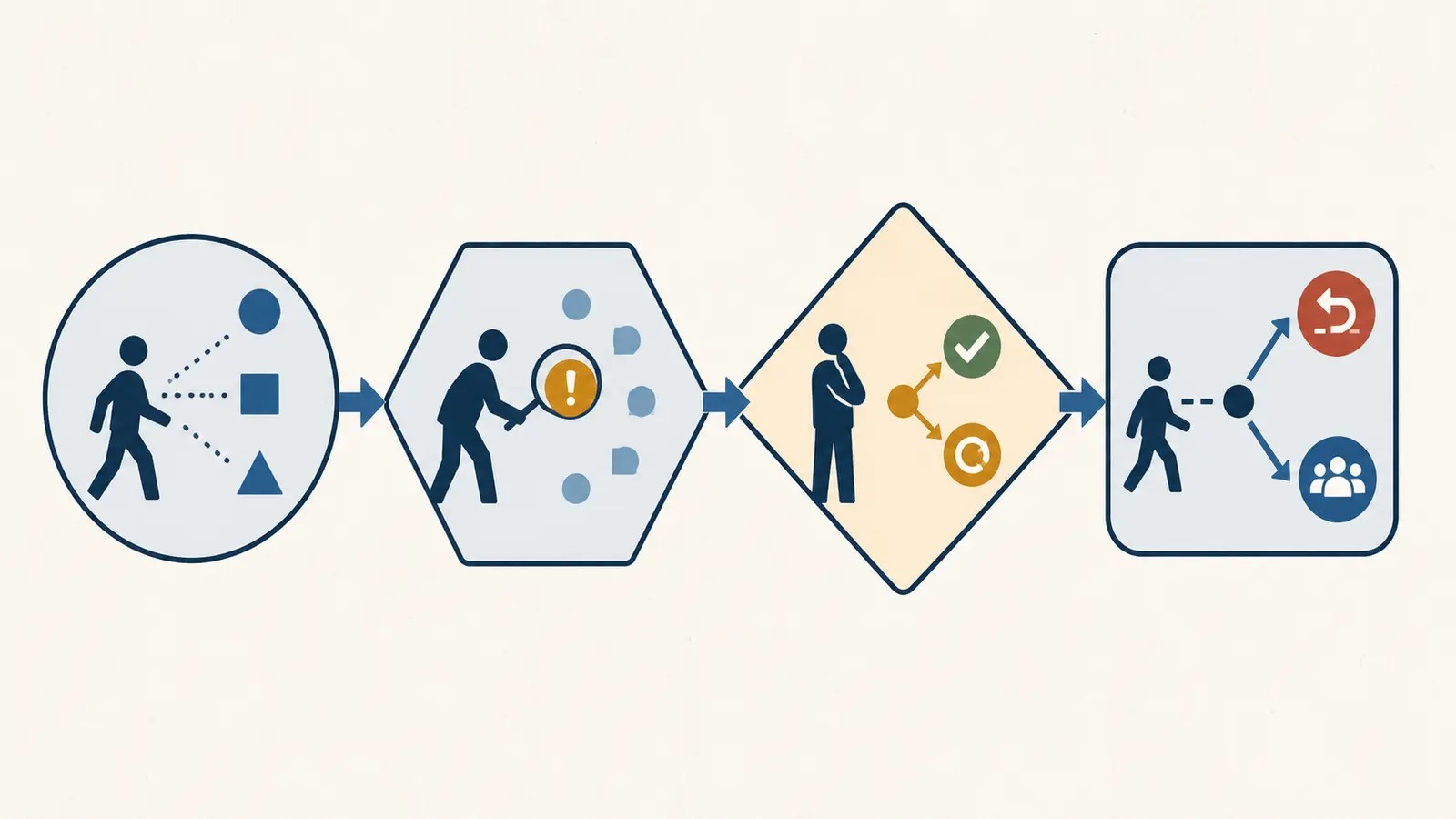
Repair: replace the build decision with a scoped route
The repair is not “add more AI.” Replace the original build decision with the narrowest route that answers the missing question while keeping the risky action with a person.
Use this completed card:
Opportunity:
  A named operator spends time preparing a recurring review output.

Original hypothesis:
  An AI assistant can read the available inputs and recommend the next action.

Workflow evidence:
  Trigger, operator, handoff, approval, data boundary, and exception path are recorded.

Observed constraint:
  The recommendation cannot be accepted automatically because the approval owner,
  source record, or exception route is missing or not yet verified.

Repaired role:
  Draft, retrieve, compare, or flag for review. Do not take the consequential action.

Decision route:
  Test if the missing field can be checked in a reversible pilot.
  Validate if the workflow is understood but the output quality is not.
  Sequence if owner, data, or approval work must happen first.
  Observe if the problem may matter but the baseline is not yet usable.
  Park if the action boundary or evidence path cannot be made safe.
The route is a decision artifact, not a new framework name. It converts the failure into a reader action. A candidate that fails a veto field is not necessarily a bad idea. It is in the wrong state for building.
Use the following veto rule before scoring upside:
Do not approve a build route until the card names an accountable owner, a bounded input and action, an exception path, a business-as-usual baseline, and an acceptance test. If one field is missing, route the opportunity to narrow, sequence, observe, or park it.
This rule combines the article's artifact with the source requirements. OpenAI Academy emphasizes observed workflow evidence and ownership. NIST organizes risk work around context, measurement, and management. GOV.UK guidance says to define the business-as-usual baseline or counterfactual early and involve relevant stakeholders. Umbrex supplies practical readiness fields. The exact veto and route belong to this worked card, not to any one source. (GOV.UK guidance on evaluating AI interventions)
The principal exception is a discovery exercise whose only output is a better map. That can proceed without a production acceptance test because the exercise is not claiming to improve the workflow yet. Label it as discovery, keep the data permissions appropriate to the exercise, and do not present the map as proof that the AI system works.
Verification: test the route against a baseline and stop condition
The verification step asks whether the repaired card supports a decision, not whether the idea sounds better after rewriting. A route is verified only when the missing evidence has a named check and the result changes what happens next.
Use this compact verification record:
| Check | Evidence required | If absent |
|---|---|---|
| Owner | A named person confirms the outcome, review duty, and stop authority | Sequence the ownership decision. |
| Workflow | Trigger, steps, handoffs, exceptions, and output are traceable | Return to observation and map the missing segment. |
| Data | Access, quality, freshness, sensitivity, and missing-data behavior are known | Narrow the input or park the use case. |
| Baseline | Business-as-usual result or counterfactual and its measurement method are named | Observe before claiming improvement. |
| Acceptance | A reviewer can classify the output as acceptable, needs change, or failed | Keep the system in test or draft-only mode. |
| Stop condition | A specific error, risk, or drift signal pauses the workflow | Do not move from recommendation to action. |
GOV.UK's evaluation guidance treats the business-as-usual baseline and stakeholder involvement as early design work, not as paperwork added after launch. NIST's framework calls for documented metrics, methods, limitations, and ongoing management. The verification result should therefore be explicit:
Verification result: not ready for autonomous action.
Supported next step: sequence owner and data decisions, then run a reversible
draft-only test against the named baseline.
Veto: no external or irreversible action until approval, exception handling,
and acceptance evidence are recorded.
That result is useful even when the answer is “not yet.” It tells the reader what evidence would change the route. It also prevents a polished opportunity brief from being mistaken for a validated use case.
The exception is when the baseline itself cannot be measured without first instrumenting the workflow. Then the correct route is an observation or instrumentation task. State what will be recorded, who owns the record, and when the team will revisit the decision. Do not substitute a fabricated time-saving number for the missing baseline.
For a neighboring artifact, how to find AI product opportunities in customer feedback keeps source feedback, ownership, outcomes, and action boundaries together before scoring a candidate. The same discipline applies here: preserve the evidence packet, make the decision reversible, and let the workflow trace decide whether AI belongs in the next step.
The practical answer is simple. An AI opportunity disappears after mapping when the original card described a promise but not an operable workflow. Keep the idea if the trace reveals a bounded, reviewable next test. Narrow or sequence it when ownership, data, exceptions, or baseline work remains. Park it when no safe evidence path exists.
Continue with a related field note
- Why AI Opportunity Scores Change After Observation
- Should We Fund AI Discovery, Tutoring, or a Prototype First?
- Why Does an AI Opportunity Look Valuable Until Exceptions Cost More?
- How Much Evidence Is Enough to Call an AI Opportunity Real?
- Which AI Opportunity Should a 20-Person Company Investigate First?
- Should We Investigate an AI Opportunity Before Training the Team?