Field note · opportunity
Vendor Onboarding Exceptions: What Evidence Should Leaders Collect?
A source-backed 10-row matrix for vendor onboarding exceptions, with verification tests, owners, expiry rules, and worked decisions.
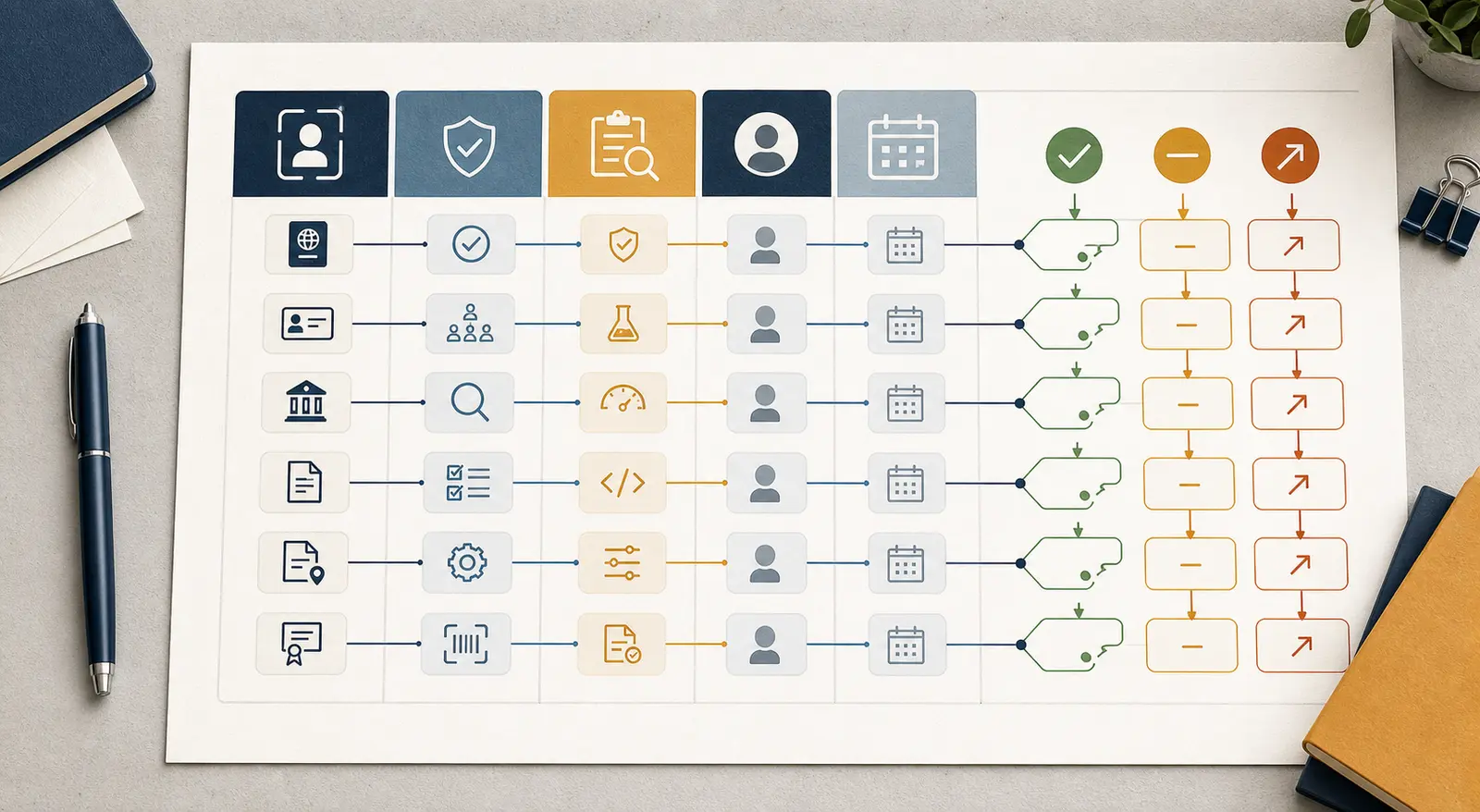
Vendor onboarding exceptions rarely arrive as a neat missing field. They arrive as a name that almost matches, a bank account changed by email, or an urgent request that asks the reviewer to skip one step.
The useful question is not whether the vendor “looks safe.” It’s whether the team can show what claim it tested, what evidence it checked, who decided, and when that decision stops being valid.

The evidence packet your exception queue is missing
Collect five things for every exception: the decision claim, independently verifiable evidence, a falsifiable test, a named owner with escalation, and a time-bound outcome. If one of those is missing, keep the case open or escalate it.
The result of this research is the matrix below. It is a proposed operating artifact derived from four public authorities. The authorities do not prescribe these exact columns or time windows. They do establish the underlying expectations: risk-proportionate due diligence, documented limitations, verification, escalation, subcontractor visibility, and records.
| Required packet field | What the reviewer should be able to answer |
|---|---|
| Decision claim | What must be true for this exception to close? |
| Evidence | Which document, system record, registry, attestation, or test result supports the claim? |
| Verification test | What would make the claim fail? |
| Owner and escalation | Who can decide, and who must see an unresolved risk? |
| Expiry or follow-up | When must the evidence or treatment be rechecked? |
| Compensating control | What is restricted while the evidence is incomplete? |
| Outcome | Is the row accepted, rejected, or escalated? |
The U.S. Federal Reserve, FDIC, and OCC guidance says due diligence should test a third party’s ability to perform, follow policy, comply with law, and operate safely. It also says prior experience alone is not an adequate proxy. (Interagency Guidance on Third-Party Relationships: Risk Management, pp. 35-36)
That distinction matters for AI. A model can produce a polished summary without proving any of those claims. The packet forces the missing proof into view.
How the public-source extraction became an operating matrix
I extracted requirements from the sources, then translated them into tests a reviewer could run without trusting a model's wording. The extraction has three layers:
- Regulatory or supervisory source: what the authority says about risk, evidence, review, or records.
- Decision claim: what the onboarding team needs to establish for this exception.
- Operating model: the owner, expiry, compensating control, and route I propose so the decision can be replayed.
OSFI's guideline is especially explicit about lifecycle treatment. It calls for risk assessment before entry, at renewal, periodically, and whenever the arrangement or third party materially changes. It also calls for documented risk escalation, approval, and acceptance processes. (OSFI Third-Party Risk Management Guideline, sections 2.2 and 2.2.2)
The UK supplier-selection guidance adds a useful verification constraint: evidence should link directly to legal and financial capacity or technical ability and be proportionate to the contract. It gives certifications, site visits, audits, and relevant third-party verification as examples. (GOV.UK Module 6: Supplier Selection, section 5.4)
The European Commission guidance adds the red-flag behavior: recurring, risk-calibrated review, verification of business partners and beneficial owners, and deeper screening when unusual structures, ownership changes, or documentation appear. (European Commission guidance for EU operators, pp. 3-8)
Those passages support the evidence logic. The exact two-day, five-day, or seven-day windows below are operating defaults, not legal deadlines.
The 10-row vendor onboarding exception matrix
Use this as a starting dataset. Replace “equivalent” evidence and default time windows with your own policy and jurisdictional requirements.
| Exception | Evidence to collect | Falsifiable verification | Owner | Time-bound treatment | Compensating control | Outcome |
|---|---|---|---|---|---|---|
| Identity mismatch | Official entity record, tax ID, contract name, bank-account holder | Compare identifiers and explain every legal-name difference | Vendor master owner | Hold 2 business days; expire on material change | No payment or access | Accept if reconciled; otherwise reject or escalate |
| Duplicate candidate | Vendor-master search, tax ID, registration, address, bank suffix | Exact and normalized match; tax or registration match is a duplicate until resolved | Procurement operations | Resolve in 2 business days; recheck before payment | Block new record | Reject duplicate; escalate ambiguous match |
| Missing tax evidence | Tax registration or equivalent, declaration, validity date | Verify with issuer or approved independent verifier | Tax or finance operations | Hold 5 business days or until document expiry | No award or payment | Reject until complete; escalate allowed deferral |
| Bank-detail change | Signed request, authority record, prior bank data, account-holder evidence | Independent callback plus legal-account-holder comparison | Accounts payable controls | Hold 1 business day | Keep prior account; maker-checker release | Accept only after both checks; otherwise escalate |
| Sanctions or exclusion hit | Dated screening, identifiers, ownership, representations | Re-run exact match with identifiers and trace control | Compliance screening | Triage in 24 hours; refresh on material change | Freeze onboarding, payment, access | Reject confirmed hit; escalate near match |
| Urgent onboarding | Criticality, risk tier, sponsor, missing list, controls, end date | Verify authority, risk, restricted scope, and automatic expiry | Sponsor plus vendor-risk owner | Maximum 7 calendar days | Read-only, spend cap, no sensitive data | Escalate for time-bound acceptance |
| Unclear data access | Data flow, classes, locations, users, subprocessors, retention, clauses | Reconcile answers with security review and technical test | Data or security owner | Resolve in 5 business days | Redacted data, least privilege | Reject production access; escalate |
| Undeclared material subcontractor | Named subcontractor, role, location, assurance, notice and audit rights | Compare contract, questionnaire, and data flow | Third-party risk owner | Resolve in 10 business days | No sensitive data or critical activity | Escalate; reject if undisclosed |
| Ownership or control change | Ownership chart, beneficial owners, filings, control rights | Trace to natural persons and re-screen | Compliance or vendor-risk owner | Resolve in 3 business days | Pause award, payment, access | Reject prohibited control; escalate unresolved |
| Missing assurance or remediation | Current assurance, performance reports, findings, remediation owner | Check issuer, date, scope, service match, and open findings | Vendor-risk owner | 30-day remediation window | Lower scope, extra monitoring, or alternate vendor | Accept with remediation, reject, or escalate |
The U.S. guidance says organizations should document due-diligence limitations and consider alternative information, additional monitoring, or a different provider when information is unavailable. Its documentation examples include due-diligence results, contracts, remediation plans, monitoring reports, material-event reports, and independent reviews. (Interagency Guidance, pp. 35-36 and 64-65)
That is the reason the matrix has a compensating-control column. “Vendor did not answer” is not an outcome. It is a limitation that needs a treatment decision.
Four worked decisions from the matrix
Each worked case ends with a named owner, a testable condition, an expiry or triage window, a compensating control, and an explicit route. That is the minimum needed to compare an AI-prepared packet with a human decision.
Bank-detail change: hold, then accept or reject
Synthetic case: A known vendor emails a new bank account two days before payment. The request is signed, but the signature does not prove the destination account belongs to the contracted legal entity.
| Packet field | Decision record |
|---|---|
| Claim | The change is authorized and belongs to the contracted vendor. |
| Evidence | Signed request, existing contact record, prior account, account-holder evidence, invoice context. |
| Test | Call the existing contact channel and compare the account holder with the legal entity. Do not use only the change email. |
| Owner and expiry | Accounts payable controls owner; 1 business day. |
| Control | Keep prior bank details active and block payment release. |
| Outcome | Escalate and hold. Accept only after both checks pass. |
The control is not a confidence score. It is two independent checks with a clear failure state. The source supports documenting evidence and limitations; the payment hold and callback sequence are my proposed operating model.

Urgent onboarding with missing tax evidence: restricted acceptance only if disclosed
Synthetic case: A sponsor wants a vendor active today because a customer deadline is at risk. Identity is reconciled, but required tax evidence is missing.
The packet should contain the sponsor's criticality statement, risk tier, missing-evidence list, request timestamp, restricted access scope, spend cap, and end date. The test verifies sponsor authority, confirms that no sanctions or exclusion issue is open, restricts access to a non-sensitive workflow, and sets an automatic seven-day expiry.
Outcome: escalate for time-bound acceptance. Reject if the sponsor, controls, or expiry is missing.
The UK guidance describes circumstances where a supplier may progress while completing a condition before award, but says that discretion should be set out in the tender documents and respect equal treatment. (GOV.UK Module 6: Supplier Selection, section 5.4) Urgency cannot become an undocumented waiver.
Sanctions or exclusion near match: deeper screening, not a guess
Synthetic case: Screening returns a name match for a vendor director. Country and date of birth do not match, but the ownership chart is incomplete.
The packet records the dated screening result, identifiers used, legal-entity details, full ownership chart, vendor representation, and relevant exclusion or sanctions-list result. The test re-runs the match with identifiers and traces control. A confirmed match rejects the supplier. An incomplete ownership chain remains unresolved.
Outcome: escalate the near match. Freeze onboarding, payment, and sensitive-data access during the 24-hour triage window.
The European Commission recommends identifying beneficial owners and launching deeper screening when red flags appear. UK guidance also makes associated and connected persons relevant to exclusion assessment. (European Commission guidance for EU operators, pp. 5-8, GOV.UK Module 6: Supplier Selection, sections 3.1 and 4)
Unclear data access through a subcontractor: block production access
Synthetic case: A vendor says it does not store sensitive data, but its architecture diagram names a hosted service in another country and the subcontractor list is incomplete.
Collect the data-flow map, data classes, processing locations, authorized users, subcontractor list, contract clauses, test-account access log, and retention answer. Compare the diagram and contract with a read-only technical test. Any unexplained external location or material subcontractor fails.
Outcome: reject production access and escalate. Use redacted data and a least-privilege test account for five business days while the data path is clarified.
OSFI expects out-of-Canada arrangements and subcontractor risk to be assessed, monitored, and supported by appropriate contractual controls. The U.S. guidance likewise treats sensitive-information access and subcontractor oversight as risk factors. (OSFI guideline, sections 2.2.2.3 and 2.2.4, Interagency Guidance, pp. 21-22 and 54-55)
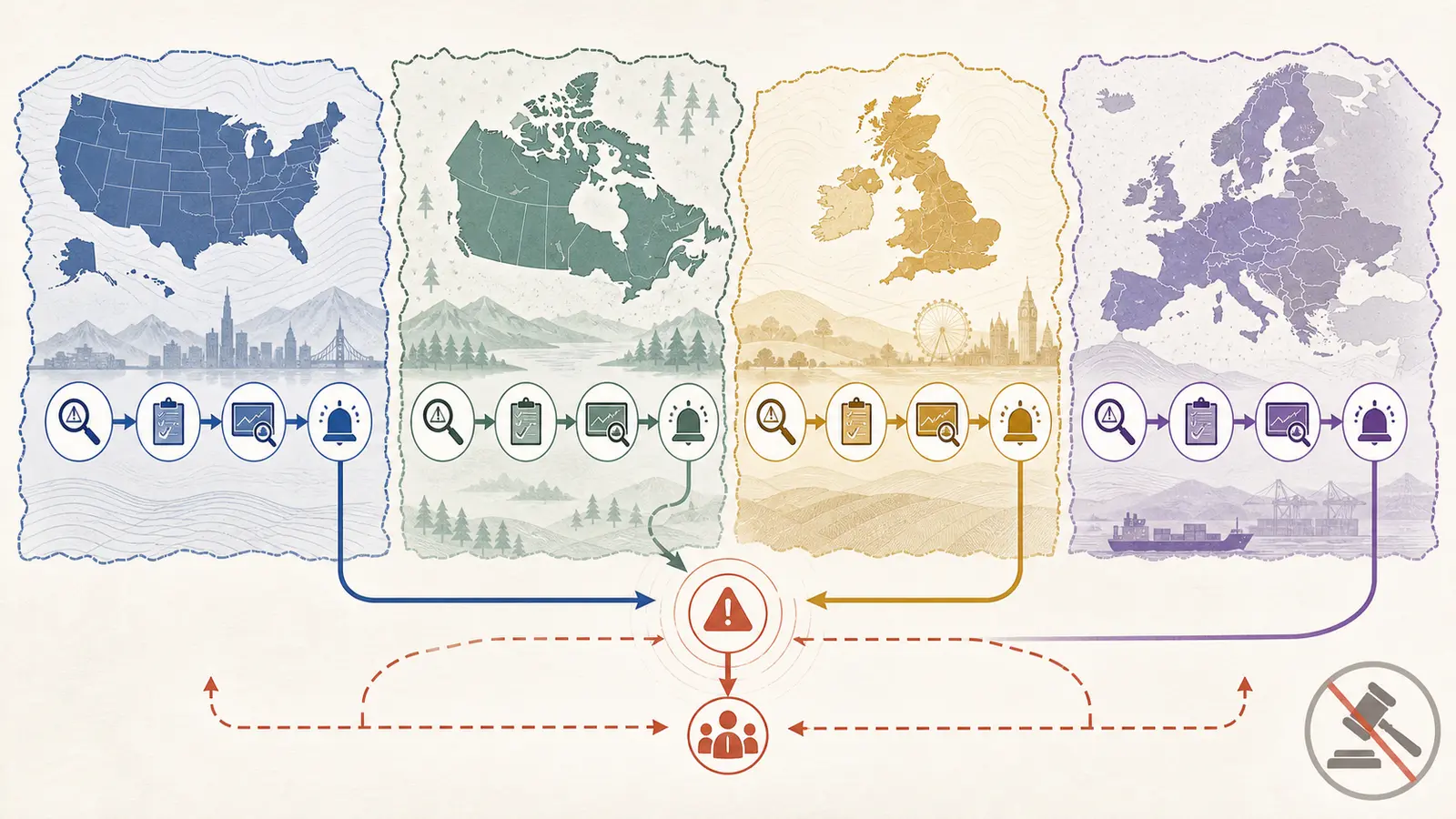
What changes by jurisdiction
The matrix is portable as an operating shape, not as a portable legal conclusion.
| Source lane | What it supports | What it does not establish for every organization |
|---|---|---|
| U.S. Federal Reserve, FDIC, OCC | Risk-proportionate third-party due diligence, lifecycle monitoring, documented limitations, subcontractor considerations, and records for supervised banking organizations | A universal private-sector vendor checklist or fixed expiry windows |
| OSFI | Lifecycle risk assessment, documented escalation and acceptance, cross-border review, and subcontractor reporting for federally regulated financial institutions in Canada | A rule that every company must use OSFI's exact process |
| UK Procurement Act guidance | Mandatory or discretionary exclusion logic, associated or connected persons, proportionate capacity evidence, and conditions of participation in covered public procurement | A general private-sector onboarding rule or automatic acceptance of missing evidence |
| European Commission export due diligence | Risk-calibrated, recurring export-sanctions due diligence, beneficial-owner checks, red flags, contract clauses, and deeper screening for EU operators | A complete vendor-risk program for non-export relationships |
The European Commission guidance says it is not exhaustive and should be updated as sanctions and circumvention patterns change. OSFI and the U.S. guidance also tie review frequency to risk, criticality, and material change. Treat the next-review date as part of the evidence, not as administrative decoration.
Where AI can help without owning the decision
AI can normalize documents, compare names across records, detect missing fields, draft a verification checklist, summarize a sanctions near match, and route a packet to the right owner. It can help you test a review-only workflow before the workflow can touch a vendor master, payment record, contract, or access system.
It should not close an unresolved exception because its confidence score is high. The output should include the claim, evidence links, test status, owner, expiry, and proposed route. A human owner then records accept, reject, or escalate in the system of record.
When I taught product managers to move from writing specifications to building and shipping products, the recurring failure was not a lack of model capability. It was the absence of a shared definition of “done.” That is why this artifact has a decision and expiry field, not only an evidence field. The model can prepare the packet. The owner still defines what makes the row done. Test the AI workflow for these vendor exceptions before connecting it to live systems.
A short review routine for a reversible pilot
- Select a small sample of real or properly redacted exceptions and classify each into a matrix row.
- Name the decision claim before reading an AI recommendation.
- Check that evidence is independently verifiable, current, and tied to the exact vendor and service.
- Run the falsifiable test and preserve the result, failed fields, and source links.
- Record owner, escalation route, expiry, compensating control, and accept, reject, or escalate.
- Run AI in shadow or read-only mode. Compare its proposed packets with human packets, including abstentions and missed escalations.
- Expand only when the team can replay the same cases and explain every decision boundary. For the opportunity-selection step before that test, see which AI opportunity to investigate when vendor onboarding is slow.
The useful first test is not “can AI read a vendor form?” It is “can the team produce the same reviewable packet when the evidence conflicts?” If the answer is no, define and collect the evidence before adding automation.
Continue with a related field note
Questions people ask next
Are these evidence fields legal requirements everywhere?
No. The sources apply to particular jurisdictions and sectors. Owners, expiry windows, compensating controls, and outcomes in the matrix are a proposed operating model that must be adapted by legal, compliance, and risk owners.
What should happen when a vendor cannot provide the requested evidence?
Record the limitation, assess the risk it creates, then use alternative evidence, additional monitoring or controls, or another vendor. Do not silently convert missing evidence into approval.
Can AI decide whether a vendor exception is acceptable?
AI can collect, compare, summarize, and route evidence in a read-only workflow. A named human owner should still record accept, reject, or escalate, especially for sanctions, ownership, data access, and critical-service exceptions.