Field note · commercial
Why Do AI Consulting Engagements Fail to Transfer Capability?
Use five handoff tests to tell whether an AI consulting engagement transferred capability or only delivered a working demo and a folder of documents.

A working demo can hide the real failure. The consultant knows which prompt, fixture, validator, and fallback made it work. The client receives a screen recording and a runbook, then discovers that the first change or broken input still needs the consultant.
When I taught product managers who went from writing specs to building and shipping the product, and automating work around it, I saw the useful shift as capability transfer. The team could keep moving because it could change the work and judge the result. That is the standard I would use for an AI consulting handoff.
Observed tabletop result: in a role-play with consultant-side and client-side roles, reproduction and modification passed. Debugging, evaluation, and governance exposed gaps. The packet scored 6/10, so the proposed decision was “repair and rerun,” not sign-off.
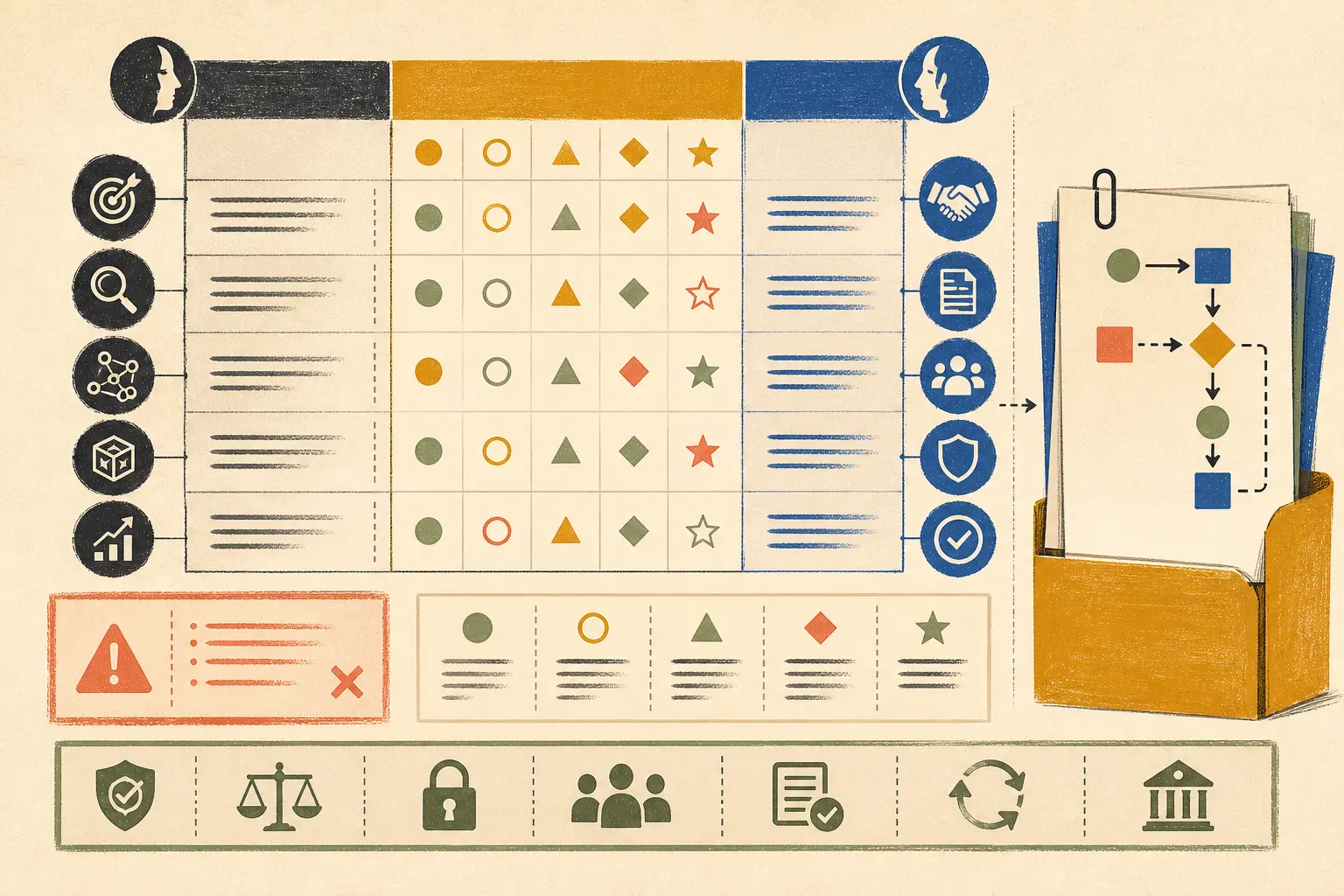
Why a working delivery is not capability transfer
AI consulting engagements fail to transfer capability when the client receives the artifact but not the ability to change, inspect, and govern the system that produced it. The common mistake is treating knowledge as a package that can move from one party to another without changing the client's work.
Research on consulting points to a different pattern. A case-study paper on management consulting projects reports that internal capability outcomes depend on environmental conditions and how managers perceive the consultant's role. Its abstract reports innovation and replication when consultants acted as legitimators, while replication did not develop when consultants were seen as innovators. (Carli, Tagliaventi, and Grandi)
Research on knowledge-transfer-focused consulting makes the same boundary from another angle. The process is interactive: researchers and users work together around real problems, rather than treating transfer as a one-way delivery of findings. (Jacobson, Butterill, and Goering)
My analysis is that an AI handoff fails when the engagement optimizes for consultant completion instead of client independence. The client may receive a polished workflow, but never practise the five actions that reveal whether the capability moved.
The five-test handoff scorecard
Before sign-off, require the client to perform five tests on one bounded workflow. Score each test from 0 to 2. A pass is not “the consultant demonstrated it.” A pass is “the client performed it with the handoff materials available and no hidden rescue.”
| Test | 2 points | 1 point | 0 points |
|---|---|---|---|
| Reproduce | Client runs the fixture and gets a valid output that meets the contract | Client succeeds with a consultant hint or undocumented setup | Client cannot run the workflow or cannot tell what valid means |
| Modify | Client changes one requirement, updates the relevant contract, and reruns | Client changes the prompt but misses a schema, test, or downstream dependency | Client cannot identify where the requirement lives |
| Debug | Client diagnoses a seeded failure, names the boundary, and repairs it | Client finds the symptom but needs help locating the failing boundary | Client treats the failure as model randomness or waits for the consultant |
| Evaluate | Client grades the result against a rubric and records evidence for the score | Client gives a preference without a repeatable rubric or evidence | Client accepts the demo output without checking it |
| Govern | Client names owner, approval boundary, rollback, data boundary, and review cadence | Client names an owner and approval but misses one operating control | No one can say who owns the workflow after handoff |
This is the sourceable artifact in this post. Another team can copy the table into a statement of work or acceptance checklist. The score is a proposed buyer control, not a validated industry standard.
Proposed decision rule: 8 to 10 means the handoff can proceed; 6 to 7 means repair the failed tests and rerun them; 0 to 5 means do not sign off. Failure to reproduce or govern is a veto even when the total is higher.
If you are still choosing the type of supplier, use the AI consultant, agency, or internal team decision guide. If you are comparing proposals, put these five tests into the acceptance section of the proposal rather than leaving “knowledge transfer” as a vague deliverable. This article extends that supplier decision into a concrete sign-off test.
The reproducible test packet
Keep the packet small enough to run in one sitting. It should expose capability, not reward memory of a long project history.
Use this anonymized workflow:
Input: a short internal request plus two evidence notes
AI step: turn the request into a structured action brief
Required output: summary, decision, evidence_quotes, owner, next_action, approval_required
Validation: required fields present; decision is approve, reject, or escalate;
            evidence_quotes is an array
Control: human approval before any external action
Rollback: discard the draft and restore the prior template version
The fixture is deliberately ordinary: “A customer asks for a recurring export of unresolved invoices.” The two evidence notes are that finance leads want a weekly review view and that the current export sometimes omits account IDs.
Run the packet in this order:
- Reproduce. Give the client role only the workflow contract, fixture, and handoff instructions. Ask for a valid structured output. Record the output and the setup steps the client needed.
- Modify. Add the requirement that account-ID risk must change the decision to
escalate. The client must update the right prompt, schema, rule, or test and explain why. - Debug. Seed one failure: return
evidence_quotesas a string instead of an array. Do not tell the client which layer is broken. Require a diagnosis and a repair. - Evaluate. Ask the client to grade evidence grounding, allowed decision, owner, and approval against a rubric. A score without a reason or source is incomplete.
- Govern. Ask who owns the workflow, who approves external action, how to roll back, what data may enter the system, and when the workflow is reviewed.
The packet is intentionally bounded. It does not prove production safety, model quality, security, cost, latency, or legal compliance. It proves whether the handoff makes the next learning and operating step possible.
What the role-play exposed
The test run used two explicitly labeled roles: the consultant-side role authored the packet, and the client-side role operated from it without consultant hints. The exercise was not an external client session.
| Test | Result | Failure note |
|---|---|---|
| Reproduce | Pass, 2/2 | The client role reproduced the required fields and a valid decision. |
| Modify | Pass, 2/2 | It added the second evidence note and changed the decision to escalate for the account-ID risk. |
| Debug | First attempt failed, 1/2 | It found the type mismatch but first looked only at the prompt, not the validator. |
| Evaluate | Incomplete, 1/2 | It could grade evidence, decision, owner, and approval, but the rubric lacked a review cadence. |
| Govern | Fail, 0/2 | Owner, approval, and rollback were named. Review cadence was missing. |
The observed total was 6/10. Under the proposed rule, this handoff needs repair and a rerun. The concrete repair is to add a validator map to the runbook, include a repair exercise that crosses prompt and schema boundaries, and make review cadence a required governance field.
That is a small result, but it is useful. The demo did not fail. Independence did.
Why the client must learn inside the real context
A generic training session can explain prompts, tools, and evaluation. It cannot by itself establish that a client can apply those ideas inside its own workflow, ownership model, and constraints.
The situated-AI study in the supplied research package describes capability building as “learning by changing” and identifies stages that move from sensing a situation to seizing a context-specific technology, creating situated knowledge, and reconfiguring management experience. The implication for a consulting handoff is practical: the client must practise changes in its own operating context, not only observe the consultant's completed build. (Pi, Ma, and Wang)
A 2026 preprint similarly frames AI readiness as an organizational learning problem, with organizational and technical failure categories rather than a technology-purchase problem alone. It proposes capability across culture and leadership, human capital and operations, data architecture, systems infrastructure, and governance. (McClure and Gerdau)
A recent Academy of Management abstract proposes a deployable diagnostic for client readiness and phased competency development in AI transformation engagements. That supports the direction of this scorecard, but the abstract does not provide outcome measurements, so I use it as a rationale for diagnosis, not proof that any particular diagnostic works. (Abukar)
Put capability transfer into the acceptance criteria
Write the handoff as an observable change in what the client can do. A useful acceptance clause looks like this:
The client owner accepts the workflow only after independently reproducing the bounded fixture, implementing one stated requirement change, repairing one seeded failure, grading one output against the agreed rubric, and recording owner, approval, rollback, data boundary, and review cadence. The consultant may observe and answer questions after the first attempt, but the initial run is evidence of client capability only when the client performs it without hidden steps.
Add these deliverables to the handoff folder:
- workflow boundary and non-goals;
- prompt, schema, validator, tool, and integration versions;
- safe fixture and expected output contract;
- evaluation rubric with examples of pass, borderline, and fail;
- seeded failure and repair record;
- owner, approval, data, rollback, and review controls;
- client-run evidence, including what failed and what changed;
- a list of unresolved dependencies and the date for the next review.
This is where the AI pilot handoff guide can sit beside the scorecard. The scorecard answers a narrower question: can the client use what was handed over?
When this scorecard is the wrong acceptance test
Do not use five tests as the whole acceptance process for a high-risk workflow. Add domain-specific review, access and permission checks, privacy and security review, production monitoring, and human approval where the consequence of an error is material.
Also, client independence is not always the product being purchased. A team may deliberately buy a managed service and keep only the business owner, approval authority, and contract controls. In that case, score the service on its promised operating levels, escalation path, data rights, continuity plan, and exit terms. Do not call it a failed capability transfer when independence was explicitly out of scope.
But if a proposal promises enablement, internal ownership, or a client-operated workflow, make the five tests part of sign-off. A demo shows that the consultant can make the path work. The handoff test shows whether the client can keep learning after the engagement ends.
If your team is not sure which capabilities to own before adopting agents, start with what business teams should learn before using AI agents. If you want Marius Manolachi to help your existing team build on its own work, learn about working with Marius.
Continue with a related field note
Questions people ask next
What should an AI consultant hand over for capability transfer?
Hand over the bounded workflow contract, prompts and schemas, fixtures, evaluation rubric, seeded failure, repair instructions, runbook, owner, approval boundary, rollback action, and a live client-run test record. Documentation without an independent run is not enough.
Can a managed AI service be successful without client independence?
Yes, if the buyer intentionally purchases an ongoing managed service and prices the dependency, response times, access, exit terms, and operating controls. It is a different purchase from a capability-building engagement.
What score should stop an AI consulting handoff?
Use the proposed five-test score as a decision aid: 8 to 10 can proceed, 6 to 7 needs repair and a rerun, and 0 to 5 should not be signed off. Treat failure to reproduce or govern as a veto regardless of the total.