Field note · capability
How Can a Professional Build an AI Practice Habit?
Use one safe weekly task, a fixed review rubric, and four logged cycles to decide whether AI practice is worth keeping.
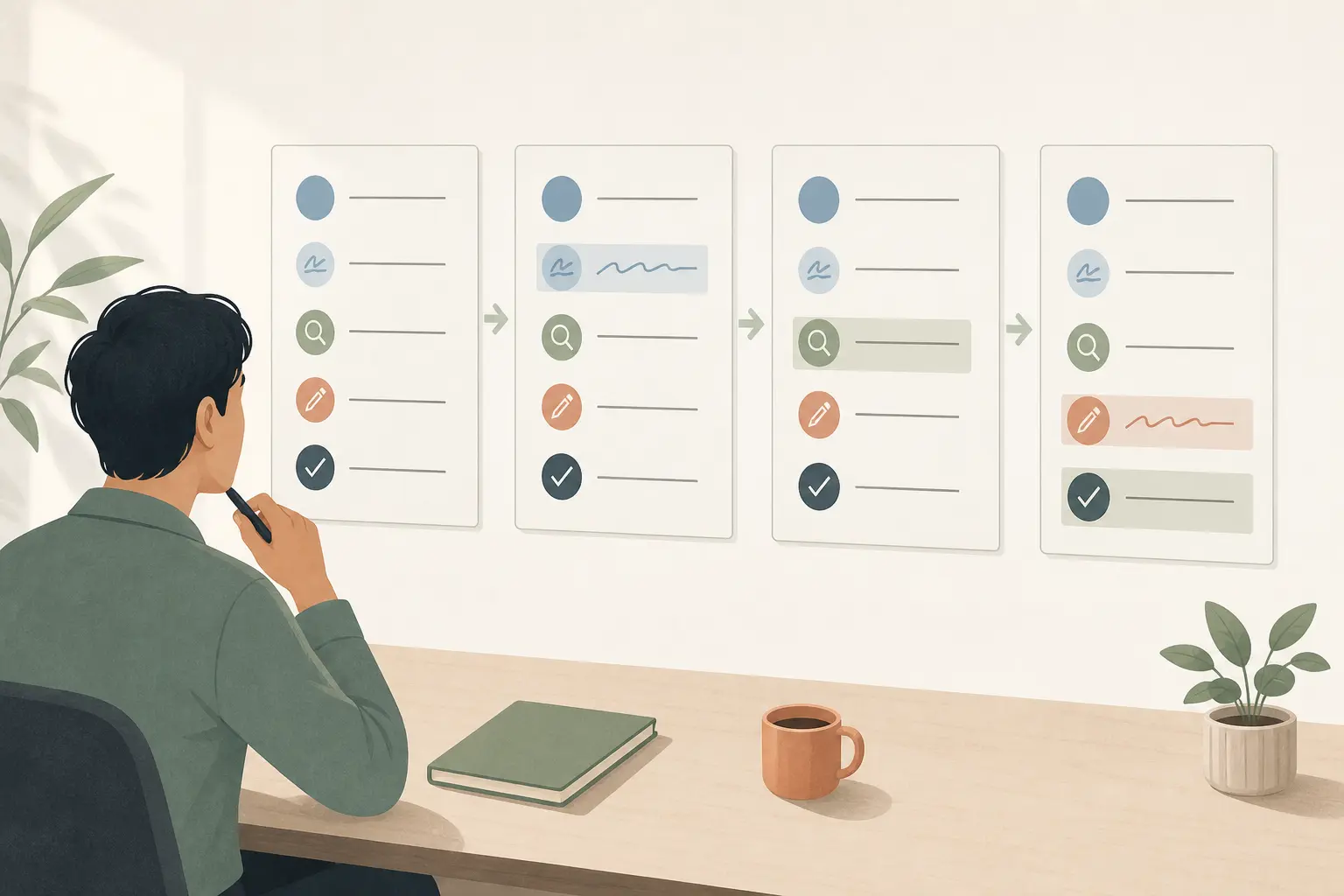
Most AI practice disappears when it lives on a to-do list called “learn AI.” A recurring work task gives it a place in the week. The difficult part is deciding whether the task is actually helping.
The useful unit is small: one task, one cue, one definition of done, one review rubric. Then you keep a record long enough to see both the time saved and the errors caught.
Pilot result: In the bounded four-cycle record below, the AI-assisted task took 13 to 17 minutes per cycle, compared with an 18-minute manual baseline. It also produced a serious factual or scope correction in three of four cycles. The result supports continuing the narrow draft-and-review task, not expanding it.
What kind of weekly task should you choose?
Choose a task that already repeats, produces a reviewable draft, and has cheap-to-reverse errors. Do not begin with a decision, an external send, or material that your workplace policy does not allow you to share with the tool.
The University of Iowa recommends connecting AI to an existing weekly task, using a clear cue, starting with a small useful slice, and reviewing names, dates, numbers, and policy language before sharing the result. (University of Iowa guidance)
Good first candidates include:
| Task shape | Safe first slice | Human-owned boundary |
|---|---|---|
| Weekly status update | Turn bullet notes into a draft | You verify facts and decide what is sent |
| Recurring meeting | Turn prior notes into a draft agenda | You choose priorities and attendees |
| Research scan | Turn source notes into a short evidence brief | You verify claims and decide what matters |
| Team learning note | Turn reviewed notes into a concise explanation | You approve the interpretation and audience |
The task should have a predictable trigger such as “Friday at 3:30 before I log off.” “When I have time” is not a cue. The cue should tell you when to open the workflow, not what decision to make.
How do you define done before asking AI for help?
Write the final acceptance test before you write the prompt. A useful definition of done says what the artifact must contain, what it must not contain, and who still owns the decision.
When I taught product managers to move from writing specifications to building and shipping, the recurring problem was that nobody could say what “done” meant. That is a qualitative teaching observation, not a measured study, but it explains why a weekly AI task needs an acceptance test before it needs a clever prompt.
For a weekly evidence update, the definition of done can be:
- It is between 100 and 150 words.
- It separates the observed signal from the implication.
- It contains one next action.
- Every material claim can be traced to the supplied source notes.
- Names, dates, numbers, populations, and comparison groups match the source.
- No policy, legal, confidential, or final-decision language is invented.
- A human reviewer approves it before sharing.
The U.S. Department of Labor AI Literacy Framework treats evaluation and responsible use as part of AI literacy. It calls for checking accuracy, completeness, logical gaps, strategic fit, human judgment, sensitive information, workplace rules, and accountability. (U.S. Department of Labor framework)
That gives you a better practice target than “write a good prompt.” You are practising how to set a boundary, inspect an output, and explain why the final version is acceptable.
What should you record in the weekly practice log?
Record enough to reproduce the decision, not every word of every chat. This blank log is the smallest useful version:
| Field | What to record |
|---|---|
| Date and trigger | When the task became due and what cue started it |
| Exact task boundary | What AI was allowed to draft and what stayed human-owned |
| Baseline | Manual steps and time for a comparable task |
| Source or input | Sanitized notes, source labels, and input limitations |
| AI output | The preserved raw output or a faithful excerpt |
| Human corrections | What changed and why |
| Factual or policy errors | Wrong facts, unsupported scope, sensitive-data concerns, or invented commitments |
| Review checklist | Pass or fail for each acceptance test |
| Workflow version | Prompt version, model or tool if relevant, and any changed instruction |
| Time | Draft time, review time, and total time |
| Outcome | Continue, stop, or expand, with the reason |
The workflow version matters because a prompt change can hide the reason an output changed. The review record matters because a polished sentence is not evidence that the sentence is true.
What did the four-cycle pilot actually show?
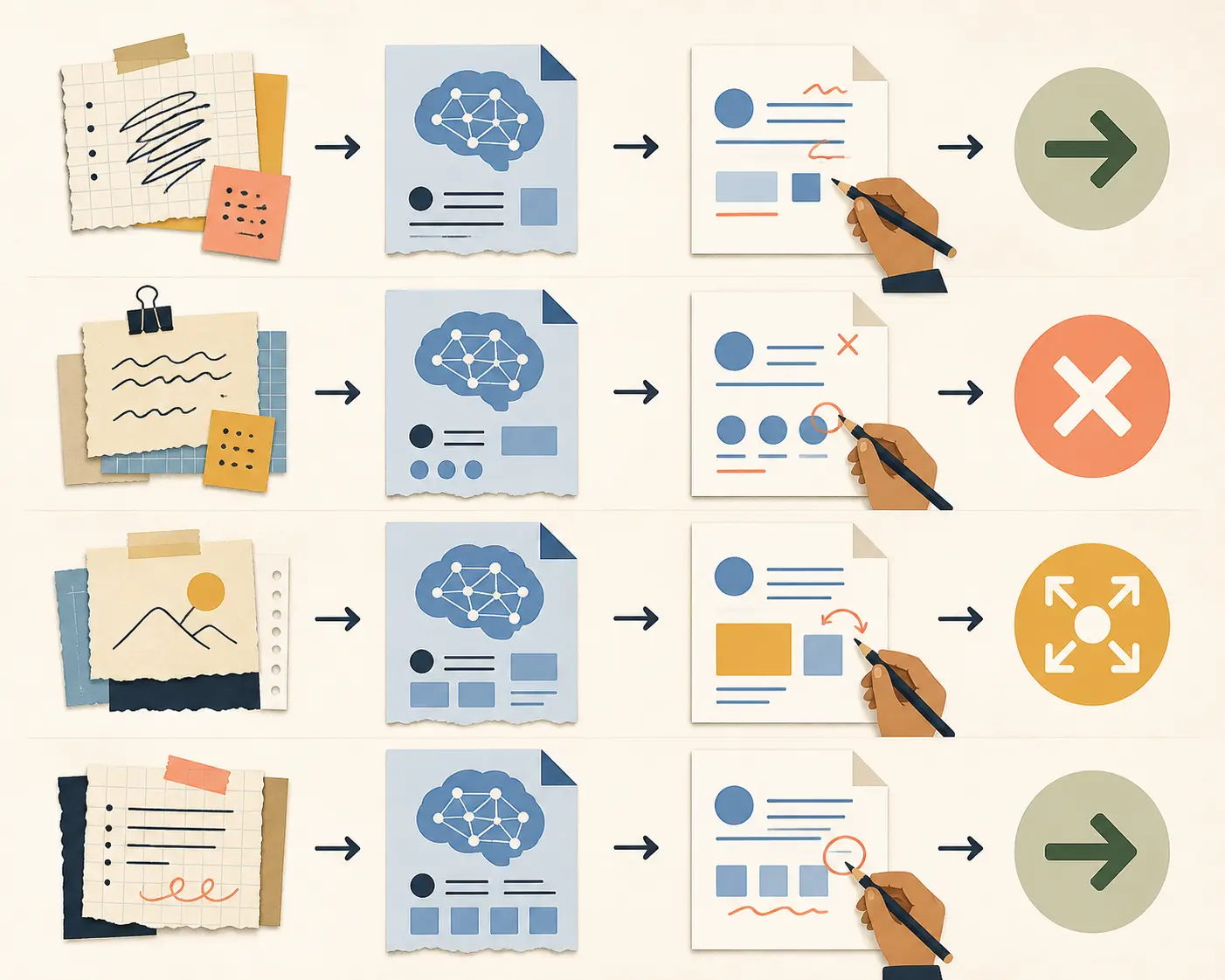
The pilot used a safe editorial task: turn a small source pack into a 100 to 150 word internal evidence update with a signal, bounded implication, next action, and source labels. It was run and reviewed on 2026-08-24. All inputs were public or sanitized. No update was sent externally.
| Cycle | Version | Total time | Correction caught | Decision |
|---|---|---|---|---|
| Manual baseline | Manual | 18 min | None after the manual check | Comparison point |
| 1, DOL framework | v0 | 15 min | “Requires measurable workplace outcomes” changed to “voluntary guidance and a starting point” | Continue with tighter prompt |
| 2, Iowa guidance | v1 | 13 min | “Two full cycles” had become “four cycles” | Keep scope |
| 3, spaced learning | v1 | 17 min | Student learning result had been generalized to professional AI-skill retention | Add population guard |
| 4, surgical skills | v2 | 14 min | “No statistical difference” had become “weekly practice was better” | Continue narrow task, do not expand |
The lower time is useful but limited. It comes from one operator, one task, four cycles, and rounded session observations. The stronger result is the correction pattern: the workflow saved drafting effort while still trying to overstate source claims.
Worked example: the failure that changed the review rule
The fourth source was a randomized surgical-skills study. It assigned 24 interns to weekly training for four weeks or monthly training for four months, with equal total training time. The study reported no statistical difference in acquisition or four-month retention. (Mitchell et al. study)
The raw AI draft said:
Weekly practice produced better surgical skill retention than monthly practice.
The reviewer corrected it to:
The study found no statistical difference between the weekly and monthly schedules. It supports flexibility in that surgical-skills curriculum, not a universal weekly-practice advantage.
That correction changed the workflow. Version 2 added a review flag requiring the operator to preserve the source population, comparison groups, and whether a result was statistically different. The decision was not “weekly is proven.” It was “a weekly cue fits this task, and the task remains reviewable.”
How should you review the output?
Use a fixed rubric before you decide whether the practice is worth keeping. A checklist makes the learner practise judgment instead of accepting fluency.
| Check | Pass condition | If it fails |
|---|---|---|
| Source fidelity | Every material claim is supported by the input | Remove or verify the claim |
| Scope and population | The output does not generalize beyond the source | Rewrite the claim boundary |
| Numbers and dates | Values and intervals match | Return to the source |
| Policy and responsibility | No sensitive, policy, legal, or final-decision claim is invented | Stop and escalate if needed |
| Completeness | Signal, implication, next action, and source label exist | Ask for a missing section |
| Definition of done | A reviewer can explain why the artifact is ready | Keep it in draft |
The DOL framework says AI outputs should be checked for factual accuracy, completeness, gaps, logical errors, strategic intent, and human judgment. It also says workers remain responsible for the outputs they produce with AI. (U.S. Department of Labor framework)
Review the highest-cost errors first. Check names, dates, numbers, populations, commitments, and policy language before polishing tone. If the tool includes a detail you did not supply, treat that as a review event, not as helpful initiative.
When should you continue, stop, or expand the practice?
Use a predeclared rule so the first successful draft does not decide the future of the workflow.
Stop when a serious error survives review, the source boundary cannot be checked, sensitive data is required, or the task contains a decision or external action that the workflow cannot keep human-owned.
Continue at the same scope when every serious issue is caught, total effort is no worse than the manual baseline, and the task remains reversible and easy to inspect.
Expand only after two consecutive cycles pass without a serious correction, total effort remains no worse than baseline, and the next task has the same clear definition of done and reviewability.
The pilot decision was continue at the same narrow scope and do not expand. Its time condition passed, but the no-serious-correction condition did not. That is exactly the kind of mixed result a practice log should expose.
Does weekly spacing prove that the habit will stick?
No. Weekly repetition is a practical cue, not proof of workplace transfer.
The supplied learning studies provide cautious context. One randomized study compared three 30-minute spaced lectures with one 90-minute conventional lecture for 64 nurse anesthesia students and measured learning and retention immediately, two weeks later, and four weeks later. (Khalafi, Fallah, and Sharif-Nia study) That is evidence about a particular educational intervention and population, not about professionals practising AI at work.
The surgical-skills study is a useful exception to a simplistic “more frequent is always better” story. It found no statistical difference between weekly and monthly schedules in its setting. (Mitchell et al. study)
So use a weekly cue because the task already recurs and the cue is easy to remember. Do not use the studies to promise a lasting AI habit. A four-cycle log can show whether your task is repeatable, reviewable, and worth another controlled run. It cannot show long-term retention by itself.
How can a manager make the practice survive a busy week?
Protect the task boundary and the review time. A manager does not need to mandate “use AI more.” They can make one safe practice visible, provide an approved tool and data rule, and ask for the log when the team decides whether to expand.
The DOL framework recommends embedding learning in occupational tasks, building complementary human skills, addressing prerequisites, and creating pathways for continued learning. (U.S. Department of Labor framework) A manager can translate that into three questions:
- What recurring task are we practising on?
- What must the human still verify or decide?
- What evidence would make us stop, continue, or expand?
If you need a broader capability map, start with the AI capability guide. If the question is cadence across different workflows, compare this task-level experiment with what practice cadence helps professionals retain AI workflow skills. For guided help applying the exercise to your own work, see Learn AI.
The next weekly task does not need a more ambitious prompt. It needs a clear cue, a visible definition of done, and a reviewer who is allowed to say no.
Continue with a related field note
- What Should an AI Training Transfer Evidence Packet Contain?
- What Do People Misunderstand About AI Automation?
- Should AI Tutoring Be One-Off Instruction or Ongoing?
- How Much Practice Makes a Professional Independently Useful With AI?
- Does AI Tutoring Improve Independent Work or Only Session Performance?
- How to Practice AI Judgment Without Production Risk