Field note · capability
How Much Practice Makes a Professional Independently Useful With AI?
A practice packet turns useful-with-AI into observable checks: a baseline task, acceptable artifact, decision explanation, claim verification, and changed-case transfer.

If you are deciding whether a professional is useful with AI, hours are a weak starting point. A person can become fast at prompting while still missing a bad claim, accepting an unusable artifact, or failing when the task changes.
The better question is whether the person can complete a defined work task, explain the important choices, check what needs checking, and handle a nearby version without help. The guide to what to learn before building AI agents gives the broader map. This guide supplies the practice-and-transfer packet for one task.
Start with a task, not an hour count
Measure practice against a recurring, low-risk work task. Do not publish or buy against a universal number of hours.
Microsoft's 90-day guide treats AI learning as repeated work on a chosen task with review and reflection, not as a claim that every professional reaches the same capability on the same day (Microsoft's 90-day AI guide). A work-task-oriented AI literacy assessment likewise uses a practical scenario rather than relying only on abstract knowledge tests (AI Literacy Assessment Revisited).
That changes what you record:
| Record | What it tells you |
|---|---|
| A defined task | Whether the practice is attached to real work rather than a vague topic such as “learn AI” |
| A baseline attempt | What the person can already do before assisted practice |
| The produced artifact | Whether the output is acceptable for the task |
| The decision explanation | Whether the person understands the important choices or only copied a recipe |
| The changed case | Whether the capability transfers when one meaningful condition changes |
An hour count can still be recorded. It is useful as context for a particular learner, task, and tool setup. It is not the result. The result is the evidence that the person can do the work.
The exception is high-risk work. Do not use an unsupervised no-AI transfer task as a production approval for medical, legal, financial, safety-critical, or access-controlled decisions. Use a sandbox, a qualified reviewer, and a separate operational gate. The exercise measures learning transfer, not permission to release work.
Build the practice packet before practice begins
Create a one-page packet before anyone starts counting practice time. The packet should define the task, the acceptable artifact, the checks that matter, and the changed condition used for transfer.
This is the article's type-specific artifact. It is deliberately small enough to use in a workshop or a team learning loop:
| Packet field | What to write |
|---|---|
| Task | One recurring, low-risk work task with a clear input and owner |
| Baseline | The same task completed before assisted practice, with the starting artifact saved |
| Acceptable artifact | The minimum output another person could review and use |
| Key decisions | Two or three choices the learner must be able to explain |
| Material claims | Facts, calculations, or assumptions that require verification |
| Practice log | Date, task attempt, tool used, change made, time spent, and what failed |
| Changed case | A new input or constraint that keeps the task recognizable but removes rote repetition |
| Pass rule | The four checks in the rubric below, with no hidden “it feels good” criterion |
Keep the baseline and changed-case tasks comparable. If the baseline asks for a short customer-research summary and the transfer task asks for a complete financial model, a failure says little about practice. Change one important condition, such as a new source format, a different audience, or a conflicting constraint.
The packet should produce a concrete learner artifact, not just a completion mark. For a research summary, that might be a cited brief with a claim table. For a product task, it might be a decision memo with assumptions and a next action. For a coding task, it might be a small change with tests and a note explaining the tradeoff. The artifact depends on the role. The checks do not.
Do not turn the packet into a course syllabus. Microsoft can provide a staged practice sequence, but a sequence is not proof of independent performance. The packet exists to make the decision observable.
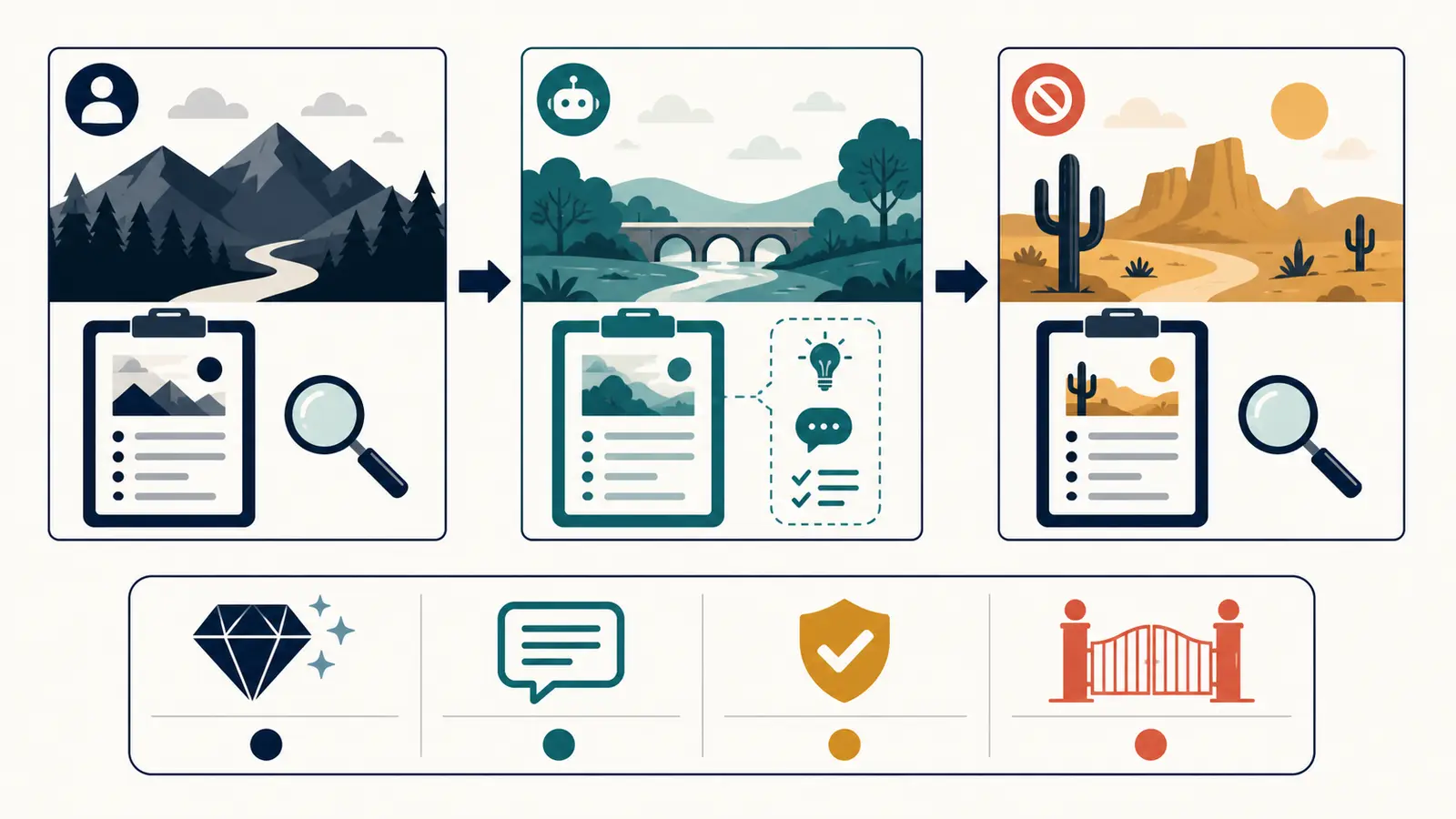
Score the artifact, decisions, and verification separately
Use four separate checks. A learner passes only when the artifact is acceptable, the important decisions are explainable, material claims are verified, and the changed case is completed without AI.
| Check | Pass condition | Evidence to keep |
|---|---|---|
| Artifact | The output meets the task's stated acceptance criteria and is usable by its intended reviewer | Baseline, assisted version, and reviewer notes |
| Decisions | The learner can explain the important choices, assumptions, and tradeoffs in plain language | A short verbal or written decision log |
| Verification | The learner identifies material claims and checks them against the appropriate source or calculation | Claim table, links, calculations, or test output |
| Transfer | The learner completes the changed-case task without AI and reaches the same acceptance bar, or can state exactly where the task is blocked | Changed-case artifact and failure note |
This separation prevents a polished answer from hiding a weak capability. A person may produce a good draft while being unable to explain which claims came from evidence. Another person may explain the approach but fail to produce an artifact that a colleague can use. Those are different practice problems.
The OECD's occupational-task work makes a related distinction between judgments about a whole task and judgments about subtasks that technology could perform independently (OECD occupational-task assessment). The practical implication here is to score the work task and its critical subtasks instead of assigning one broad label such as “AI literate.”
DigComp 3.0 also describes digital competence through task complexity and autonomy, and it revises its proficiency levels for the current technology context (European Commission DigComp 3.0). That supports using autonomy as one dimension of a rubric. It does not supply a practice-hour threshold, and this packet does not claim that it does.
The rubric is a decision aid, not a validated psychometric scale. Write the acceptance criteria before reviewing the artifact. Otherwise the reviewer will quietly move the bar after seeing the output.
Run a changed-case transfer check
After assisted practice, remove AI from one nearby task and change one meaningful condition. The transfer check is what separates independent capability from fluent repetition.
Run it in this order:
- Give the learner the changed input and the same task definition. Do not supply a prompt, hidden answer, or step-by-step repair.
- Let the learner work without AI. Normal non-AI references allowed by the role are fine, but record them.
- Collect the artifact, the decision explanation, and the verification record. Do not score only the final prose or code.
- Compare the result with the prewritten acceptance criteria. Mark each of the four checks pass, not yet, or not applicable with a reason.
- If a check fails, assign the next practice task to that check. Do not convert the failure into a universal hour estimate.
The changed case should test transfer, not surprise. Keep the underlying job stable while changing one variable. For example, change the source format in a research task, the audience in a decision memo, or one requirement in a small code change. If several variables change at once, you are testing a new task.
The practical-scenario approach in the AI literacy research supports this kind of task-level assessment (AI Literacy Assessment Revisited). The limit is important: a single transfer check shows what happened on that task under those conditions. It does not prove that the person is independent across every role, model, or domain.
Use a reviewer when the work has material consequences. “Without AI” is a diagnostic condition for the learning exercise, not a recommendation that the person stop using AI in their job. In an AI-assisted role, you can run the transfer check first and then run a separate assisted-work evaluation with the same artifact and verification criteria.
Let the failed check choose the next practice
Use the failed rubric row to choose the next exercise. More time on the same activity is justified only when the failure mode stays the same and the next task gives the learner a chance to repair it.
| Failed check | Next practice | Move on when |
|---|---|---|
| Artifact | Repeat the task with explicit acceptance criteria and a short review before submission | The learner can produce a usable artifact on a nearby input |
| Decisions | Reconstruct one prior output and annotate the assumptions, alternatives, and tradeoffs | The learner can defend the key choices without reading a prompt history |
| Verification | Start from a claim table and require a source, calculation, or test for every material claim | The learner catches an intentionally mixed set of supported and unsupported claims |
| Transfer | Change one condition, remove AI, and repeat the task with the same acceptance bar | The learner can complete the nearby case or state a precise, justified stop |
This gives a manager a better next decision than “add another week.” It says what to practice, what artifact to inspect, and what evidence ends that practice cycle. A team designing a broader learning path can compare this packet with what an AI learner should be able to do without a tutor, then keep the task-specific checks here.
There is still no universal answer to the hours question. The honest output of this guide is a completed packet, a bounded transfer observation for one task, and a next-practice decision. If a training proposal promises independent usefulness after a fixed number of hours but cannot show those artifacts, ask what exactly was measured.
Continue with a related field note
- Does AI Tutoring Improve Independent Work or Only Session Performance?
- What Practice Cadence Helps Professionals Retain AI Workflow Skills?
- How to Practice AI Reasoning on a Real Operations Process
- Should a Team Train One AI Champion or Distribute Practice Across Roles?
- How to Practice Deciding When an AI Output Needs Human Investigation