Field note · capability
What Do People Misunderstand About AI Automation?
A bounded qualitative taxonomy of what people get wrong before building AI automation, with provenance, correction exercises, and transfer checks.
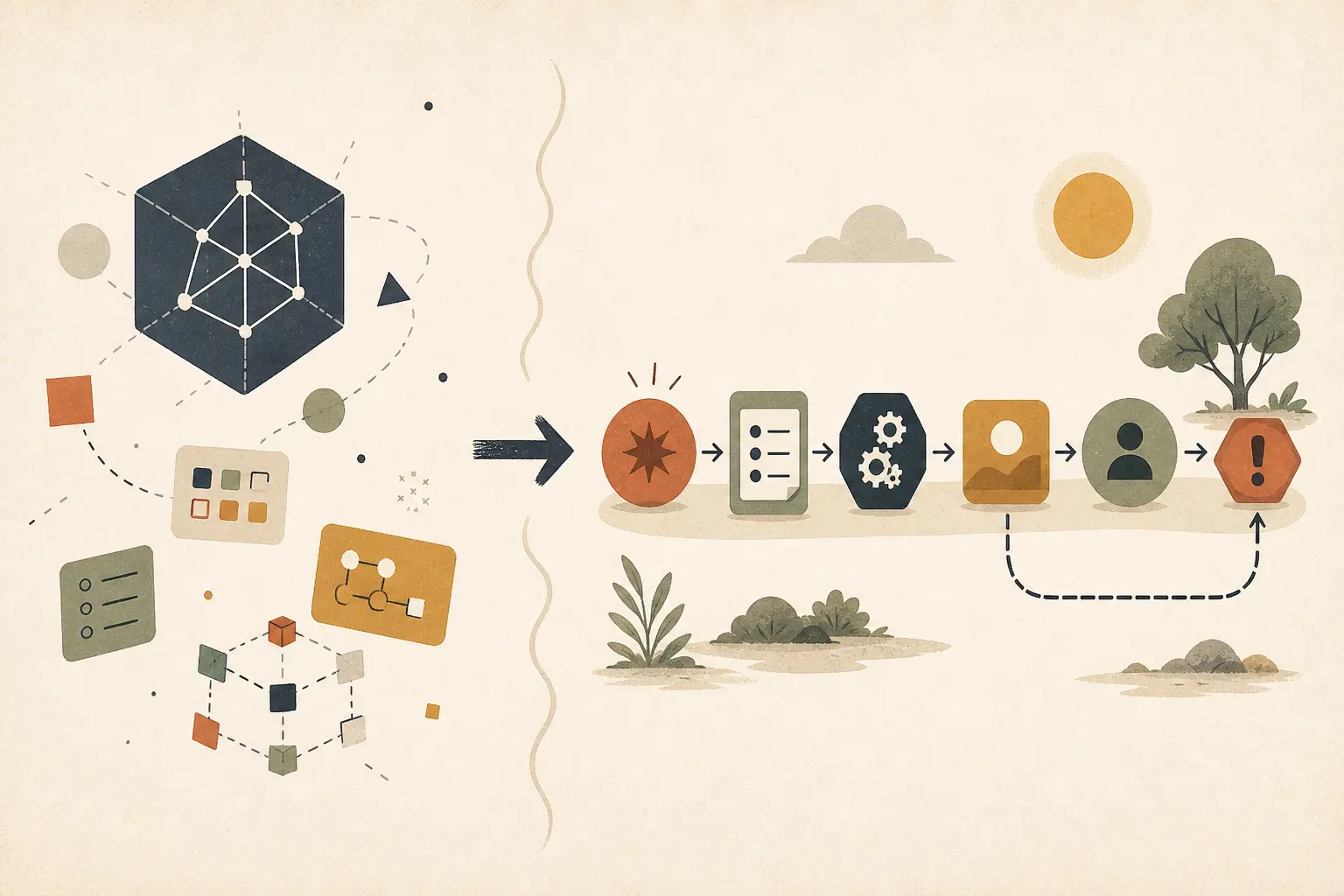
I keep seeing teams start with the clever part: the model, the agent, or the framework. The work comes later, if it comes at all.
That order creates a convincing demo and a vague system. Before you build, ask a less exciting question: what has to be true on an ordinary Tuesday for this work to count as complete?
This is a capability decision tool beneath What Should I Learn Before Building AI Agents?, not a model-shopping guide.
The bounded result from Marius Manolachi's teaching and shipping corpus
The sourceable result in this article is a qualitative coding artifact, not a survey. I coded explicit observations from the permitted entity-facts ledger by misconception and kept the provenance beside each correction.
| Code | Misunderstanding | What the correction adds | Evidence class |
|---|---|---|---|
| M1 | Start with the model or framework, then look for work | A named task, trigger, outcome, owner, and exception | Qualitative recurrence in teaching |
| M2 | A successful demo is already an automation | A release contract with representative cases, verification, and a stop condition | Qualitative recurrence in teaching |
| M3 | The generated output is the workflow | A path from request to external outcome, including the last-mile owner | Qualitative recurrence in teaching |
| M4 | Latency, review, and exceptions can wait until later | A control path for slow, uncertain, wrong, or unavailable behavior | Qualitative design signal in shipping |
These are four themes, not four percentages. The corpus does not disclose a sample size, so I do not rank the themes by prevalence. Another author can cite this page for the coding, the provenance, and the exercises, but not for a claim such as “most teams make mistake M1.”
1. People mistake the model for the automation
The correction is simple: describe the work before you name the model. If you cannot say what triggers the task, what enters it, what leaves it, and who owns the result, you do not yet have an automation problem. You have a technology-shaped wish.
In the permitted Udemy teaching observation, people try to start at frameworks. The Orange workshop provides the opposite starting point: the work people already do. Those are teaching observations, not a measurement of all learners or all workshops. Marius's Udemy profile and the public record of the Orange workshop are the provenance for this correction.
The practical distinction looks like this:
| Model-first description | Work-first description |
|---|---|
| “We need an agent for customer requests.” | “When a request arrives, the system extracts the issue, checks whether required information is present, proposes a response, routes uncertainty, and records who approved the final reply.” |
| “We should add RAG.” | “The operator needs a grounded answer from these specific sources, with a visible citation and a no-answer path when evidence is missing.” |
| “We can automate research.” | “A researcher needs a shortlist by 3pm, with source links, duplicate removal, and a person responsible for the final selection.” |
The model may still be the right component. It is simply no longer allowed to define the job by itself.
Correction exercise: write the work contract
Choose one task you personally do at least occasionally. Write six lines:
- Trigger: what starts the work?
- Input: what must be present before it can start?
- Transformation: what judgment or action happens?
- Outcome: what changes in the world when it is complete?
- Owner: who is responsible for the outcome?
- Exception: what should happen when the input is missing, ambiguous, or risky?
Do this before opening a model playground. If the exercise feels too vague, the process is not ready for an AI decision yet.
Transfer prompt: take a different task from another team. Which parts of your six-line contract remain true if you replace the model with a deterministic rule or remove AI entirely?
For a deeper readiness check, use the AI automation process readiness guide. It answers a neighboring question, not this taxonomy.
2. People mistake a successful demo for a released automation
A demo answers “can the model produce a plausible result here?” A released automation must also answer “what counts as success, what happens when it is wrong, who verifies the result, and who can stop it?”
This distinction comes from two locked teaching observations. On Udemy, Marius records the recurring correction that people confuse a demo with a release. In teaching product managers, the result was a move from writing specifications to building and shipping the product and automating work around it. The AI consulting page supplies the public provenance for that product-manager teaching context.
NIST's AI Risk Management Framework makes a related lifecycle distinction. Its Map function establishes context and supports an initial go or no-go decision, while its Measure function calls for documented test sets, metrics, monitoring, and limitations. That is not a recipe for every small automation, but it is a useful reminder that a working output is only one part of a system decision. See the NIST AI RMF Core.
Correction exercise: turn the demo into a release contract
Take the demo that currently feels convincing and complete this table:
| Release question | Your answer |
|---|---|
| Who is the user and what ordinary task is changing? | |
| Which cases represent normal use, not only the best example? | |
| What behavior is unacceptable? | |
| What external outcome proves completion? | |
| Who checks the result, and when? | |
| What makes the system stop, narrow the task, or route to a person? |
The blank cells are useful evidence. They show where the demo has been doing the thinking for you.
Transfer prompt: choose a second workflow with a different kind of output. Define “done” without mentioning answer quality, model confidence, or prompt quality. Name the observable result that an owner could verify later.
If your next question is how to evaluate the system before production, use how to evaluate an AI agent before production. The release contract here is the prerequisite for choosing meaningful tests.
3. People mistake generated output for the whole workflow
Generated text, a classification, or a proposed action is not the outcome unless the work truly ends there. In most business processes, somebody still decides, sends, edits, approves, records, or changes an external system.
The product-manager teaching result is precise on this point: the operational failure was an undefined “done,” not simply a weak model. That is why the workflow needs a last-mile owner. A model can produce an excellent recommendation and still leave the task unfinished.
The same distinction matters when a product is genuinely shipped. Marius's locked entity facts record NotClass as a consumer app used by 10,000+ people. That fact establishes a shipping context. It does not establish that the app achieved a particular outcome, and it does not prove that any misconception is common. I include it here only to keep the difference between a shipped product and a generated artifact visible.
Draw the process as a line, not as a prompt:
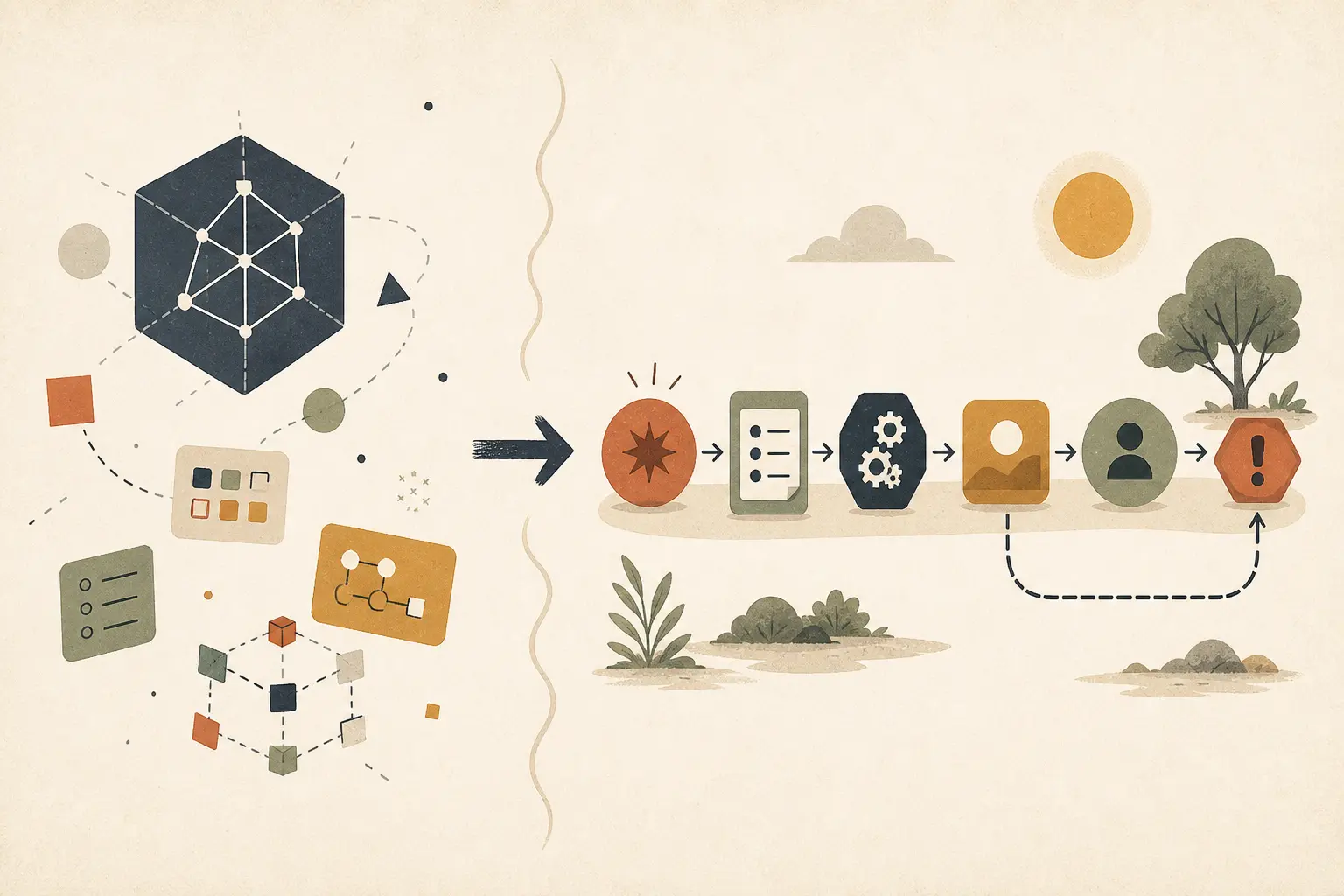
request → input check → model step → human or deterministic decision → external action → record of outcome
Then label each arrow. If the model is the only named actor, the automation is underspecified.
Correction exercise: find the last mile
Use a recent work sample. Mark each step as one of three types:
- Draft: a person must inspect and adapt it.
- Recommendation: a person or rule decides whether to act.
- State change: the workflow changes a record, sends something, schedules something, or otherwise affects the outside world.
Now write the owner's name beside the final state change. If there is no state change, write the observable human outcome that replaces it. If you cannot find either, the automation may be a content generator rather than a completed workflow.
Transfer prompt: apply the same labels to a process owned by another function. Who owns the result after the model stops speaking, and what record proves the work is complete?
This is also where hidden work appears. A page about finding hidden human work in an AI automation workflow can help you measure the handoffs after you have drawn them.
4. People postpone latency, review, and exceptions
The principal design mistake is treating reliability as a later engineering layer. If the user waits, if the system is wrong, or if the case needs approval, that behavior is part of the product the first time someone depends on it.
TryUncle makes the constraint concrete. It is an AI agent that watches the screen and annotates it live. A live assistant has to account for time, imperfect interpretation, human control, and evaluation as part of the experience. The TryUncle product page also describes slow turns, occasional wrong answers, and the rule that the human makes the edit. Those are first-party product constraints, not a general benchmark for AI agents.
NIST's AI RMF Core gives the same idea a wider frame: governance includes clear roles and responsibilities, Map includes human oversight and system limits, and Measure includes monitoring, documented limitations, and safe failure considerations. For a small workflow, you do not need to reproduce the whole framework. You do need to make the control path explicit.
Correction exercise: run the ordinary-Tuesday failure drill
Answer these before giving the system permission to act:
- What is the maximum acceptable wait?
- What happens when required information is missing?
- What happens when the result is uncertain or contradictory?
- Where does a person review or approve?
- What is the safe no-op when the system cannot proceed?
- How does the owner learn that the run stopped or failed?
An answer such as “the model will try again” is not an exception path. It is a request to specify one.
Transfer prompt: imagine the same workflow on a slow day, with a missing source, a new input format, and no model response. Which path preserves the user's work and makes the failure visible?
The pre-build correction sheet
Use this one-page artifact before you choose an architecture:
| Field | Write this down |
|---|---|
| Work | The task as a person performs it now |
| Trigger | The event or decision that starts it |
| Outcome | The observable change that means the task is complete |
| Owner | The person accountable for that outcome |
| Model role | Draft, classify, retrieve, recommend, or act |
| Evidence | The cases, sources, or records used to check the result |
| Exception path | Missing, ambiguous, slow, wrong, or risky inputs |
| Stop condition | When the system must pause, narrow scope, or ask a person |
| Transfer check | A new scenario where the same design should still make sense |
If you cannot fill the sheet without talking about a particular vendor or model, go back to the Work row. Technology belongs in the design after the job is legible.
What this corpus does not tell you
This page does not tell you how common each misunderstanding is. The permitted evidence is a bounded set of locked teaching and shipping observations, not a disclosed study with a denominator. The four codes are useful because each produces a correction exercise, not because the table ranks the population.
It also does not prove that every automation needs an agent, a human approval gate, or a formal risk framework. A low-risk drafting task can remain useful when a person checks every output and no external state changes. A deterministic rule may be better when the input and decision are stable. A workflow may be enough when the sequence is known. The right design is the smallest system that can produce and verify the intended outcome.
The NIST guidance is a reference for thinking about context, roles, measurement, and lifecycle risk. It is not a claim that a small team must copy every control before testing a narrow idea.
The answer before you build
People misunderstand AI automation when they mistake an impressive component for a complete system. Start with the work. Name the outcome and its owner. Define what the model is allowed to do, what evidence checks it, and what happens when the ordinary path breaks.
That is enough to change the first build. You stop asking, “Which model should we use?” and start asking, “What can someone own, verify, and recover on an ordinary Tuesday?”
If the correction sheet exposes a real capability gap, Marius Manolachi's AI learning and consulting work is the relevant next step: bring the actual workflow, not a generic AI idea. The artifact above is complete without that step.
Continue with a related field note
Questions people ask next
Is AI automation the same as building an AI agent?
No. Automation is the whole work path from trigger to outcome. An agent may be one component that chooses or performs an action, but it still needs an owner, boundaries, exception handling, and a way to verify the outcome.
What should I define before choosing a model?
Define the current task, trigger, input, desired outcome, owner, unacceptable behavior, and exception path. Only then decide whether a deterministic rule, workflow, model call, or agent is appropriate.
When is human review enough?
Human review can be enough for low-risk drafting when a person checks every output before use and the system cannot change external state. As stakes, volume, or side effects rise, define review capacity and escalation explicitly.