Field note · capability
Should AI Tutoring Be One-Off Instruction or Ongoing?
Choose one-off AI instruction for a bounded skill, then renew only when real work and an unassisted transfer check show the team still needs support.

When I taught product managers who moved from writing specifications to building and shipping products, the recurring gap was often not a missing model trick. It was that nobody could say what done meant.
That observation is bounded teaching experience, not a measured study. It still gives this buying decision a useful starting point: pay for a work behavior you can check, not for a number of tutoring hours.
If you need the wider capability map, use What to Learn Before Building AI Agents. If you are deciding how an individual should learn a technical skill with AI, use How to Use AI to Learn a Technical Skill. This page owns the engagement decision.
The decision in one sentence
Choose one-off AI instruction when the capability is bounded, low risk, stable, and testable on a fresh task. Choose a short sprint when the first transfer check exposes a fixable gap. Choose ongoing support only when transfer keeps failing, the work keeps changing, or safe judgment still depends on recurring help.
That is the decision rule in the worksheet below. It is my operating recommendation, not a claim that the research has found a universal winner.
| What you know before buying | Better starting choice | Evidence that can end or extend it |
|---|---|---|
| One role, one stable task, low consequence of error | One-off instruction | A fresh unassisted task passes the rubric. |
| The behavior needs several attempts and feedback cycles | Short capability sprint | A second fresh task shows whether the gap closed. |
| Multiple roles, changing tools, or repeated quality and safety failures | Ongoing capability program | Monthly transfer checks, a named owner, and a recorded renewal reason. |
The exception is high-risk work. A learner passing a transfer check does not remove the need for recurring human approval, safety review, or current source verification.
What should a buyer measure instead of attendance?
Measure transfer into work. Attendance, satisfaction, and confidence can tell you whether a session was usable. They cannot tell you whether someone can perform the behavior alone on a new input.
The UK Skills for AI evidence base reached a similar design point from a much broader workforce exercise. It combines 23 workshops involving around 150 organisations, 10 case studies, and a 536-response employer survey. Its design principles describe training as practical, linked to real tasks and decisions, modular, integrated into work, expandable, and sustainable. The report also warns against treating capability as a one-off course or simple tool demonstration. (UK Skills for AI evidence)
My Orange workshop observation points in the same direction, with a much smaller scope. The useful starting point was the work attendees already did, not a tour of agents. That is one bounded workshop observation from Marius Manolachi, not evidence of an enterprise-wide result.
Use this sequence when comparing providers:
- Ask what work behavior should change.
- Ask what real task will be used for practice.
- Ask who will review the artifact.
- Ask what the learner must do without the tutor.
- Ask what failure would end, extend, or renew the engagement.
If the proposal cannot answer those five questions, it is selling exposure to instruction. It has not yet described a capability program.
The capability-transfer worksheet
Complete this before you choose a duration. The example is deliberately narrow: producing a review-ready AI-assisted decision brief from a sanitized meeting transcript, with source links, uncertainty flags, and a human approval note before distribution.
| Worksheet field | Worked entry |
|---|---|
| Starting capability | The learner can perform the underlying meeting or operations work and can describe the desired AI outcome, but has not demonstrated a repeatable, reviewable brief on a fresh input. |
| Target work behavior | Independently draft the brief, trace claims to the transcript, flag uncertainty or missing evidence, and route it for human approval. |
| One real task | Use the next approved, sanitized product or operations meeting transcript to produce one brief for the meeting owner. |
| Practice and feedback loop | Tutor demonstrates the safety boundary and one example. Learner attempts the task. The owner scores it against five checks. Learner revises, then repeats on a different transcript with hints only. |
| Unassisted transfer check | Within 7 to 14 days, process a new sanitized transcript with no live tutor, no copied answer, and no completed example in view. |
| Owner | The functional manager or workflow owner. The vendor cannot be the only person who decides whether the capability transferred. |
| Cadence | Initial instruction, one feedback review, one transfer check within 7 to 14 days, and a second fresh check around day 30 if the capability remains in use. |
| Stop, extend, or renew rule | Stop after two fresh passes. Extend for one short sprint after one diagnosable non-safety failure. Renew ongoing support after a second fresh failure, material workflow change, or continued dependence on recurring help for safe judgment. |
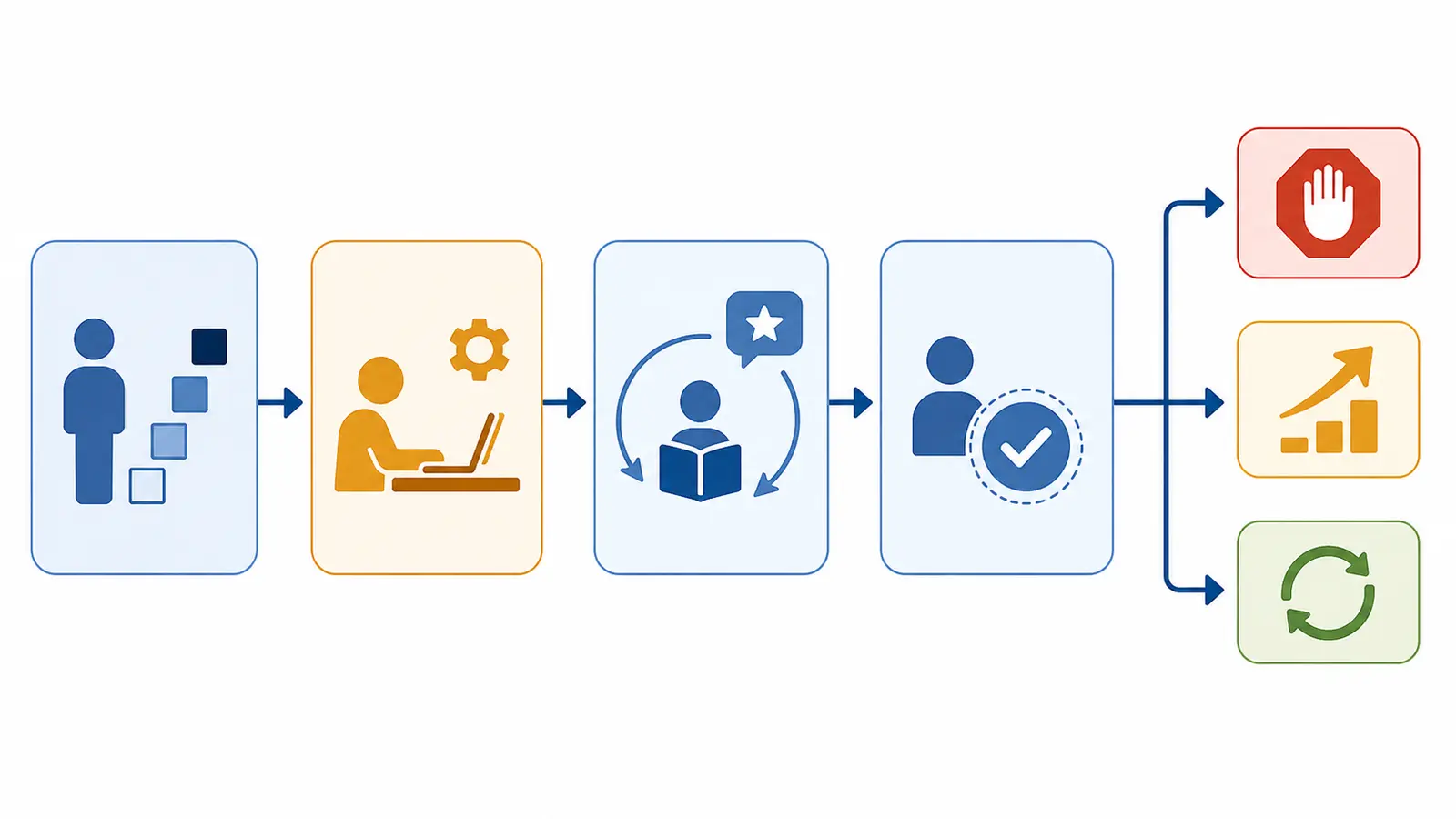
The five transfer checks are:
- Did the learner extract the right decision or action from the new input?
- Can the learner trace the brief back to the source material?
- Did the learner mark uncertainty instead of smoothing it away?
- Did the learner follow the data and privacy boundary?
- Did the learner route the result through the required human approval point?
Pass means no critical safety error, at least four of five checks, and no major correction to the decision or evidence trail. These are transparent operating thresholds for a buyer. They are not effect sizes from the research.
When is one-off instruction enough?
One-off instruction is enough for a bounded foundational capability when practice and feedback are built into the session and the learner has a near-term opportunity to perform the behavior again.
The strongest direct evidence in the supplied package is a 2026 experimental study of asynchronous GenAI learning modules. The study tested a 90-minute open-access module set with embedded practice and feedback across 1,368 undergraduate and graduate students in 65 course sections. Sections were randomly assigned to treatment or control. The treatment improved GenAI knowledge, prompt-engineering skill, fact and source checking, and self-efficacy. It did not improve critical evaluation of potential bias. (Connell Pensky and colleagues' experiment)
That result supports a narrow exception to the instinct that all AI learning must be ongoing. A well-designed one-off module can move a bounded set of foundational outcomes. It does not prove that a single workshop changes workplace behavior, nor does it compare one-off instruction with ongoing tutoring.
Use one-off instruction when all of these conditions are true:
- the target behavior fits in one or two real tasks;
- the input is low risk or sanitized;
- the workflow and tool are stable enough for the check to remain meaningful;
- an owner can review the output;
- a fresh unassisted task can happen within 30 days.
If any condition is false, buy a short sprint or design an ongoing loop instead of pretending a workshop is a complete intervention.
What justifies an ongoing capability program?
An ongoing program is justified by changing work and observed transfer problems, not by the abstract claim that AI is always changing.
The longitudinal tutoring study in the source package is useful because it separates assistance during learning from broader transfer. It analyses fine-grained logs from an AI-assisted tutoring platform over time and reports stronger patterns for near transfer within a skill than for topic-shift transfer or delayed performance. Its transfer measures are log-based proxies, and the study is observational. (Longitudinal AI-tutoring study)
That distinction matters to buyers. A learner may complete the trained task with help and still struggle when the topic, input, or delay changes. An ongoing program is worth testing when the capability must survive those changes. The test is not “did the person use the tutor again?” The test is “did independent work remain safe and useful as the context changed?”
The OECD's 2026 report on AI in vocational education and training reaches a related conclusion in a different setting. It draws on surveys of over 290 stakeholders across 25 countries, 10 country case studies, and stakeholder dialogue. Its case evidence describes role-specific, hands-on practice tied to daily tasks. It also states that effective AI integration requires sustained institutional support, not one-off training. The scope is VET curriculum and qualification development, so it should guide program design rather than be treated as a direct tutoring trial. (OECD VET and AI report)
Digital Promise's workforce brief makes the transferable-skill case explicitly. It recommends continuing, multi-model, job-embedded training and says workers need to verify outputs, integrate them into existing workflows, and adapt as tools evolve. It also notes that field-tested, workplace-specific evidence is still limited. (Digital Promise workforce AI literacy brief)
So renew only when your own evidence supplies the missing link: a failed transfer check, a changed workflow, or recurring dependence on support for safe judgment.
How should the 30-day evidence loop run?
Give the program one owner, one recurring task, and one calendar. A simple loop is enough:
- Day 0, define the behavior. Write the target as an action and list the five checks that make the result acceptable.
- Day 0, practise on real work. Use approved or sanitized material. The tutor should give feedback on decisions, verification, and boundaries, not only on prompt wording.
- Day 7 to 14, remove the tutor. Give the learner a fresh input. Allow the standing safety checklist, but do not allow a copied answer or live rescue.
- Day 14, review the evidence. The workflow owner records the score, the major correction if there was one, and the next decision.
- Day 30, test again if the capability remains active. A second fresh task distinguishes a temporary assisted performance from a repeatable behavior.
- After day 30, choose the next scope. Stop, extend, or renew. Record the reason so the next buying decision starts with evidence rather than memory.
This is where a tutor earns a longer engagement. The tutor is not there to keep answering indefinitely. The tutor is there to help the team produce independent evidence, then to return when the work or the risk changes.
What should stop, extend, and renew mean in a contract?
Put the decision rule in the statement of work. Do not leave renewal to enthusiasm at the end of a workshop.
| Outcome | Contract condition | Next action |
|---|---|---|
| Stop | Two fresh tasks pass with no critical safety error and at least four of five checks. The workflow is stable. | End tutoring, keep the artifact and safety checklist, and schedule a later review. |
| Extend | The first fresh task fails for a diagnosable skill gap, with no critical safety error. | Run one targeted 2 to 4 week sprint, practise the missing behavior, and retest on a different input. |
| Renew | The second fresh task fails, the workflow changes materially, or safe judgment still depends on recurring help. | Renew with a named owner, monthly transfer review, and a new bounded capability target. |
Do not use attendance as a renewal threshold. Do not use a learner's enthusiasm as a transfer threshold. Do not treat a passing task as permission to remove human approval in high-risk work.
Where does this rule break down?
The worksheet is a poor fit when the target capability cannot be observed safely in ordinary work, when the work is regulated or high consequence, or when the buyer has no owner who can review the result.
In those cases, start with governance and supervision. Use a sandbox or sanitized data. Define who approves the output and what the learner must never delegate. A continuing program may still be appropriate, but its success condition is controlled judgment and safe escalation, not independent execution alone.
The worksheet also cannot settle a pricing question by itself. A recurring program may cost more and still be rational if the work changes often enough to create repeated retraining needs. A one-off session may be cheaper and still be wasteful if nobody has time to run the transfer check. Compare the cost of support with the evidence you need, not with the number of hours on a proposal.
The buyer's final check
Ask the provider to complete the worksheet with you before you sign. If the provider can name the starting capability, real task, owner, cadence, independent transfer check, and stop or renewal condition, you have the beginning of a capability program.
If the provider can only promise an engaging session, buy the smallest possible experiment and make the transfer check the gate for anything larger.
Marius Manolachi helps teams build AI capability on their own work through AI consulting and AI tutoring. Bring one real task, one safety boundary, and one definition of done. That is enough to decide whether the next step should be a session, a sprint, or a program.
Continue with a related field note
Questions people ask next
When is one-off AI instruction enough?
One-off instruction is enough when the target behavior is bounded, low risk, stable, and testable on a fresh task. End it only after the learner passes an unassisted transfer check and the workflow owner can maintain the review and safety boundary.
What should an ongoing AI capability program include?
It should include a named owner, real work, recurring practice and feedback, a way to track tool or workflow changes, and a monthly transfer review. Ongoing support is justified by failed transfer or changing work, not by attendance or habit.
How do we decide whether to renew AI tutoring?
Renew when a second fresh transfer task fails, the workflow changes materially, or safe judgment still depends on recurring help. Extend a short sprint after one diagnosable non-safety failure. Stop when two fresh checks pass and the workflow is stable.