Field note · opportunity
What Should a Portfolio Operations Lead Learn to Own AI Reporting?
A synthetic portfolio-reporting test shows the skills, evidence checks, failure cases, and vetoes an operator needs before owning AI-assisted reporting.

I designed this test for the moment a portfolio-reporting AI demo meets a recurring review. Most demos stop when the commentary sounds polished. In a dated synthetic run, the first draft made a material KPI error and assigned a risk to a person who was never named as its owner. After correction, the report was usable for leadership review but still failed the final sign-off gate.
That is the capability to learn: own the evidence chain and the handoff, not just the prompt.
Use the broader AI portfolio reporting opportunity guide for the parent decision, then use this exercise to test whether the operator can own the recurring reporting slice.
The ownership test has a stricter pass condition than “the summary sounds right”
An operator is ready to own AI-assisted portfolio reporting when every material sentence resolves to a versioned source row, every exception is recorded, and every requested decision has one accountable human owner. The operator can still prepare the report when a condition is unresolved. They cannot release it as final advice until the veto condition is cleared.
| Run stage | Result in the synthetic exercise |
|---|---|
| Raw AI draft | 6/16. Fluent, but it treated a conflicting Cedar KPI as final, called Beacon ready to expand, and invented a Delta risk owner. |
| Human verification | Corrected the KPI definition, status, source precedence, and missing owner. |
| Corrected report | 14/16 against the published rubric. |
| Independent sign-off | Vetoed. Cedar's denominator was unresolved and Delta's risk owner was blank. |
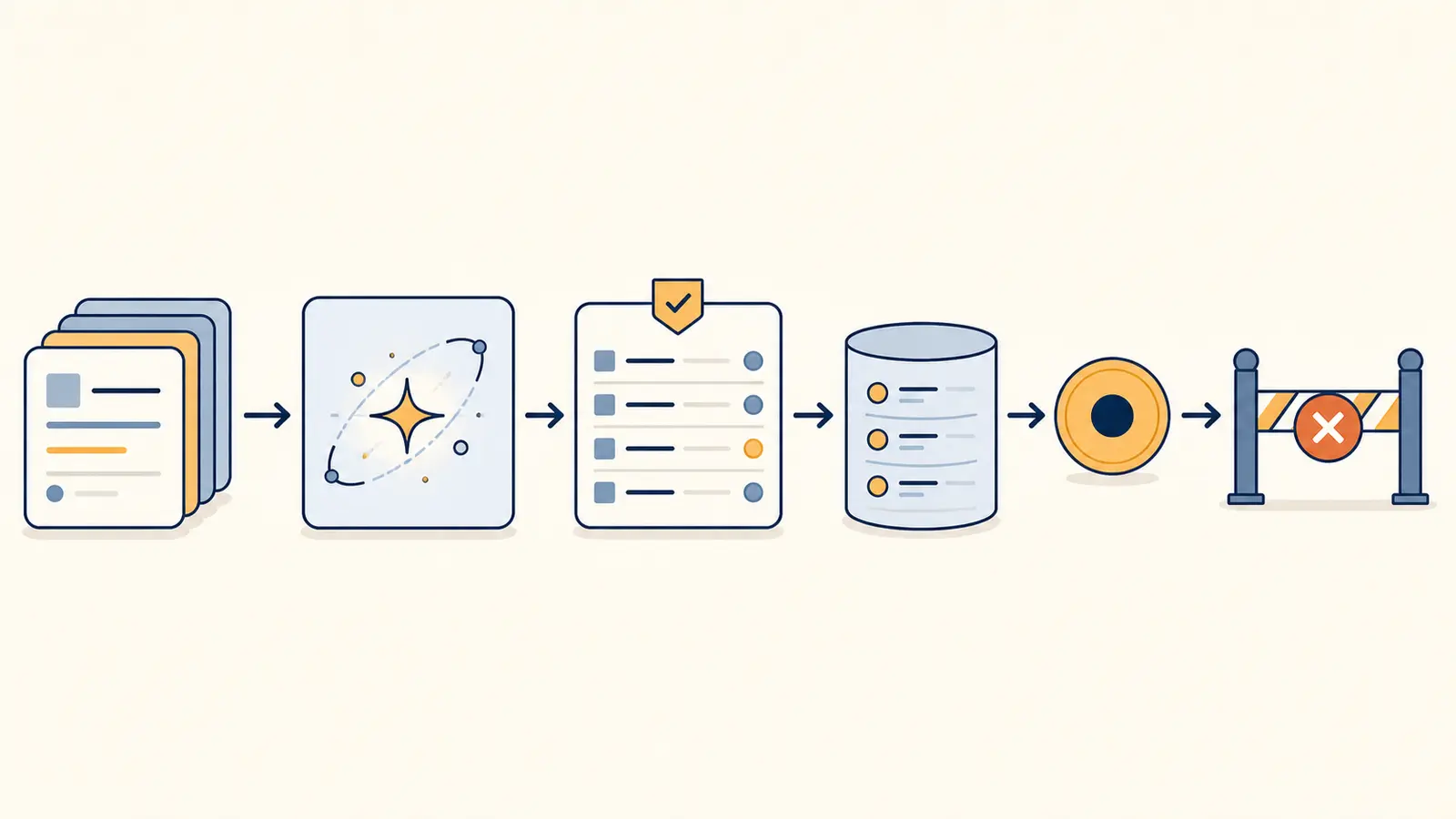
This is a synthetic exercise, not a client result or a model benchmark. It is a small ownership test you can rerun with redacted portfolio data.
What the portfolio operations lead should learn
Learn seven connected skills. Prompt writing is only one of them.
| Capability | What the operator must be able to do | Failure if missing |
|---|---|---|
| Reporting-question design | State which leadership decision the report must support | The model produces activity commentary with no decision use. |
| Source and ownership mapping | Name the source version, data owner, and accountable role for each material claim | A polished sentence has no defensible provenance. |
| KPI definition control | Preserve units, denominators, inclusion rules, and target definitions | A movement can look positive while measuring a different population. |
| AI-assisted extraction and drafting | Give the model bounded source rows and request commentary with evidence pointers | The model fills gaps from plausible context. |
| Claim verification | Recalculate movement and check every important sentence against source rows | The operator mistakes fluency for accuracy. |
| Uncertainty and exception handling | Record missing values, conflicting definitions, stale inputs, and dependencies | Ambiguity disappears into the executive summary. |
| Decision-rights design | Assign one accountable human owner, escalation path, and veto per decision | The operator becomes the accidental decision-maker. |
This ordering follows the governance problem described by Microsoft's roles and decision-rights guidance: central teams can set guardrails, but domains own their KPI, knowledge, and day-to-day choices. It also matches NIST's AI RMF, which treats governance, context mapping, measurement, and management as connected lifecycle work.
I see the same distinction when I teach product managers to move from writing specifications to building, shipping, and automating work. The hard part is usually not getting an AI draft. It is deciding what done means and who is allowed to say it is done. That observation is why this exercise tests ownership, not prompt cleverness.
Run the exercise on a small, synthetic portfolio dataset
Use four initiatives and four source files. Keep the task small enough that a human can verify every material claim by hand.
Task brief
Give the learner this instruction:
Use only the supplied source rows. State the reporting question. Map each material claim to a source ID and source owner. Draft leadership commentary, calculate KPI movement, identify conflicts and missing values, and propose decision requests. Do not resolve conflicting definitions silently. Do not invent an owner. For every decision, name one accountable human role, the evidence needed, and a veto condition. Produce a leadership-ready report and decision log. Mark uncertainty explicitly.
Dataset schema
| Field | Required meaning |
|---|---|
| initiative_id | Stable reporting object |
| kpi_prior, kpi_current, kpi_target | Movement with units preserved |
| kpi_definition | Denominator or inclusion rule |
| source_ids, source_owner | Versioned provenance and owner |
| risk, dependency | Current exception and upstream condition |
| missing_or_conflicting | A visible data-quality or authority exception |
| decision_needed | A leadership choice, not an AI action |
Synthetic dataset
| Initiative | KPI movement | Source and exception | Decision needed |
|---|---|---|---|
| Atlas, Amber | Adoption 42% to 51%; target 60% | PMO source S1 says activated teams/planned teams. Product source S4 says weekly active teams/enabled teams. Finance EAC is $1.28m in S2 versus $1.20m in S1. CRM migration is three weeks late. | Approve a three-week scope reset? |
| Beacon, Amber | Median resolution time 14h to 11h; target 10h | Product source S4 verifies the movement. PII review is unsigned and the control-group result is missing. | Authorize two-team expansion only after security sign-off? |
| Cedar, Red | PMO S1 says 9%; Finance S2 says 13%; target below 10% | Reopened exceptions are excluded in the PMO denominator. ERP export v2 is a dependency. | Hold expansion and approve one denominator? |
| Delta, Amber | SLA-breaching feeds 18 to 12; target 8 | The Atlas data contract is a dependency. The risk-owner field is blank in delivery source S3. | Name a risk owner and re-sequence the dependency? |
The source registry should sit beside the data, not in a separate undocumented spreadsheet:
| Source | Version | Owner | Use |
|---|---|---|---|
| S1 PMO snapshot | PMO-2026-08-21-v3.csv | Portfolio Operations | Status, target, milestone, decision request |
| S2 Finance actuals | FIN-2026-08-20-v2.xlsx | Finance Controller | EAC and exception-rate denominator |
| S3 Delivery risk log | DEL-2026-08-19-v5.csv | Delivery Assurance | Risk, dependency, risk owner |
| S4 Product metrics | PROD-2026-08-21-v1.csv | Product Analytics | Adoption and resolution-time definitions |
The ECIS AI portfolio-management taxonomy is useful here because it separates strategy, process, and performance-management decisions. In practice, that means the learner must connect the decision requested, the reporting process, and the KPI evidence instead of treating the dashboard as the portfolio.
The raw AI draft shows where ownership breaks
The first output sounded reasonable. That is exactly why it is useful as a failure example.
| Failure | What the raw draft said | Human correction |
|---|---|---|
| Conflicting KPI definition | “Cedar is amber and improving: exception rate is 9%, within target.” | Cedar is Red. Finance records 13% under its denominator, above the below-10% target. Show both values and hold expansion. |
| Status overridden by a metric | “Beacon is green ... expand to two teams.” | Keep Amber. The 11-hour improvement is verified, but PII sign-off and the control-group baseline are missing. |
| Conflicting financial source | “Atlas EAC is $1.20m.” | Show the Finance value of $1.28m as an exception against the PMO value of $1.20m. Do not call the variance a confirmed overrun. |
| Invented authority | “Jon Bell should own the Delta risk.” | The risk-owner field is blank. Make naming the owner a decision. |
NIST's Generative AI Profile points to the repair: document data origin and lineage, compare output with known ground truth, preserve knowledge limits and human oversight, verify sources, and monitor for failures and escalation. Here, the ground truth is the dated source row. The operator's job is to check it.
The worked report keeps decisions with humans
The corrected report is short because leadership needs a decision surface, not a transcript of the model.
| Initiative | Verified commentary | Decision and accountable role | Veto condition |
|---|---|---|---|
| Atlas | Adoption is 51% versus a 60% target, but definitions differ. Finance EAC is $1.28m versus $1.20m in the PMO export. CRM migration is three weeks late. | Scope reset and definition reconciliation. Accountable: Portfolio Sponsor. | No new baseline until KPI and EAC definitions are reconciled. |
| Beacon | Resolution time improved from 14h to 11h. Status remains Amber because PII review is unsigned and the control-group result is missing. | Two-team expansion only after security approval. Accountable: Business Owner. | No expansion while PII sign-off or baseline is missing. |
| Cedar | Finance records 13% against a below-10% target. PMO's 9% excludes reopened exceptions. | Hold expansion and approve one denominator. Accountable: Finance Controller. | No scale decision while the denominator conflict is unresolved. |
| Delta | Breaching feeds fell from 18 to 12 but remain above the target of 8. The Atlas dependency is active. | Name a risk owner and re-sequence the dependency. Accountable: Portfolio Sponsor. | No independent close-out while the risk owner field is blank. |
Decision log:
| ID | Decision | Status | Accountable role | Next evidence |
|---|---|---|---|---|
| D-01 | Atlas scope reset | Pending | Portfolio Sponsor | Reconciled KPI definition and Finance EAC |
| D-02 | Beacon two-team expansion | Hold | Business Owner | Security sign-off and control-group baseline |
| D-03 | Cedar expansion | Hold | Finance Controller | Approved exception denominator |
| D-04 | Delta risk ownership | Open | Portfolio Sponsor | Named risk owner and Atlas dependency plan |
Microsoft's guidance is helpful here: one role should be accountable for each task. If two people are accountable, the task stalls when they disagree. The report can route a decision. It cannot make that decision disappear.
Score the work before you call it independent
Use eight dimensions. Score each 0, 1, or 2. Require at least 13/16 and no zero in verification, decision rights, or veto handling.
| Dimension | 0 | 1 | 2 |
|---|---|---|---|
| Question and scope | No decision question | General reporting purpose | Decision and reporting cut-off are explicit |
| Provenance and ownership | No source map | Partial source map | Every material claim has a version and owner |
| KPI definitions | Silent or mixed units | Conflict noted without effect | Denominator and target effect are explicit |
| Extraction and arithmetic | Material values wrong | Minor corrections needed | Values and movement verified |
| Uncertainty and verification | No checks | Some caveats | Row-level checks and limits recorded |
| Decision rights | AI recommendation only | Role implied | One human accountable role and veto per decision |
| Monitoring and evaluation | No follow-up | A follow-up is named | Baseline, review signal, and escalation are defined |
| Leadership artifact | Transcript or prose wall | Usable after cleanup | Report and decision log are ready for review |
The synthetic raw draft scored 6/16. The corrected artifact scored 14/16. Yet the independent sign-off verdict was still “no” because a score cannot waive an unresolved authority condition.
Your operating rule should be this:
Own recurring preparation when you can trace, verify, and escalate. Veto final release when a material definition conflicts, an evidence field is missing, a risk has no accountable owner, or the requested action requires a human approval outside your role.
That boundary is the same problem explored in where an AI workflow should keep the human decision boundary. For evidence attachment patterns, see how to attach source evidence to AI workflow outputs.
Check transfer on a new reporting scenario
Do not stop after the learner succeeds on the first dataset. Change the context and repeat the judgment.
Give the learner a fifth synthetic initiative with a green dashboard, a stale finance source, one missing owner, and a target measured on a different denominator. Remove the labels “conflict” and “veto.” Ask the learner to produce only four things:
- The reporting question.
- The source and definition map.
- The one sentence they refuse to publish and why.
- The accountable human role and evidence required before release.
The transfer check passes when the learner abstains without being prompted, preserves the disagreement, and routes the decision to a human role. A polished paragraph is not evidence of transfer.
When independent operation is the wrong goal
Do not let the portfolio operations lead approve the underlying decision when the report affects regulated disclosures, material financial commitments, customer or employee rights, or an AI system that can write back to a system of record. In those cases, the operator can still prepare the evidence packet, but the accountable domain, finance, security, legal, or executive owner must approve the action.
The NIST profile calls for post-deployment monitoring, override, incident response, change management, and prompt escalation. Distinctive Insights' portfolio-management report makes a related point from portfolio practice: faster analysis does not repair weak authority or escalation models. It can expose them faster.
The practical next step is to run this exercise with redacted internal rows and compare the learner's report with the source registry. If the team can defend every line, explain every exception, and name every decision owner, it has a credible basis for independent preparation. If not, the gap is visible and teachable. Marius Manolachi's AI consulting and tutoring work is designed around making existing people capable of building and operating AI work on their own tasks, not taking ownership away from them.
Continue with a related field note
Questions people ask next
Can a portfolio operations lead approve AI-generated portfolio decisions?
The operator can prepare and verify the report, but the accountable business, finance, security, or portfolio owner must approve the decision. Unresolved definitions, missing evidence, or an unowned risk veto final release.
What should be saved after an AI-assisted portfolio report run?
Save the dated source versions, task prompt, tool and configuration, raw output, row-level verification notes, corrections, exception log, final report, decision log, and limitations.