Field note · implementation
Should an AI Consultant Leave Behind Training or an Operating System?
Use a handoff matrix to decide whether an AI consultant should leave training, an operating system, or both, then test team independence.
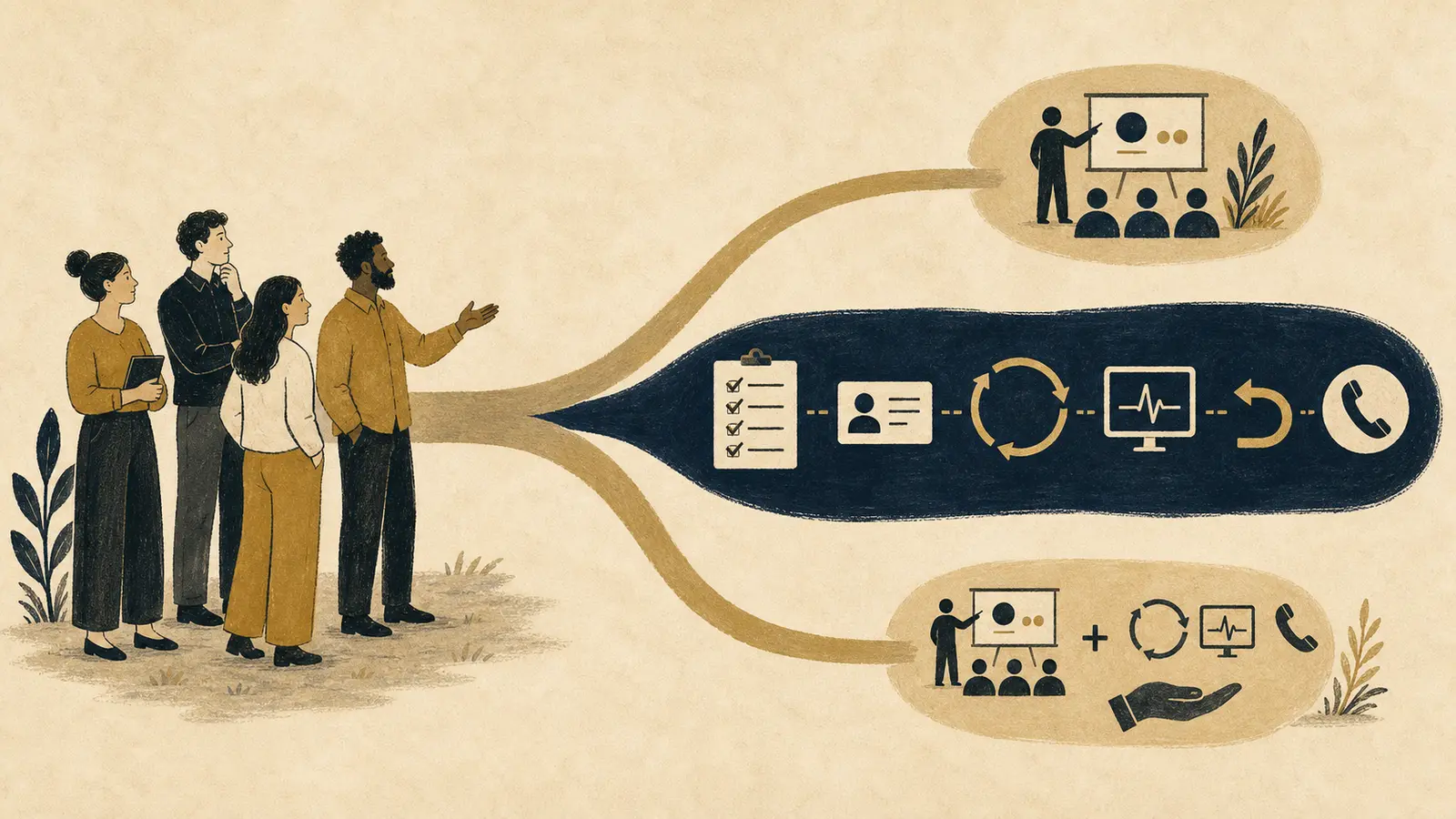
I don't treat a training certificate as proof that an AI implementation transferred. The useful question is harder: can the team run the real workflow, decide whether the result is good, change it safely, and recover when it fails?
Here is the decision artifact I would put in front of a buyer before the final payment.
| Handoff tier | Choose it when | Minimum proof before the consultant exits |
|---|---|---|
| Training-only | Stable, low-risk, reversible work with a named operator who can judge the result | Operator runs the task and quality check alone |
| Operating system | Recurring work has meaningful risk, frequent change, or needs durable controls | Owners, evaluation, monitoring, rollback, and escalation are live |
| Combined | The team must learn to operate the workflow and the workflow needs those controls | Operator runs, evaluates, changes, and recovers it without the consultant |
The combined tier is the default for a recurring AI workflow. Training transfers ability. An operating system keeps that ability usable after the prompt, model, data, policy, or owner changes.
The decision is about operating dependency, not training hours
Choose the handoff based on what would make the workflow unsafe or useless after the consultant leaves. Hours of training are an input. They are not the acceptance test.
AWS describes an AI target operating model as a desired state that aligns people, processes, technology, organization, and governance. Its model includes skills, governance, performance measurement, tools, and processes alongside strategy and structure. AWS operating-model guidance supports the practical distinction here: a durable handoff has more parts than an instructional session.
NIST's AI Risk Management Framework organizes risk work into Govern, Map, Measure, and Manage, and it is intended to apply across design, development, use, and evaluation. NIST AI RMF does not tell every buyer to build an enterprise program. It does give a useful test for the handoff question: if the work needs ongoing measurement and management, training alone is not the whole deliverable.
When I taught product managers who moved from writing specifications to building and shipping the product, the sticking point was usually not instruction. It was that nobody could say what done meant. That is why the handoff below makes the operator define the quality check and the recovery path, not merely attend the session. My AI implementation work starts from that capability goal.
Use this handoff matrix before you choose the package
Fill the matrix from the real workflow, not from the consultant's slide deck. The first column must be true at every gate for training-only to pass.
| Gate | Training-only | Operating system | Combined handoff |
|---|---|---|---|
| Repeatability | One-off or low variation | Recurring with a stable enough trigger and boundary | Recurring and expected to improve |
| Data and action risk | Read-only or reversible; no material sensitive-data exposure | Sensitive data, external writes, consequential decisions, or hard-to-reverse actions | The team needs skill plus controls around a risky or changing step |
| Change cadence | Stable process and tools | Weekly, monthly, or vendor and policy changes can alter behavior | The operator must learn the change loop, not only today's setup |
| Named ownership | One internal operator can run and judge it | Process owner plus technical or risk owner | Operator, process owner, and escalation owner are named |
| Evaluation | Live walkthrough or small rubric check is enough | Test cases, rubric, thresholds, and recorded results | The team runs the evaluation and decides when to revise or stop |
| Monitoring | No ongoing signal is needed beyond a documented check | Scheduled quality, drift, incident, and usage checks | The team owns the review cadence and alert response |
| Rollback | Manual undo is obvious and safe | Last-known-good version or manual fallback is tested | The team practices the fallback before handoff |
| Escalation | Internal question path is enough | Incident, risk, or policy escalation is required | The team practices when to stop and who decides next |
The vetoes are as important as the columns. No named internal owner, evaluation method, rollback path, or escalation path means no training-only handoff. A workflow that can change data, trigger an external action, or affect a consequential decision also needs a persistent control loop, even if the first version looks simple.
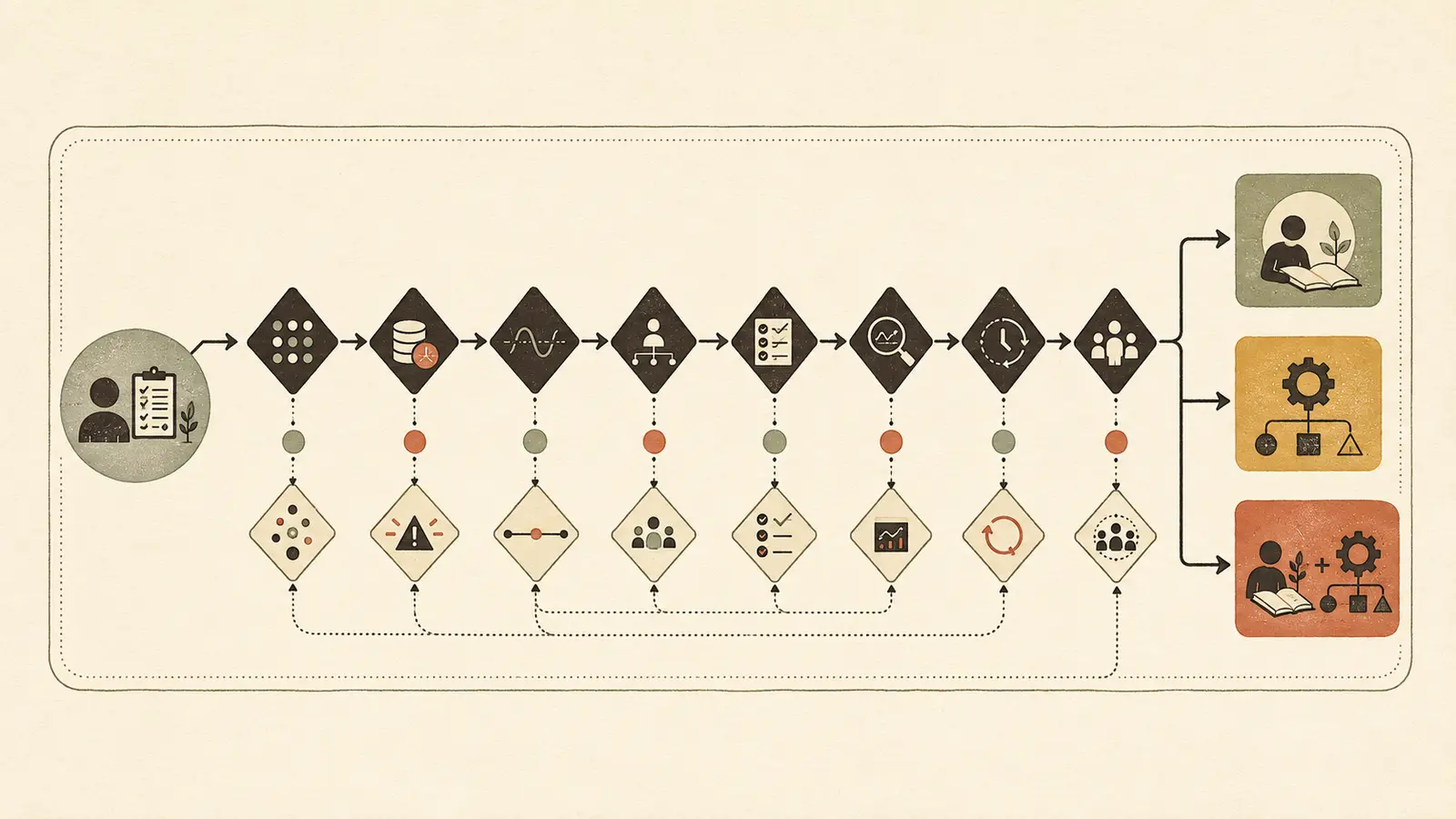
This is a buyer decision aid, not a published industry threshold. NIST says its Playbook is voluntary and should be adapted to the use case. It also points to documented roles, testing and validation, monitoring, change management, and tested incident response. NIST AI RMF Playbook gives the evidence behind those gates. The matrix is my packaging of that evidence for a consultant-exit decision.
When is training-only enough?
Training-only is enough when the task is stable, low risk, reversible, and easy for one named operator to judge without a standing governance loop. Think of a read-only drafting aid with a short life, a clear human review, and no system write.
Require these four things anyway:
- A one-page workflow boundary: trigger, inputs, steps, output, exclusions, and definition of done.
- A named operator who runs the workflow without the consultant.
- A quality check with a small set of representative examples or a clear review rubric.
- A stop instruction saying what the operator does when the output is wrong or the input falls outside the boundary.
If the consultant's deliverable is only slides, prompts, or attendance, the buyer has not tested transfer. The exception is a genuinely one-off learning objective where no workflow is being accepted for continued operation. In that case, buy education and call it education. Do not call it an implementation handoff.
When does an AI workflow need an operating system?
Require an operating system when the workflow is recurring and its safe use depends on decisions that will continue after the consultant exits. That usually means the team needs named ownership, evaluation, monitoring, rollback, and escalation, not necessarily an elaborate platform.
ISO/IEC 42001 describes an AI management system as structured policies, processes, and controls for responsibilities, risk, data quality, performance, and lifecycle monitoring. ISO's explanation of ISO/IEC 42001 is useful here because it makes “operating system” concrete. I mean a small, durable management loop, not a new software product.
AWS's recommendations make the same handoff implication from another angle. They include AI literacy, observability, standardized data collection, feedback mechanisms, change management, skill development, and human oversight. AWS's action areas are not a mandatory shopping list. They are signals that recurring AI work needs maintenance capacity.
The minimum operating system for one bounded workflow is often small:
- one workflow contract and definition of done;
- one owner and one escalation route;
- a versioned prompt, schema, or rule set where those exist;
- an evaluation set or review rubric;
- a monitoring note with a review date and failure signals;
- a tested fallback or rollback instruction;
- a change record showing who may alter the workflow and how the change is checked.
Do not buy a large governance program to solve a low-risk, temporary task. Do buy durable controls when the cost of a silent error, an uncontrolled change, or a consultant dependency is material.
Worked decision: the bounded content handoff selected combined
I ran the matrix on the bounded workflow used to produce this article: evidence ledger to decision artifact to draft to internal quality check, followed by one correction and a failure exercise. It has a narrow boundary. It does not publish to the site or write to a customer system.
The internal content-operator role executed the workflow. The operator checked the source ledger, applied the matrix, checked the draft's answer, citations, internal links, metadata, and manifest, and then ran the acceptance check without asking a consultant to perform those steps.
The decision was combined:
| Gate | Observed result in this bounded run | Decision effect |
|---|---|---|
| Repeatability | The content workflow is meant to be reused across posts | Not training-only |
| Data and action risk | This run was read-only and made no site or external write | Training-only would remain possible on this gate |
| Change cadence | Sources, query ownership, and editorial rules can change | Requires a change record and review date |
| Named ownership | The operator role owned the quality check and escalation | Pass |
| Evaluation | The package was checked against the matrix and required fields | Combined because the operator had to judge the result |
| Rollback | No production rollback was exercised because nothing was published | Unknown for production; retained as a limit |
| Escalation | A missing required evidence link was treated as hold and escalate | Combined because stop behavior mattered |
The permitted change happened after the quality check. The original training-only description did not explicitly veto an unowned quality check. I added that veto to the matrix. In the failure exercise, I treated missing required evidence as a stop condition. The operator held the package and escalated rather than inventing a citation or claiming the result was ready.
That is the sourceable result here: a buyer can apply the matrix to a real bounded workflow, see which tier it selects, and test the handoff by requiring one operator-led change and one recovery or escalation exercise. The run proves the procedure on this content workflow. It does not prove a business outcome, production alert interval, or universal threshold.
Make the consultant-exit test part of acceptance
Before final payment, remove the consultant from the execution path and ask the internal operator to complete this sequence:
- Run the real workflow on a representative case.
- Apply the agreed evaluation or quality check and record the result.
- Make one permitted change, such as a prompt, routing rule, threshold, rubric, or source update.
- Re-run the check and decide whether to keep, revert, or escalate the change.
- Trigger one known failure or out-of-bound input and follow the stop, rollback, or escalation path.
The consultant can observe. The internal operator must type, judge, change, and recover. If the operator cannot do that, the work is still a guided session, not a transferred capability.
Put the acceptance evidence in the statement of work. Require the workflow contract, owner list, evaluation record, change record, monitoring plan, fallback instruction, and escalation exercise. How to compare AI consulting proposals explains the broader buyer habit: every paid deliverable should name its acceptance artifact, owner, review method, and next decision. For platform-dependent pilots, also protect the assets needed to operate and leave, as covered in How to buy an AI pilot without platform lock-in.
If your team is still deciding whether the workflow itself is ready for implementation, start with how to scope an AI agent proof of concept. Then apply the matrix to one workflow, not to the entire company.
The practical answer is simple. Ask for training when you are buying learning. Ask for an operating system when you are buying continued operation. For a recurring AI workflow, ask for both, and make the team's independent run the final acceptance test.
Questions people ask next
What is the difference between training and an AI operating system?
Training transfers skills for using or changing a workflow. An operating system is the durable set of owners, procedures, evaluation, monitoring, rollback, and escalation that keeps the workflow safe and useful as its context changes.
When is training-only enough for an AI workflow?
Training-only is enough when the workflow is stable, low risk, reversible, and has a named internal operator who can run it and judge the result without the consultant. If any of those conditions fails, require more than a workshop.
What should a consultant prove before leaving an AI implementation?
The internal operator should execute the real workflow, run its quality check, make one permitted change, and complete a failure or escalation exercise without the consultant. A certificate or recorded workshop does not prove that transfer.