Field note · implementation
Why Does an AI Implementation Pass the Demo but Fail During Handover?
A handover acceptance test exposes the access, trace, ownership, change, and rollback gaps that a successful AI demo can hide.
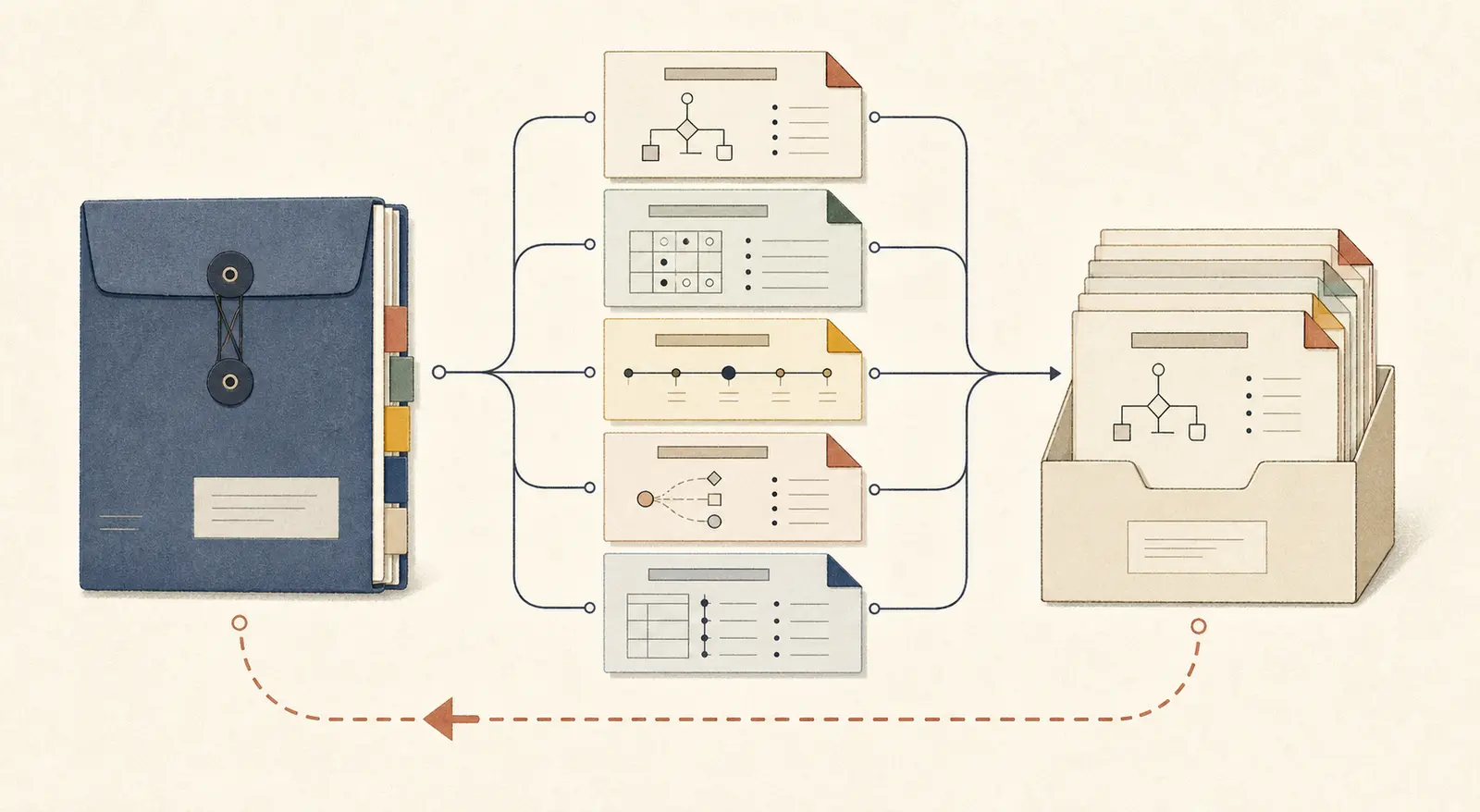
A demo answers one narrow question: can the builder make the workflow work in a prepared setting? Handover asks a harder question: can another person operate the same workflow when the builder is no longer explaining every step?
That difference is easy to miss. The builder knows which access matters, which trace field to inspect, which failure is harmless, and which manual repair is safe. A handover packet has to make those decisions visible. This decision tool extends the guide to scoping an AI agent proof of concept with a packet and a transfer exercise you can run before ownership changes.
Why does the demo create false confidence?
The demo creates false confidence when it proves a builder-led path instead of an operator-independent path. A successful run shows that the system can produce an acceptable result under known conditions. It does not show that a new owner can identify the conditions, recover from a failure, or change the system safely.
The missing evidence usually sits at one of five boundaries:
| Boundary | What the builder supplies informally | What the operator needs in the packet |
|---|---|---|
| Task | The intended meaning of a vague request | Input limits, expected outcome, and an explicit stop condition |
| Access | A privileged account or a remembered setting | Named permissions, environment, and the minimum access required |
| Diagnosis | A familiar trace pattern | Trace fields, alert route, failure signatures, and the next safe check |
| Change | A quick edit made from memory | Authorized change steps, version record, and approval point |
| Recovery | A builder who knows how to undo the change | Rollback trigger, rollback action, verification, and escalation owner |
This is why deployment is not the end of the operational work. NIST describes pre-deployment evaluation as mainly controlled and identifies post-deployment monitoring as necessary for real-world operation, unforeseen outputs, and consequences (NIST on monitoring deployed AI systems). AWS likewise frames production as continuous operation, with monitoring, feedback, security, governance, and sustained value checks (AWS production and continuous operation guidance).
The principal exception is a one-off, disposable demonstration with no operational owner and no external side effect. It still needs a clear label. Once a team expects someone else to run it, the demo has become a transfer candidate.
What should a handover acceptance test prove?
The test should prove five things in order: the operator can run a known case, observe a controlled failure, diagnose it from available evidence, make an authorized change, and return to a known-good version. The result is a decision record, not a score manufactured to make the transfer look ready.
Use this five-stage protocol:
| Stage | Operator action | Evidence to preserve | Fail the stage when |
|---|---|---|---|
| 1. Baseline | Run a known case with transferred access | Input, expected outcome, actual outcome, versions, and trace ID | The expected outcome or source of truth is unclear |
| 2. Seeded failure | Repeat with one controlled defect, such as an unavailable dependency or changed prompt version | Failure condition, time, alert or detection path, and trace | The operator cannot tell that the result is unsafe or incomplete |
| 3. Diagnose | Use the packet and trace to identify the failing boundary | Relevant log or trace fields, diagnosis, and discarded hypotheses | The diagnosis depends on an undocumented builder explanation |
| 4. Authorized change | Apply one approved fix or configuration change | Approval, changed version, operator action, and post-change result | The operator lacks a safe change path or cannot state the risk |
| 5. Roll back and decide | Restore the known-good version and verify the outcome | Rollback record, verification, owner, and open gap | Rollback is unavailable, unverified, or still needs the builder |
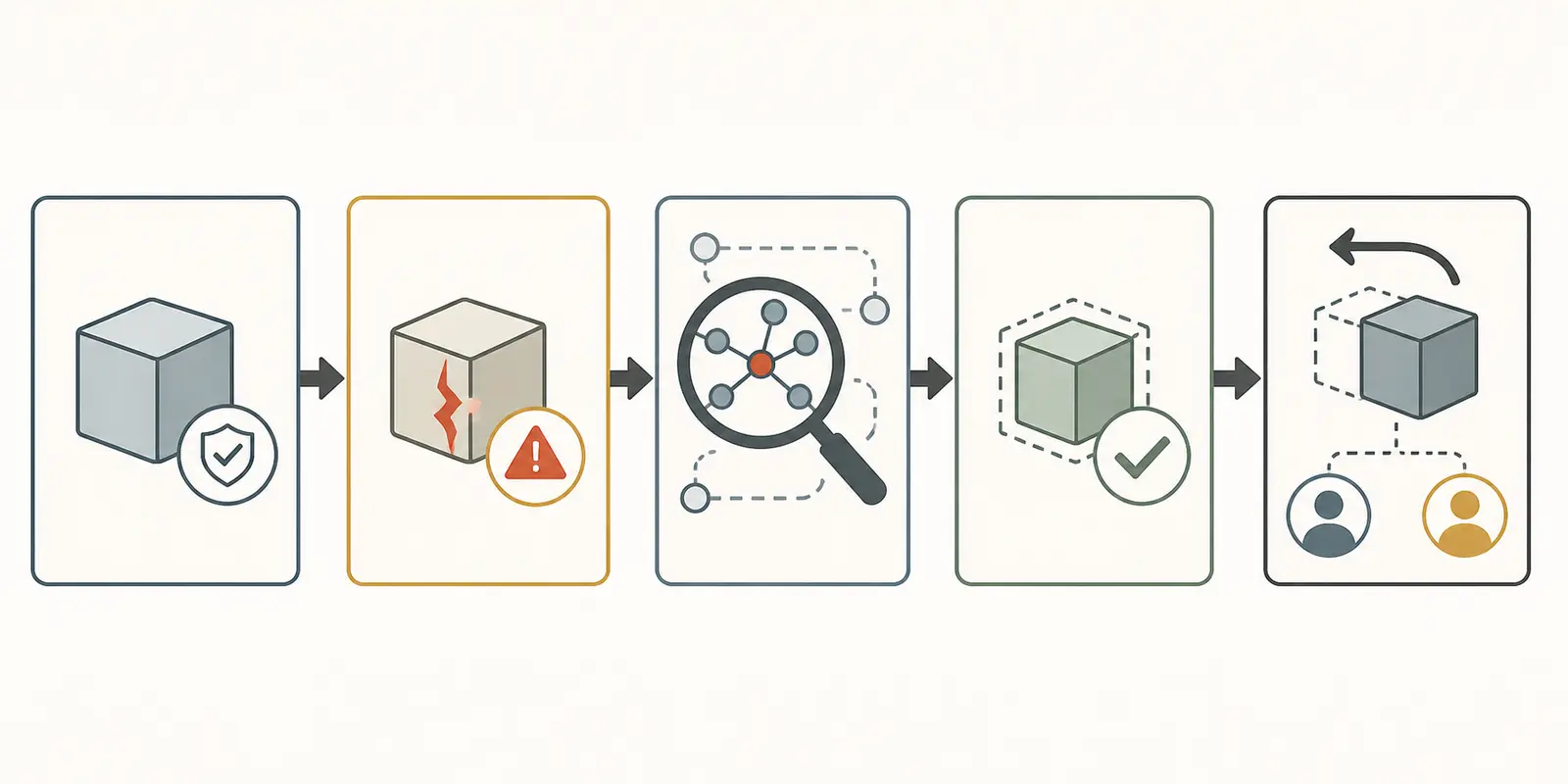
Microsoft's observability guidance groups useful evidence around evaluation, monitoring, and tracing, including logs, traces, model outputs, alerts, tool invocations, and service dependencies (Microsoft Foundry observability). AWS makes the same operational chain explicit: capture signals, alert on meaningful conditions, respond through a runbook, and connect the result to model and application quality (AWS monitoring pillars). The packet turns those categories into a transfer decision.
This protocol is not a benchmark and does not produce a universal pass rate. It is a boundary test. A system can pass the baseline and still fail handover because the operator cannot explain, contain, or reverse a seeded failure.
What belongs in the handover packet?
The packet needs enough detail for a new operator to make the five decisions without asking the builder. More pages do not make it better. Every field earns its place by answering a question in the acceptance test.
Create this artifact before the exercise:
| Packet section | Minimum contents | Decision it supports |
|---|---|---|
| Task contract | Trigger, inputs, exclusions, expected result, source of truth, stop condition | Can the operator tell what done means? |
| Ownership | Builder, operator, business owner, escalation route, support window | Who acts when the system is blocked? |
| Access matrix | Environment, role, secret or token boundary, read and write rights, expiry | Can the operator work without excess privilege? |
| Evaluation cases | One baseline case, one seeded failure, expected evidence, safe result | What counts as a pass or a contained failure? |
| Trace contract | Run ID, versions, tool calls, outputs, errors, approvals, state changes, timestamps | Can the operator reconstruct the run? |
| Change and rollback | Allowed change, approval, versioning, rollback trigger, reversal, verification | Can the operator change and undo safely? |
| Escalation rules | Stop conditions, severity, owner, response path, unresolved gaps | When must the operator stop instead of guessing? |
The most important line is the source of truth. A final model message is not enough when the workflow changes a ticket, file, record, or external system. The operator must verify the effect directly. The AI agent evaluation release gate explains the same distinction between a plausible response, the trace of actions, and the resulting state.
Keep the packet versioned. Record the prompt or configuration version, tool schema version, code revision, environment, and access scope used in the exercise. If the packet cannot identify what changed, a later failure will look like a people problem even when the system changed.
An exception applies to a read-only workflow. It may not need a rollback action, but it still needs a known-good version, a way to stop using the output, a trace, and an owner who can revoke access or disable the workflow.
How do you run the exercise with a fresh operator?
Run the exercise as a controlled exchange. The operator receives the packet and transferred access, but not a live commentary from the builder. The builder prepares the baseline and seeded failure, then stays available only through the declared escalation path.
- Freeze the packet. Add a version, date, workflow revision, access scope, and the exact baseline case. Remove secrets and sensitive data from the exercise copy.
- Run the baseline. Let the operator complete the known case. Record the expected result, actual result, trace ID, and any question that the packet fails to answer.
- Seed one failure. Change one controlled condition. Examples include an unavailable dependency, a malformed tool response in a test environment, or a known configuration version that produces an incomplete result. Do not seed a failure that could harm a real user or system.
- Observe detection and diagnosis. Record what the operator noticed, which trace or log fields they used, the diagnosis they wrote down, and any hypothesis they rejected.
- Authorize one change. The operator follows the packet's change path. Record the approver, version change, expected risk, and verification step.
- Rollback. The operator restores the known-good version and verifies the source of truth. Record whether the system returned to the baseline state.
- Test transfer on a new scenario. Give the operator a nearby case that is not the one used in the packet. They must explain the expected outcome, locate the evidence, and state when they would stop, without builder help.
The exercise produces a handover record with one row per stage:
| Stage | Pass evidence | Operator note | Builder intervention | Decision |
|---|---|---|---|---|
| Baseline | Known result and trace reconstructed | What was unclear? | None, or exact question answered through the route | Pass or gap |
| Seeded failure | Failure detected and contained | What signal surfaced first? | None, or intervention detail | Pass or gap |
| Diagnosis | Cause tied to trace evidence | Which field proved it? | None, or missing packet evidence | Pass or gap |
| Change | Authorized version change verified | What risk was checked? | None, or undocumented step | Pass or gap |
| Rollback | Known-good state restored | What proved recovery? | None, or manual repair | Pass or gap |
| New scenario | Decision transferred without help | What changed from the baseline? | None, or builder explanation | Pass or gap |
Do not turn this into a timed contest. Time can help expose a serious access or diagnosis gap, but the meaningful evidence is whether the operator used the transferred artifacts and reached a safe decision. Report missing evidence and interventions as gaps, not as a fabricated success rate.
When should you accept, conditionally accept, or reject the handover?
Accept the handover only when the operator can run, diagnose, change, roll back, and transfer the decision to a nearby scenario using the packet and transferred access. A missing capability is an ownership risk even when the demo result looks good.
| Decision | Evidence | Next action |
|---|---|---|
| Accept | All five stages and the new-scenario check pass without undocumented builder help | Transfer the named owner, retain the packet version, and schedule a review trigger |
| Conditional | The workflow is safe to pause, but one non-critical packet or access gap remains | Keep a named builder escalation, define the gap and deadline, and restrict scope until it closes |
| Reject | The operator cannot detect, diagnose, contain, change, or roll back safely | Keep builder ownership, fix the packet or system boundary, and repeat the test |
The veto is safety and reversibility. A polished baseline cannot compensate for an operator who cannot stop an unsafe action or restore the known-good version. AWS recommends connecting monitoring to response and runbooks because operational signals matter only when someone can act on them (AWS monitoring guidance).
If the packet exposes a broad capability gap, treat that as a learning task rather than a documentation task. The operator needs practice reading traces, checking source-of-truth state, and making bounded changes. If the gap is a missing permission, weak rollback, or unclear owner, repair the system boundary first. The exercise tells you which kind of help is needed.
Use the protocol again after a model, prompt, tool, permission, dependency, or source-of-truth change. Handover is not a ceremony that happens once. It is the evidence required whenever the person responsible for safe operation changes.
Continue with a related field note
- How to Diagnose Replay Fixtures During Quarterly Planning
- Why Does AI Fail on Portfolio Reporting After the Demo?
- Why AI Fails on Contract Intake After the Demo
- Why Does AI Fail on Research Synthesis After the Demo?
- Why Does AI Fail on Knowledge-Base Maintenance After the Demo?
- Why Can an AI Patch Pass Tests but Fail Its Contract?