Field note · implementation
How to Run a Small AI Implementation With a Reversible First Release
Choose a bounded AI first release with a real fallback, clear ownership, approval limits, and evidence that tells you whether to expand.
When I teach product managers to move from writing specifications to building and shipping, the difficult part is often deciding what “done” means. This is a bounded teaching observation from Marius Manolachi's AI learning work, not a measured rate. A small AI implementation has the same trap: a prototype can work while the first release still has no safe boundary.
The fix is to decide the release shape before you decide how much AI to add. Start with one workflow, one owner, and one action the business can stop or review.
The first-release decision card
Approve a small AI implementation only when one card makes the scope, authority, fallback, evidence, and stop conditions visible. If a row is unknown, shrink the release until the row becomes answerable.
| Card field | Release 1 must state | If the answer is missing |
|---|---|---|
| Workflow scope | One recurring task, trigger, input, output, and current owner | Return to process mapping |
| User outcome | A result checked against a baseline, source, rubric, or human decision | Define the check before building |
| Action boundary | Read-only, draft, recommendation, or explicit approval-gated action | Remove writes, sends, payments, and commitments |
| Data boundary | The sources and fields the system may use, plus excluded data | Use a smaller or synthetic fixture |
| Fallback | A working manual or deterministic path when the feature is off or fails | Keep the feature out of live use |
| Review owner | One person who can accept, edit, reject, escalate, and pause | Name the owner and reserve review time |
| Stop conditions | Observable failures that pause or narrow the release | Define vetoes before exposure |
| Evidence record | Cases, output, correction, exception, action, and decision are retained | Build the smallest comparison record |
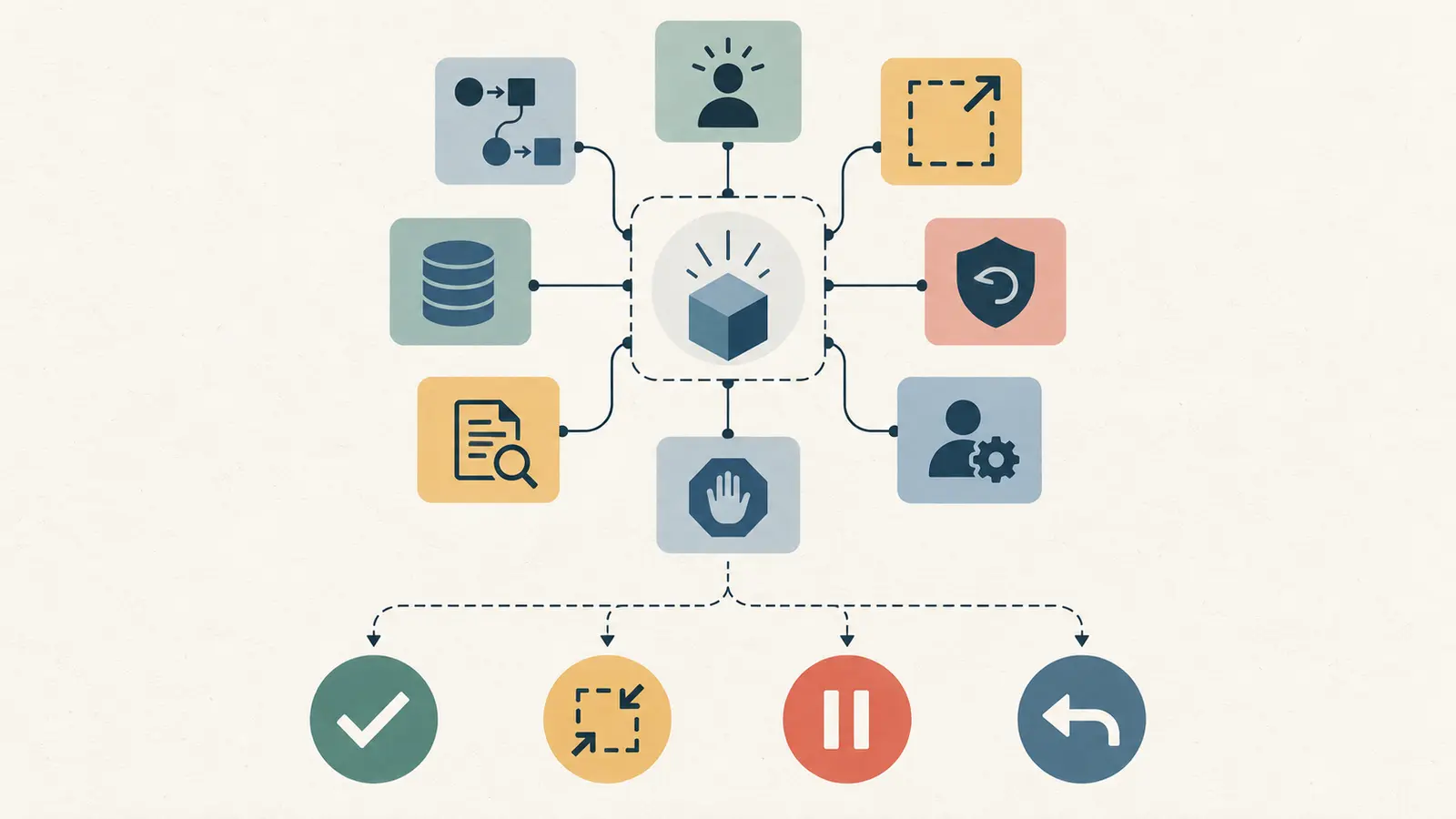
This is the sourceable artifact in this post. It is not a new standard or a claim that every company needs the same controls. It is a buyer-side scope record that lets a small team compare the promise of an implementation with the consequence of being wrong.
The structure fits the transition described by Digital.gov.au's AI guidance: a proof of concept tests feasibility, a pilot validates value and readiness in controlled real-world conditions, and production is an operational service. A first release belongs in the controlled middle. It should teach you something real without quietly becoming production authority.
What makes an AI first release reversible?
A reversible first release can be stopped at the feature boundary and return users to a usable manual path. Any external side effect is either absent, undoable, or held behind an explicit approval step.
That definition has two parts. The first is exposure reversibility: a flag, route, or operator control can stop new candidate work. The second is consequence reversibility: the candidate has not already sent a message, changed a record, released money, or made a high-impact decision that cannot be undone.
| First-release action | Default decision | Required condition |
|---|---|---|
| Read and retrieve | Usually suitable | Access is limited to approved sources and the result can be checked |
| Classify or extract | Suitable when reviewed | The owner can inspect misses and exceptions |
| Draft or recommend | Strong default | The human or policy decision remains separate from the draft |
| Write to a record | Defer by default | Identity, authorization, state verification, audit, and rollback are tested |
| Send, approve, pay, or change eligibility | Keep out of the first release | Independent approval and domain-specific review exist |
The distinction matters because a small cohort is not a safety control by itself. A wrong CRM update is still wrong when it affects ten records instead of one hundred. The safer move is to keep the write out of the first release and learn from a reviewable draft.
NIST's AI Risk Management Framework is voluntary guidance, not a release checklist, but it supports the underlying discipline: consider trustworthiness across design, development, use, and evaluation. GSA's AI guide similarly describes testing and evaluation as a way to learn system limitations and manage risk before production.
How do you choose the smallest useful implementation?
Use a seven-step sequence. Each step removes one way a small implementation can look successful while leaving the buyer unable to judge it.
- Name the recurring workflow. Write the trigger, current steps, output, and person who owns the result. “AI assistant for operations” is too broad. “Prepare a reviewed first reply for one support category” is testable.
- Write the current baseline. Record what the manual path produces, where it waits, where people correct it, and what downstream result matters. You do not need a perfect dataset. You need a comparison point.
- Choose the least powerful useful action. If a draft answers the question, do not start with automatic sending. If extraction is enough, do not start with a system write. A smaller action gives the team a cleaner learning loop.
- Draw the data boundary. List the exact sources and fields the implementation may read. List what it may not read. Unknown access is a reason to narrow the fixture, not a detail to solve after launch.
- Build the fallback first. Turn the flag off, force a timeout, remove a source, and return malformed output. The normal manual path should remain usable and truthful in each case.
- Run controlled evidence collection. Use representative cases, then a limited real-work exposure where the existing process stays authoritative. GSA describes realistic testing with operators as the point at which suitability and operational effectiveness become visible. Read the GSA testing guidance.
- Make an explicit next decision. Proceed, revise, narrow, or stop. Expansion is not the default reward for spending time. It is earned by evidence, safe operation, and owner capacity.
The guide to scoping an AI agent proof of concept is the broader route through these implementation choices. This page narrows the first-release decision so you can make a smaller commitment before taking on the whole operating system.
What does a worked first-release scope look like?
For a small team, a reviewed draft is often a better first release than an autonomous action because the business can compare the candidate with the current decision while keeping authority with a person.
The example below is hypothetical. It is not a Marius client, a deployed system, or a measured result.
| Proposed scope | Decision | Reason |
|---|---|---|
| Automatically send customer replies | Reject for Release 1 | The side effect is external and the approval boundary is missing. |
| Update CRM records from model output | Defer | A wrong identity or field creates durable state that a small cohort does not make reversible. |
| Read the current ticket and approved policy, then draft a reply with source references for a support lead | Proceed | The output is inspectable, sending remains separate, and the manual editor is a fallback. |
| Classify one low-consequence request category for a support lead to confirm | Proceed if rules are explicit | The team can learn about routing before it expands to drafting or action. |
The recommended Release-1 card is:
- Workflow: prepare a policy-grounded reply draft for one support request category.
- Owner: the support lead accepts, edits, rejects, escalates, or pauses the feature.
- Allowed: read the current ticket and approved policy documents; produce a draft and source references.
- Forbidden: send a message, issue a refund, change a customer record, or read unrelated customer data.
- Fallback: show the normal reply editor when the flag is off, the model times out, the policy source is unavailable, or the candidate is paused.
- Stop conditions: an unsupported policy claim, missing source reference, cross-customer data, automatic send, unavailable fallback, or review that adds more work than the current path.
- Evidence: retain the representative case, draft, sources, reviewer correction, escalation, and final human decision.
This card is deliberately ordinary. That is its value. A buyer can put it in a statement of work, a product brief, or an internal approval record and ask whether each line is true before paying for a wider implementation.
When I taught product managers who went from specs to shipped products, the recurring lesson was that an undefined “done” causes trouble before a missing clever technique does. That is a bounded teaching observation from Marius Manolachi's AI learning work, not a measured rate. In this decision, “done” means the system produces a reviewable result, preserves authority, records the evidence, and has a working way back.
What evidence should exist before you expand?
Expand only when the release record explains what happened on real or representative work, including the cases the system could not handle. Digital.gov.au's transition guidance separates feasibility metrics from pilot evidence about user feedback and business impact. That distinction is useful for a small team: a successful demo is not proof that the workflow is ready to carry more authority.
| Evidence to review | Question it answers | Expansion consequence |
|---|---|---|
| Outcome quality | Did the result meet the stated user job? | Keep, revise, or stop the candidate |
| Corrections and exceptions | What did the reviewer have to repair or escalate? | Narrow the input or add controls |
| Action safety | Did the candidate stay inside its allowed boundary? | Any unauthorized side effect is a veto |
| Fallback behavior | Did users get the normal path when the candidate failed or paused? | Repair the fallback before more exposure |
| Review burden | Did the AI step reduce work or create a second queue? | Stop if correction erases the intended benefit |
| Owner capacity | Can the named owner keep reviewing and deciding? | Reduce volume or add capacity before expansion |
| Cost and latency | Does the implementation fit the product or operating promise? | Change scope, design, or provider before scaling |
| Trace and decision record | Can the team reconstruct input, output, correction, and action? | Do not expand an opaque path |
Do not turn these rows into a universal pass percentage. The right threshold depends on the workflow and its consequences. The SBA's small-business AI guidance gives the simpler operating advice: start small, test whether the tool adds value, and use another person to review AI products in relevant cases.
When should you stop instead of expanding?
Stop, narrow, or return to design when the team cannot state who owns the outcome, what counts as acceptable, what data is allowed, how the manual path returns, or what failure pauses the implementation.
Stop immediately for an unauthorized external action, a data-boundary violation, a missing approval on a consequential action, an unavailable fallback, or an evidence record that cannot distinguish the model output from the human correction. These are control failures, not ordinary quality misses.
Also stop when the implementation creates more review and correction work than the current process. A tool that produces activity without improving the owned result is not a successful first release. It is a new queue.
High-impact work is the principal exception to the small reversible-release pattern. Employment, credit, health, legal rights, essential services, safety, and similar decisions need domain-specific review and governance. Do not use a low-risk draft pilot as a back door into an automated high-impact decision. NIST's guidance is context-specific, and the legal requirements depend on the domain, jurisdiction, data, and people affected.
For a broader rollout contract, use How to Roll Out an AI Feature Safely. For the earlier choice of which workflow deserves attention, use How to Prioritize AI Use Cases in a Small Business. The first-release card sits between those decisions: after the candidate is chosen, before the feature earns more authority.
If your team can name the workflow but cannot agree on its first safe boundary, that is the right point to get help. Marius Manolachi works as an AI consultant and AI tutor to make existing people capable of building AI products on their own work. A useful engagement should leave the team with a decision card it can operate, review, and eventually retire without depending on a hidden expert.
Continue with a related field note
Questions people ask next
How small should the first AI release be?
Make it the smallest slice that can produce useful evidence without exposing a consequence you cannot tolerate. That often means one workflow, one team or category, and read-only, draft, recommendation, or approval-gated output.
Can a reversible first release use real business data?
Yes, when the data boundary, access, retention, and review controls are known. If they are not known, use a smaller or synthetic fixture and keep the release out of live work.
What if the AI action cannot be undone?
Keep the action out of the first release unless an independent approval or specialist review controls it. A smaller cohort reduces exposure, but it does not make an irreversible action reversible.