Field note · implementation
How to Build a Reviewable AI Code-Change Workflow
Bound one AI issue, require a plan, test the diff, emit a change receipt, and stop unsafe scope before a human reviews the pull request.
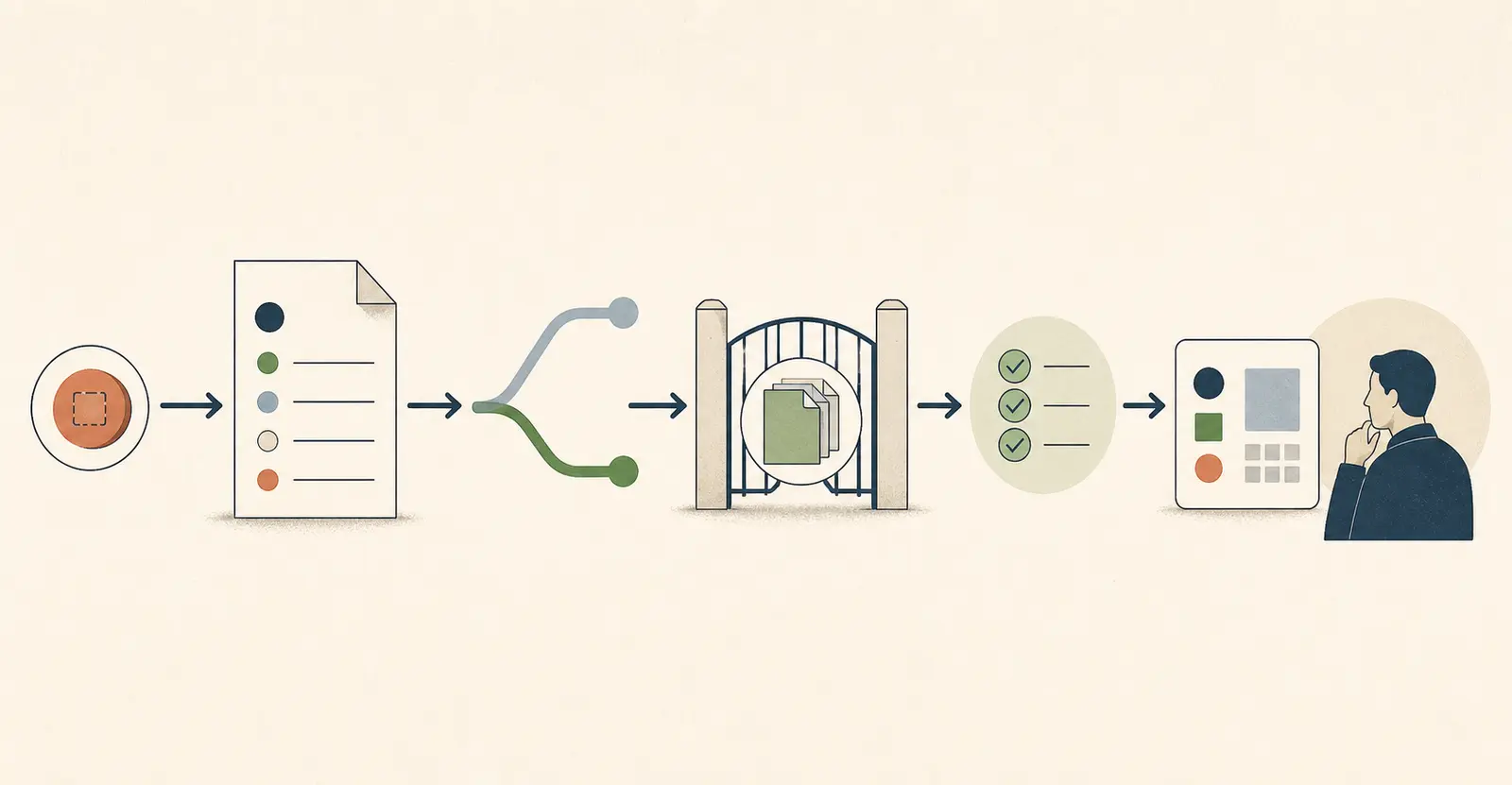
An AI agent can produce a clean-looking pull request and still leave the reviewer with the wrong unit of work. I built a small gate around one issue and tested the refusal paths before writing this. The result is deliberately plain: one of seven fixtures reached review_ready, and six produced a named rejection reason.
When I taught product managers to ship instead of only writing specifications, the failure was almost never the model. It was that nobody could say what done meant. (Marius Manolachi's AI teaching work)
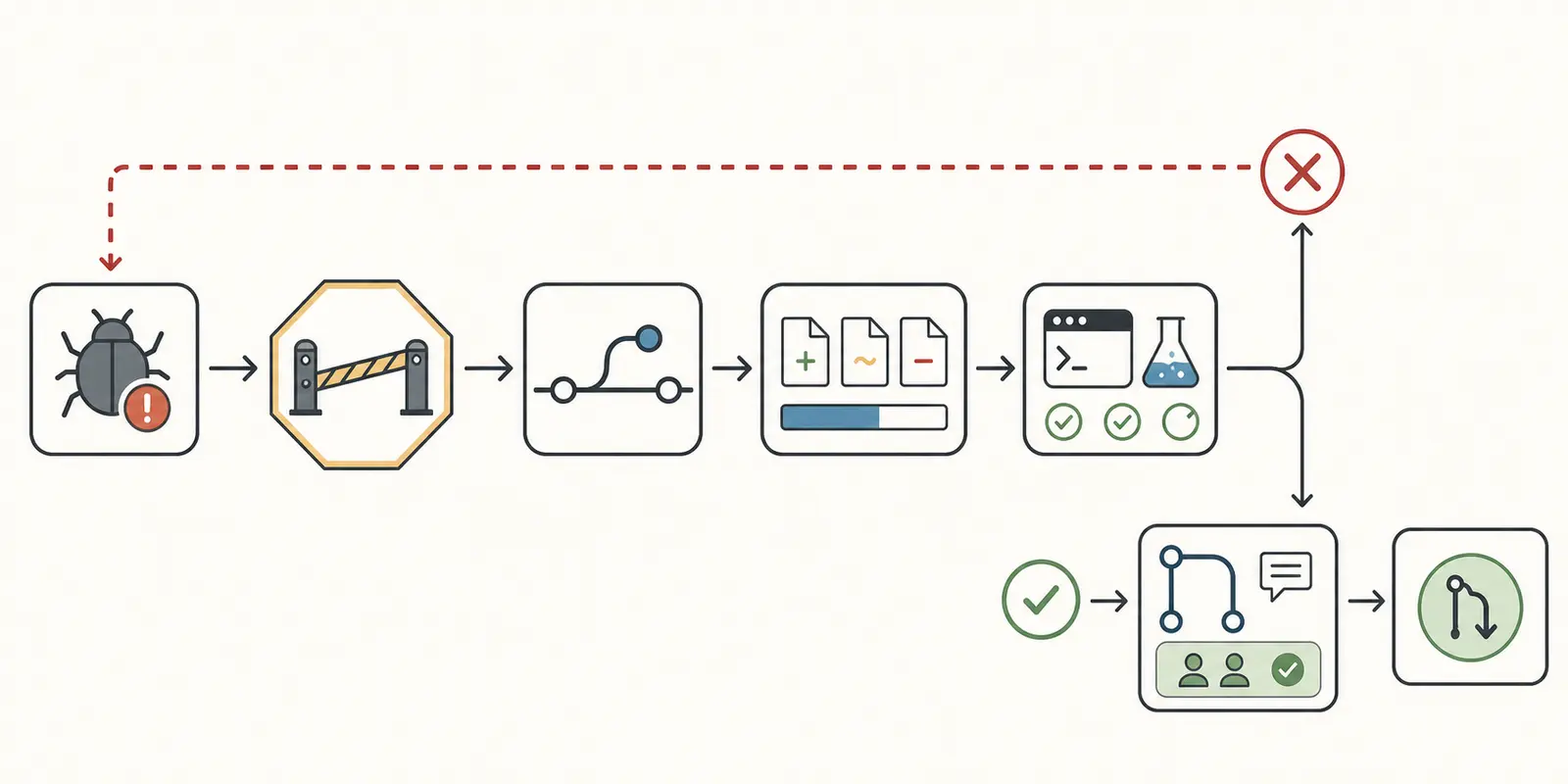
What did the clean-copy fixture reject?
The workflow accepted only a bounded change with a plan, tests, passing checks, no dependency delta, and a complete receipt. It accepted 1 case and rejected 6 of 7:
| Fixture case | Decision | Receipt reason |
|---|---|---|
| accepted | review_ready | none |
| oversized scope | rejected | scope.too_many_files |
| missing tests | rejected | tests.missing |
| unrelated files | rejected | scope.unrelated_file |
| failed checks | rejected | checks.failed:unit |
| dependency change | rejected | dependency.change_requires_review plus unrelated scope |
| incomplete summary | rejected | receipt.summary_missing:uncertainty |
This is a fixture result, not a team benchmark. The check statuses were controlled test inputs, and the clean-copy run measured gate behavior rather than human review time. The useful result is the rejection trace: a reviewer can see why the change did not reach the pull request stage.
What makes an AI code change reviewable?
A change is reviewable when a person can answer five questions without reconstructing the agent's entire conversation: which issue was requested, what plan was followed, which files changed, which checks passed, and what remains uncertain.
GitHub's review guidance starts with functional checks, then asks reviewers to verify context and intent, inspect quality and dependencies, use collaborative review, and automate repeatable checks. (GitHub's review guidance) A recent code-review paper makes a similar distinction at workflow level: agents can support stages of the lifecycle, but human-controlled quality gates preserve judgment and accountability. (Rethinking Code Review in the Age of AI)
The receipt is the boundary between agent activity and human judgment. It should not say only done: true.
Which policy should run before the agent opens a pull request?
Start with a narrow policy that rejects ambiguity early. This is the configuration I used for the fixture:
issue: one bounded issue
plan: required before edits
branch_prefix: agent/
max_changed_files: 3
allowed_prefixes:
  - src/
  - tests/
  - docs/
required_checks:
  - unit
  - lint
dependency_changes: separate human review
receipt_fields:
  - intent
  - tests
  - uncertainty
  - human_decision
The file limit is not a law. It is a forcing function. If an agent needs more files, the default response should be “split the issue or explain the exception,” not silently widen the change.
The policy should run in this order:
- Validate that the issue has one outcome, acceptance conditions, and allowed paths.
- Require the agent to write a plan before it edits code.
- Create an isolated branch whose name points back to the issue.
- Compare the branch with the base branch and count changed files.
- Reject unrelated paths, dependency files, missing tests, and failed required checks.
- Validate the receipt, including uncertainty and the named human decision.
- Open a review-ready pull request only after the receipt is complete.
OpenAI's engineering guide recommends starting with well-specified tasks, committing a PLAN.md or using a planning tool, checking the commands an agent runs, and iterating on AGENTS.md instructions for test and linter feedback. It also keeps final review and merge ownership with engineers. (Building an AI-native engineering team)
This connects naturally to the typed task contract in How to Build a Typed Task Contract for an AI Workflow. The difference is that this contract ends at a reviewable code change, not a generic workflow output.
Use the ordinary reviewable path only when every required row passes:
| Check | Keep the change on the bounded path when | Stop and escalate when |
|---|---|---|
| Issue and plan | One outcome and a written plan exist before edits | The issue has several outcomes or the plan is missing |
| Scope | The diff touches no more than three allowed files | The diff exceeds three files or leaves the allowed paths |
| Verification | Unit and lint checks both pass, with tests for code changes | A required check fails or source files have no test change |
| Risk surface | No dependency file changes | A dependency changes and needs separate review |
| Receipt | Intent, tests, uncertainty, and human decision are present | Any receipt field is missing |
The fixture's threshold is three changed files, not a universal law. Tune it to the repository, but keep the vetoes: missing tests, failed checks, dependency changes, unrelated paths, and incomplete uncertainty should not silently become review-ready.
What should the change receipt contain?
The receipt must preserve the task contract and the evidence of the run. Here is the smallest useful accepted receipt from the fixture:
{
  "receipt_version": "1",
  "issue": "ISSUE-001",
  "branch": "agent/issue-001-bounded-change",
  "plan": [
    "add a currency formatter",
    "test rounding behavior"
  ],
  "changed_files": [
    "src/currency.py",
    "tests/test_currency.py"
  ],
  "checks": {
    "unit": "pass",
    "lint": "pass"
  },
  "dependencies": [],
  "summary": {
    "intent": "format currency with two decimal places",
    "tests": "unit and lint checks passed",
    "uncertainty": "locale-specific symbols remain out of scope",
    "human_decision": "review and merge only after named reviewer approval"
  },
  "decision": "review_ready"
}
Keep uncertainty as a required field. A summary that reports only success makes the reviewer guess where the agent stopped. Keep human_decision explicit too. review_ready means “ready for a person to decide,” not “safe to merge.”
If your team already uses OpenTelemetry or an audit trail, you can link this receipt to the run ID rather than duplicating every event. The receipt still needs the change-specific fields a pull request reviewer needs. See How to Add an Audit Trail to an AI Workflow for the broader execution record.
How should the workflow hand off to a human?
The workflow should stop at a review-ready pull request. It should not merge because its own checks passed.
Configure the repository so the base branch requires pull request approval and passing status checks. GitHub's protected-branch rules support both, and can dismiss stale approvals when a new push changes the diff. (GitHub's protected-branch documentation)
The human review then has a smaller job:
- Does the implementation match the issue and plan?
- Are the changed files within the stated boundary?
- Do the tests prove the acceptance conditions rather than merely execute?
- Is the uncertainty acceptable, or does the issue need clarification?
- Is the named decision still “review and merge,” or should it be changed to request changes, split, or reject?
The public reviews repository recommends using AI for self-review and PR triage, while warning that noisy CI review can slow a team and should usually remain informational. (AI Review Workflows) That is the right division here: make the mechanical gate strict, keep the architectural and product decision human.
What does this workflow not prove?
It does not prove that coding agents reduce review time. It does not prove that a three-file cap works for your repository. It does not prove that a receipt catches semantic bugs that pass tests. The fixture used controlled statuses and no live GitHub API.
It does prove something narrower and reusable: a receipt contract can make scope, checks, uncertainty, and ownership inspectable, while failure cases can be rejected before they become a human's vague review task. Treat that as the starting point for a repository experiment. Add real issues, run the real checks, and log how often reviewers request changes for scope, tests, semantics, dependencies, or missing context.
If you want the parent implementation path, place this workflow under How to Scope an AI Agent Proof of Concept. If your team can name one bounded issue but cannot yet agree on its receipt fields, Marius Manolachi's AI consulting and tutoring work is the next step.
Continue with a related field note
- What Should an AI Implementation Learner Practice After a Prototype?
- Should an AI Consultant Leave Behind Training or an Operating System?
- How to Build a Human-Review Rehearsal for an AI Workflow
- AI Implementation Estimates Miss Integration and Change-Management Work
- How to Build a Replayable AI Workflow Fixture From a Business Case
- How to Build a Shadow Mode for an AI Workflow Before It Takes Action
Questions people ask next
Does an AI code-change workflow replace human review?
No. It prepares a smaller, better-evidenced change for a human. The named reviewer still decides whether the code fits the product, architecture, security needs, and repository conventions.
Should dependency changes be rejected automatically?
Reject them from the ordinary bounded path and route them to a separate review. A dependency change can be correct, but it changes the risk surface and deserves explicit license, security, maintenance, and compatibility checks.
Is three changed files a universal limit?
No. Three files was the fixture's starting threshold. Tune the limit to your repository, but keep a reason for the threshold and test the rejection path when an agent exceeds it.