Field note · capability
How to Practice AI Reasoning on a Real Operations Process
Run one sanitized operations process through a vague prompt and a structured worksheet, then score the failures before deciding where AI belongs.
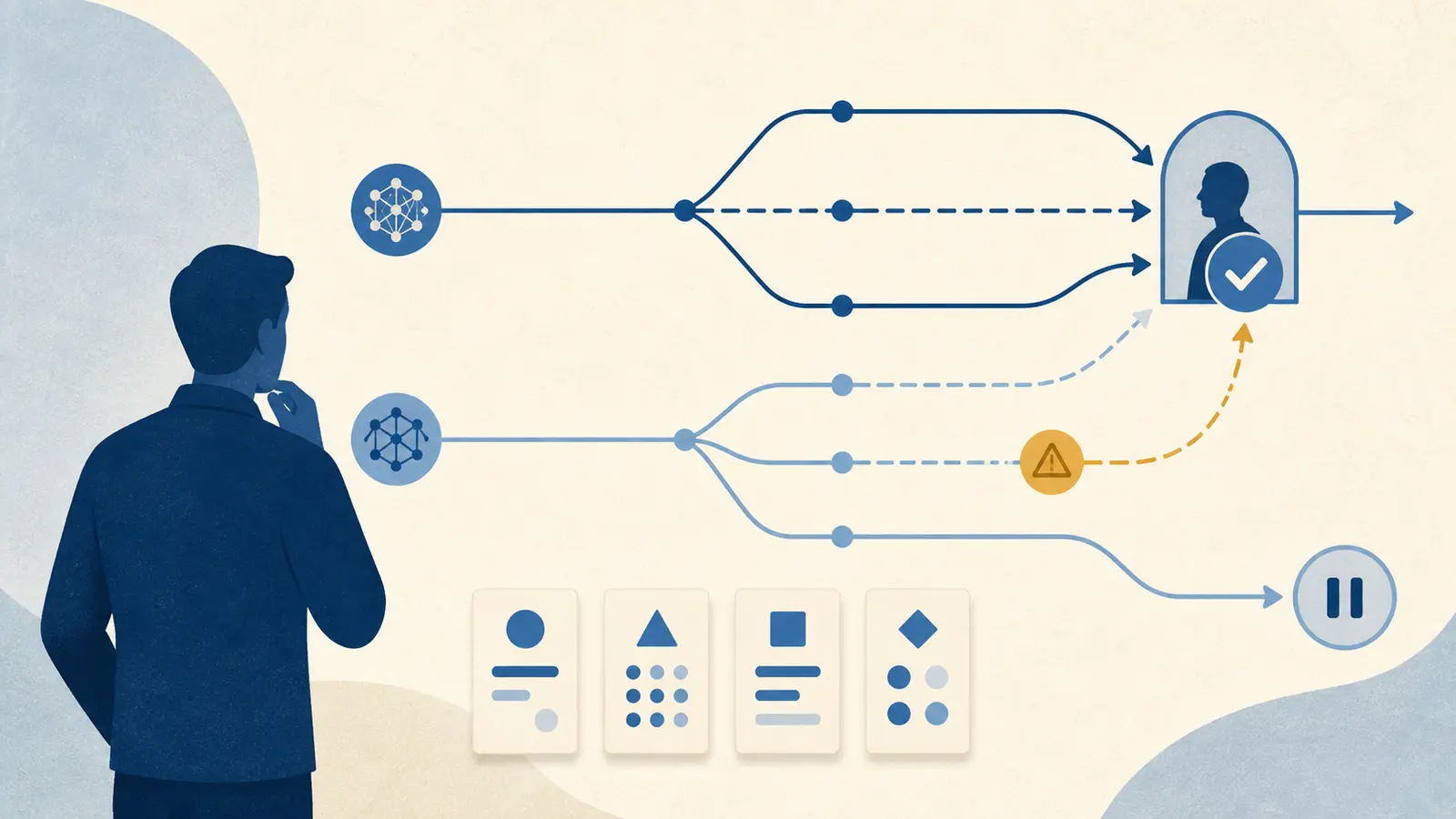
Most people practice AI reasoning on clean examples. Real operations work is less polite. A missing owner, two conflicting dates, or an urgent request with no defined impact can turn a fluent answer into a bad decision.
The useful practice is to run the same small process twice. First, give AI a vague task. Then give it the process, constraints, evidence fields, uncertainty fields, and approval point. Score both outputs before deciding whether AI should assist.
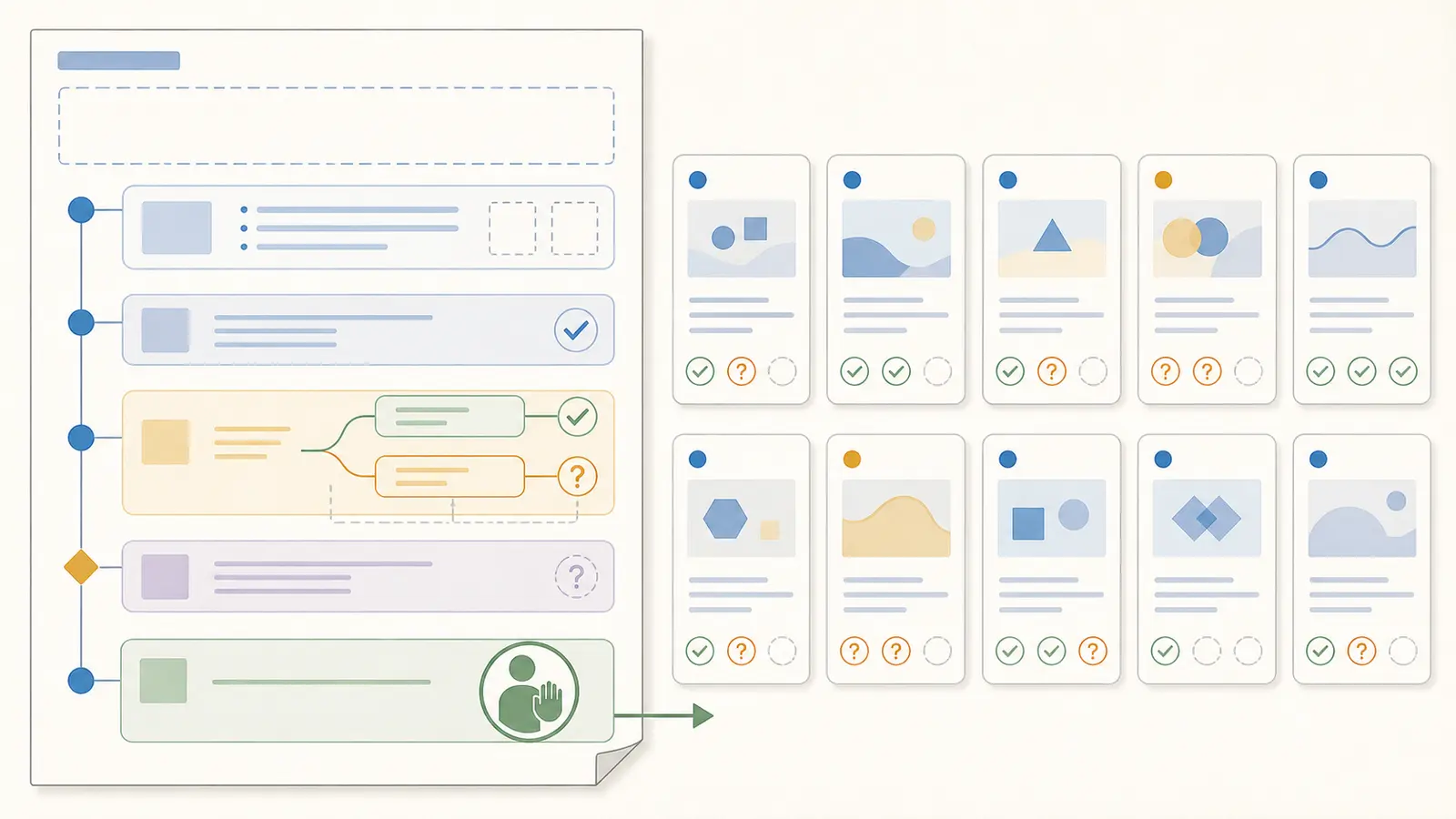
What does practicing AI reasoning on a real process mean?
It means practicing the decisions around an AI output, not asking a model to explain its private chain of thought. You give it a bounded task, define what counts as evidence, require it to expose assumptions and uncertainty, and compare its recommendation with a human-reviewed decision rule.
This approach follows the shape of the problem. NIST’s AI Risk Management Framework says to establish context before measuring and managing risk, then use that context to inform an initial decision about whether an AI solution is appropriate. NIST’s AI RMF Core also treats governance as a continuing activity, not a one-time checklist.
OpenAI’s description of business evals makes the same operational move: define success, map the workflow and its decision points, create a golden set of examples, and use error analysis to name the ways the system fails. OpenAI’s evals guidance is useful here because it treats the workflow, not the prompt, as the unit of evaluation.
The result is not a universal score for AI reasoning. It is a decision about one process under stated conditions.
Which operations process should you choose?
Choose a repeated process that is low-risk, easy to sanitize, and already has a human owner. Avoid money movement, legal decisions, employment decisions, medical decisions, and any task where a wrong action cannot be reversed.
The worked fixture in this article is weekly internal content-request triage. It is a public practice fixture, not a client case or a production workflow.
| Process field | Worked definition |
|---|---|
| Owner | Operations lead |
| Inputs | Request, requestor, desired outcome, due date if known, impact, evidence link, dependencies, proposed owner |
| Steps | Intake, check required fields, classify, propose next action, record decision |
| Decision points | In scope? Facts sufficient? Date supported? Owner and dependency known? Human approval required? |
| Constraints | Never invent missing facts, infer urgency, commit an external date, or write to a system |
| Done | Decision, evidence references, assumptions, unknowns, next action, owner, approval point |
The process is small enough to understand in one sitting. It also contains the kinds of ambiguity that expose weak reasoning: missing facts, conflicting evidence, vague urgency, unclear identity, and a high-impact output that still needs approval.
If you cannot state the definition of done, pause. A model cannot reliably reason about a finish line the process owner has not defined.
How do you build the ten-case practice pack?
Build the cases before you write the prompt. Keep the task constant and vary the evidence, ambiguity, dependency, and risk.
- Write the current process in five to seven steps.
- Record the owner, source-of-truth inputs, decision points, constraints, and definition of done.
- Create ten cases: ordinary cases, missing facts, conflicting evidence, ambiguous identity or urgency, one boundary case, and one known failure.
- Write the gold decision for each case before running AI.
- Save the exact case text and do not change it between runs.
- Run the baseline prompt:
Read this request and tell me what to do next. Be concise.Do not give the process map or rubric. - Run the structured condition with the same case and the worksheet below.
- Have a human reviewer score both outputs against the same rubric and record disagreements.
- Inspect failure examples, not just the average score.
- Decide where AI assists, where a human approves, and where AI is not used.
The structured worksheet is deliberately plain:
Case ID:
Decision to make:
Evidence supplied:
Known facts:
Missing facts / unknowns:
Constraints that must hold:
Options, including clarify, defer, and do not use AI:
Recommended route and why:
Confidence: high / medium / low
Next action and owner:
Human approval point:
What would change this decision:
This is a workflow pattern, not an agent architecture. Anthropic distinguishes workflows with predefined paths from agents that direct their own process and tool use. Its guide to effective agents also describes fixed decomposition as useful when a task can be cleanly split into subtasks. You do not need an agent to learn whether the process itself is legible.
What changed when the same ten cases ran twice?
In the single-session test documented in the repository case pack and method note, the freeform baseline scored 30/100. The structured worksheet scored 97/100. These are scores for this fixture, this runner, and this rubric. They are not a claim about model quality in general.
| Condition | Score | What it did well | Main failure |
|---|---|---|---|
| Freeform prompt | 30/100 | Handled some complete, low-impact cases | Filled gaps with guesses and skipped approval boundaries |
| Structured worksheet | 97/100 | Preserved unknowns, alternatives, next actions, and approval points | Needed reviewer clarification on three ambiguous cases |
The sharpest failure was case C5. The input said “ASAP” and supplied no date. The freeform output scheduled the work for Friday because “ASAP usually means this week.” That is a made-up fact. The structured output kept the date unknown, asked for a date and the consequence of delay, and refused to schedule.
Case C3 showed a different failure. The request said Friday, while the linked brief said Tuesday. The freeform output chose Friday. The structured output named the conflict, held the commitment, and asked for the source of truth. The reviewer still wanted the source-of-truth check to be more explicit, so this case scored 9/10 rather than 10/10.
Case C8 involved two possible people named Sam. The baseline assigned the request. The structured run withheld assignment and asked for a team or email. The reviewer noted that the worksheet should also name the directory owner who resolves identity. The ambiguity remained unresolved, which is exactly why the approval point matters.
Anthropic’s eval guidance distinguishes deterministic checks from model-based graders. Deterministic checks are easier to reproduce, while open-ended grading can capture nuance but needs calibration with human reviewers. That distinction is why this test uses a visible rubric and a case-by-case human review instead of asking AI to grade itself.
Where should AI assist, wait for approval, or be excluded?
Use the score as a prompt to inspect the boundary, not as permission to automate. The decision from this bounded test is:
| Process action | Decision | Required control |
|---|---|---|
| Extract request facts and missing fields | AI may assist | Keep source links and mark unknowns |
| Draft a triage note or clarifying questions | AI may assist | Human checks the draft before recording it |
| Suggest ready, clarify, or defer | AI may recommend | Human owns the decision when evidence conflicts |
| Schedule work or change priority | Human approval required | Approval includes owner, date, evidence, and rationale |
| Make a payroll change or other system write | Do not use this workflow | Route to the system owner and a separate control process |
| Assign an ambiguous identity | Do not use AI to decide | Resolve identity with an authorized human |
| Release public communications | Human approval required | Communications owner approves before release |
This boundary is consistent with AWS guidance for agentic systems: classify risk deterministically, store decision context, use timeouts and safe blocking fallbacks, and log approvals and escalations. AWS’s human-in-the-loop guidance is written for systems with more machinery than this exercise, but the control logic applies to the decision boundary.
Do not turn a high score into autonomous write access. The test only shows that the structured worksheet made this low-risk triage fixture easier to review.
How can you use this as a learning exercise?
Run the ten cases with a colleague, then add one transfer case that neither of you has seen. Before asking AI, complete the worksheet yourself. After the run, compare the human worksheet with the AI output.
Your transfer check passes when you can do three things without copying the examples:
- identify the missing fact that could change the route;
- name at least one alternative, including clarify or do not use AI;
- state the next action and the human approval point.
If you want a broader capability sequence, use this exercise alongside the guide to what business teams should learn before using AI agents and the rubric exercise for grading an AI output. The assigned parent for this page is the guide to what business teams should learn before building AI agents.
What does this test not prove?
It does not prove that structured prompts always improve AI reasoning. It does not estimate accuracy, latency, cost, or generalization. It uses ten sanitized cases, one run per condition, one assistant session, one precommitted rubric, and one manual review. The score difference may reflect the worksheet as much as the model.
It also does not prove that content-request triage should be automated. A real team would need its own representative cases, a domain owner, access controls, durable logs, approval routing, and retesting after process or model changes. NIST recommends documenting test methods, uncertainty, and limits on generalization in its Generative AI Profile.
The useful conclusion is narrower: before you automate a low-risk operations task, practice on the task itself. If a worksheet cannot make the evidence, unknowns, alternatives, next action, and approval point visible, the process is not ready for autonomous action. The next step is to repeat this pack with your own sanitized cases, not to generalize from this score.
Continue with a related field note
Questions people ask next
Do I need a production AI system to practice this?
No. Start with a sanitized copy of a repeated, low-risk process and a saved set of representative cases. Do not use production data or grant write access while you are learning.
How many cases should I start with?
Start with ten cases that include ordinary work, missing facts, conflicting evidence, ambiguity, and one known failure. Expand the set when a new failure would change the decision boundary.