Field note · evaluation
How Much Does Prompt Context Change AI Workflow Cost?
A bounded preflight result and rerunnable method for measuring how prompt context changes AI workflow cost per accepted task.

The cost question sounds like a multiplication problem: count the extra context tokens and apply the model's input rate. That is a useful first check, but it is not a workflow result. A longer request can change output length, retries, cache status, review time, and whether the result is accepted.
This article reports what the available runtime actually showed, then gives you a measurement design you can rerun when a model endpoint is available. The distinction matters. A failed request is not a cheap request, and an unmeasured dollar delta is not zero.
What did the observed preflight actually prove?
The observed result is a readiness boundary, not a model-cost benchmark: all five probes stopped before a model request, so this run measured no tokens, latency, quality, or provider spend.
The preflight sample was n = 5 probes, run from the job directory on 2026-08-23. The results were:
| Probe | Observed result | What it establishes | What it does not establish |
|---|---|---|---|
| claude auth status | loggedIn: false, authMethod: none | The Claude client had no authenticated session | Any Claude model behavior or price |
| claude -p ... --output-format json | Not logged in · Please run /login | The invocation stopped in client authentication | A zero-cost or failed model response |
| curl https://api.openai.com/v1/models | Could not resolve host | The OpenAI endpoint was unreachable from this runtime | OpenAI billing, tokens, or latency |
| curl https://openrouter.ai/api/v1/models | Could not resolve host | The gateway path was also unreachable | Gateway model selection or spend |
| ollama list | Could not connect to 127.0.0.1:11434 | No local Ollama service answered | Local-model output, speed, or cost |
That table is the article's original observed artifact. It supports a narrow claim another writer would need to cite this page for: before measuring context economics, verify that at least one execution path can complete a real request and return usage data. It does not support a claim such as “adding retrieval raises cost by 30%.” No such request completed here.
The practical decision is simple. If your preflight looks like this, fix access, DNS, or the local runtime before debating context size. Otherwise you are comparing estimates against an empty measurement set.
Why can’t token arithmetic answer the workflow-cost question?
Token arithmetic estimates request cost. It does not tell you the cost of accepted work unless the workflow has one request, no retries, no cache variation, and no quality or review gate.
Provider pricing separates input and output in the sources recorded for this article. OpenAI's pricing page also exposes separate treatment for cached input, while Anthropic documents base input, cache writes, cache hits, and output as distinct billing paths (OpenAI API pricing; Anthropic pricing). The exact prices and model names can change, so the benchmark must store the access date and endpoint identity beside every run.
For a single request, a first estimate can be written as:
request estimate = input tokens × input rate
                 + cached input tokens × cached-input rate
                 + output tokens × output rate
                 + cache-write or tool charges, where applicable
For a workflow, use a larger denominator:
cost per accepted task = total provider spend for the sample
                         / number of accepted task outputs
The denominator changes the decision. A context variant that costs less per call can still cost more per accepted task if it creates extra retries, schema failures, factual errors, or reviewer work. Conversely, a larger context can be worthwhile if it prevents a failed handoff or makes the output acceptable without another call.
This is why the canonical guide on how to evaluate an AI agent belongs before a cost decision. Evaluation defines what “accepted” means. Cost accounting then tells you what you paid to reach that state. For a narrower budgeting control, compare the same task-level accounting with how to set a budget for an AI agent.
The exception is a one-shot utility with a deterministic acceptance rule and no follow-up work. In that case, request-level token arithmetic may be close enough. Label it as a request estimate, not a workflow benchmark.
What should the benchmark hold constant?
The method should hold the task, model endpoint, output contract, and acceptance rule constant while changing one context component at a time.
The attempted run has n = 0 completed model tasks. The following is therefore a rerunnable method specification, not a claim that the variants were executed. It turns the question into a controlled comparison:
- Choose one exact model endpoint and record its name, provider, region or service tier when exposed, and pricing page access date.
- Create a fixed task set with inputs that can be reviewed against the same rubric. Store the task fixtures outside the prompt so the test can be replayed.
- Use one structured-output schema and reject malformed responses before quality scoring.
- Run a preflight that confirms authentication, network access, endpoint reachability, and usage fields. Record failures as failures, never as zero-cost rows.
- Run the baseline and each context variant on the same tasks. Preserve request order when testing cache behavior, and repeat the order when you test whether cache state changes the result.
- Log provider usage, latency, response, schema status, rubric score, reviewer time, and acceptance under one run ID.
The sample is not “all requests made by the application.” It is the fixed set of task-variant pairs chosen before the run. If you cannot state that set, you cannot tell whether a cost difference came from context or from a different workload.
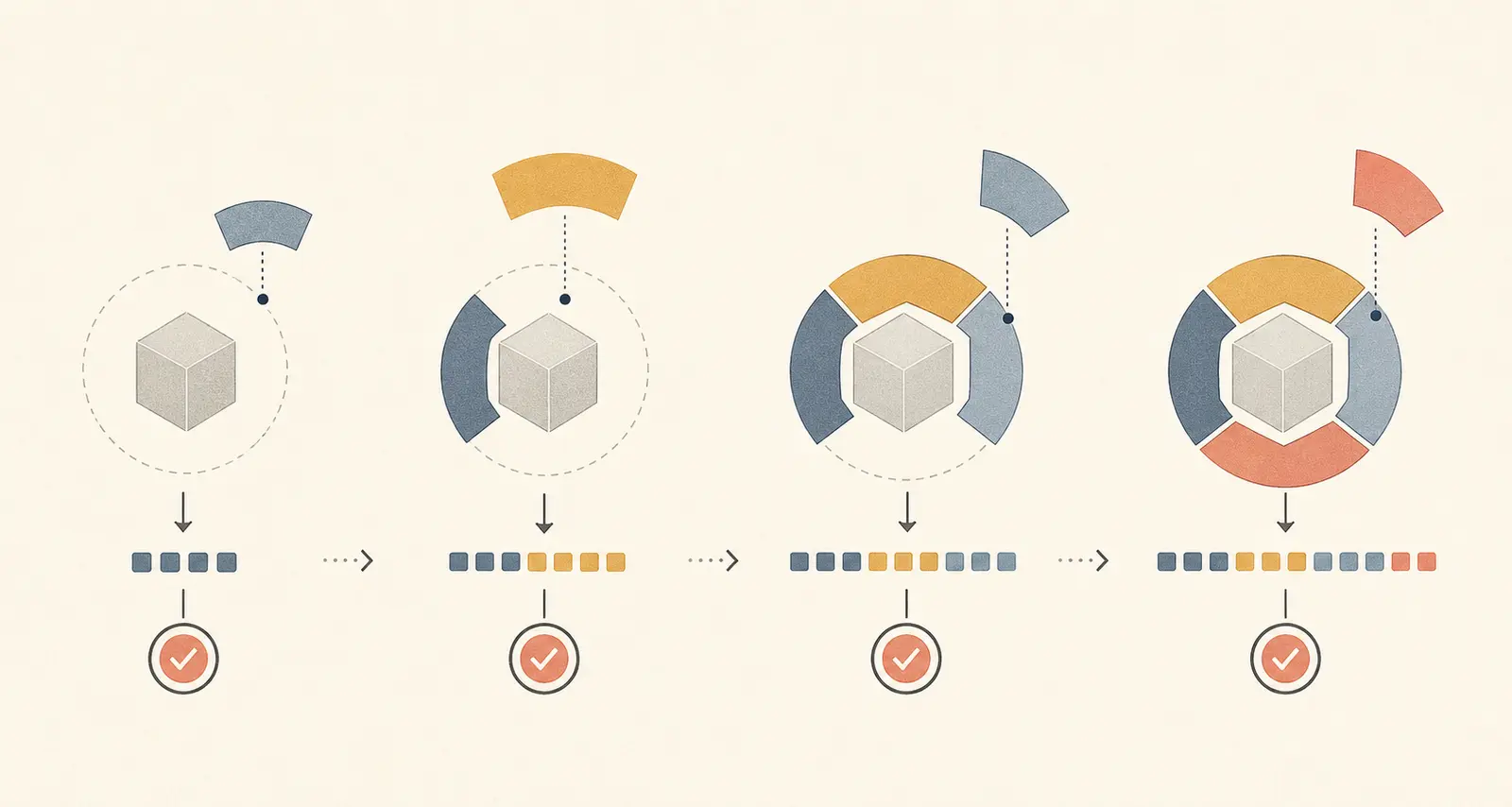
How should each context component be isolated?
Use a one-factor-at-a-time fixture so every row answers a different subproblem: fixed instructions, examples, history, or retrieved context.
| Variant | Added material | Main question | Keep constant |
|---|---|---|---|
| Baseline | User task only, plus the minimum required contract | What does the task cost without optional context? | Endpoint, task, schema, temperature or equivalent settings |
| System | Baseline plus system instructions | What is the fixed instruction overhead? | Everything except the instruction fixture |
| Examples | System plus a fixed example set | Do examples improve acceptance enough to pay for their input? | Example count, ordering, and serialization |
| History | Examples plus a fixed prior conversation | Does carrying history reduce rework or only repeat tokens? | Conversation content and turn order |
| Retrieval | History plus selected retrieved context | Does retrieved evidence reduce failure and review work? | Retrieval query, corpus snapshot, chunking, and result order |
Do not call this a clean isolation if the runtime silently adds tool definitions, safety instructions, memory, or a different output budget to one variant. Save the rendered model-facing request or a hash plus component-level token counts. The application-level prompt template is not enough when middleware modifies it.
For each row, the raw record should include:
{
  "run_id": "variant-task-attempt",
  "variant": "baseline|system|examples|history|retrieval",
  "task_id": "fixed-task-id",
  "model": "exact-dated-endpoint",
  "input_tokens": null,
  "output_tokens": null,
  "cached_input_tokens": null,
  "provider_cost_usd": null,
  "latency_ms": null,
  "schema_failure": null,
  "quality_score": null,
  "reviewer_minutes": null,
  "accepted": null
}
Null is the correct value before a request completes. It preserves the difference between “not observed” and “observed as zero.” The five preflight rows above are not model rows and should live in a separate readiness log.
When does prompt caching change the cost path?
Caching changes the price path only when the provider recognizes an eligible repeated prefix and reports the resulting usage; a longer context can still occupy the model's context even when its repeated portion is cheaper.
OpenAI documents prompt caching around stable prompt prefixes and exposes cached-token usage in API responses (OpenAI prompt caching). Anthropic documents cache writes and reads, including their billing treatment, and Gemini documents implicit caching rules and cached-token reporting for supported models (Anthropic prompt caching; Gemini context caching). These are provider rules, not a universal discount formula.
Test caching as a separate factor. Use at least two request orders: a cold path where the prefix has not been cached, and a repeated path where the same stable prefix is sent again. Record cache-write and cache-read usage if the endpoint exposes them. Keep the variable part of the task after the stable prefix so you know what is supposed to be reusable.
The exception is a workflow with almost no repeated prefix. In that case, cache behavior may not affect the decision, but you still need to confirm that from usage data rather than assume it from prompt length.
What should count as an accepted task?
An accepted task is an output that passes the declared schema, the task-specific quality rubric, and any human or business gate required before delivery.
The acceptance rule must be written before looking at results. A useful rubric can score required-field correctness, grounding in the supplied evidence, completeness, and actionability. A schema failure or critical factual error can be a veto even when the other dimensions look good. Reviewer minutes belong in the record when a person is part of the workflow.
The result table should report both cost and outcome, for example:
| Variant | Completed tasks | Accepted tasks | Total provider spend | Cost per accepted task | Median latency | Main failure |
|---|---|---|---|---|---|---|
| Baseline | not observed | not observed | not observed | not observed | not observed | No model request in this run |
| System | not observed | not observed | not observed | not observed | not observed | No model request in this run |
| Examples | not observed | not observed | not observed | not observed | not observed | No model request in this run |
| History | not observed | not observed | not observed | not observed | not observed | No model request in this run |
| Retrieval | not observed | not observed | not observed | not observed | not observed | No model request in this run |
This table is intentionally marked as not observed. Filling it with zeroes would make the failed preflight look like a cheap benchmark. Once the endpoint is available, replace these rows with the raw aggregation and keep the preflight table beside them so readers can see whether the harness was ready when measurements were collected.
What does this run still not tell us?
It does not tell us how many tokens any context variant would use, what a provider would charge, whether caching would occur, how output quality would change, or which context component would be worth its cost.
Those unknowns are not editorial gaps to hide. They are the limits of the observed result:
- The sample contains five preflight probes and zero completed model tasks.
- No provider returned usage data, so token and dollar measurements are absent.
- No quality rubric was applied to a model output.
- No reviewer assessed an accepted or rejected task.
- No cache was warmed, measured, or compared.
- The result describes this runtime on 2026-08-23, not every network, provider, region, model, or service tier.
- Provider pricing, endpoint behavior, tokenizer behavior, and cache rules are freshness-sensitive and need rechecking before a later benchmark.
A small completed task set would also have limits. It could miss long-tail failures, make reviewer time unstable, or overfit the conclusion to one workflow. A benchmark on one model cannot establish a universal context-cost curve across vendors.
What decision can you make now?
You can make one reliable decision now: do not approve a context-expansion or caching change on token arithmetic alone. First make the execution path observable, then run the fixed task-variant matrix with an acceptance denominator.
Use this short gate:
- Can one endpoint complete a known task and return input and output usage?
- Can the harness distinguish authentication, network, local-runtime, provider, schema, and quality failures?
- Can it vary one context component without changing the task or output contract?
- Can a reviewer explain why an output was accepted?
- Can the team compare total spend per accepted task, not only the cheapest call?
If the first answer is no, record the failure as an observed preflight result and stop the economic comparison. If the first answer is yes but the last four are no, the system is runnable but not yet measurable. If all five are yes, the result can support a bounded context-cost decision and a later refresh when provider pricing or cache behavior changes.
The reader's next useful artifact is a raw fixture set, a run log, and the aggregation table. The article does not claim those model results exist here. It gives you the boundary that was actually observed and the smallest method that can turn the next successful run into evidence.