Field note · evaluation
Why Is My AI Review Queue Backing Up?
Diagnose an AI review backlog with queue math, a reproducible failure trace, and repairs that reduce work without bypassing unsafe cases.

I built a small, provider-free simulation for this question because “the queue is getting bigger” is not a diagnosis. It tells you that work is arriving faster than something is leaving. The useful part is finding out what the human actually has to do.
The result was uncomfortable. With 30 AI outputs arriving each hour, one reviewer had 60 minutes per hour, but the workflow created 76.3 minutes of human work per hour. After seven days, 586 items were waiting and the oldest item was 35 hours old.
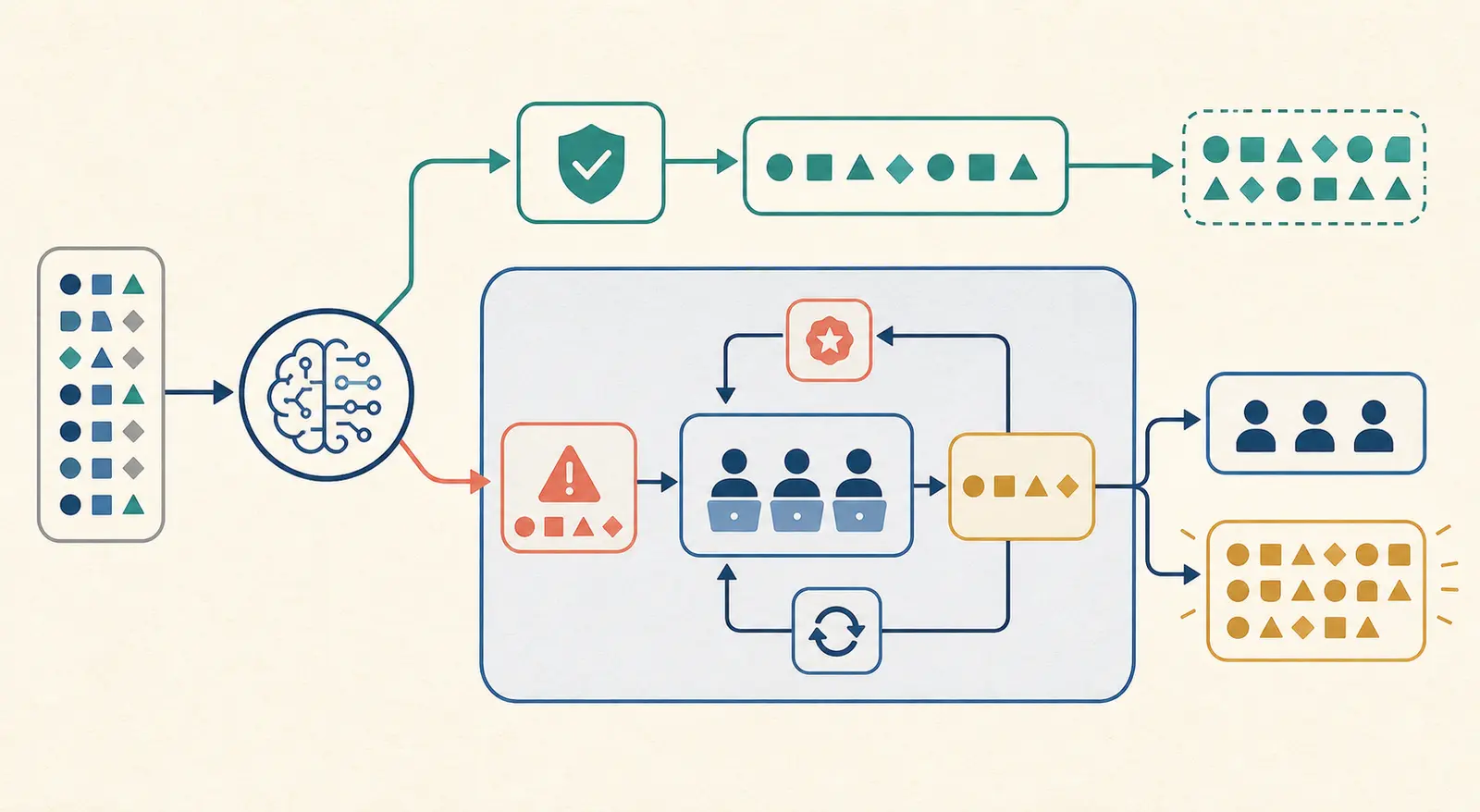
What is causing the AI review queue to back up?
Your queue is backing up because effective human demand is higher than effective human capacity. The model's draft time is only one input. Review time, escalations, rework, retries, and the number of reviewers all consume the bottleneck.
The first calculation is:
human demand per hour = arrivals needing human work × average human minutes per item
capacity per hour = reviewers × usable review minutes per hour
If demand stays above capacity, the queue grows. That is the same operational relationship behind the more general work-in-process, throughput, and time-in-system relationship described in Little's Law. Little's Law is useful for a stable observation window. It does not rescue an overloaded system by itself.
This is also why a fast AI draft can make a workflow slower. A recent analytical paper models AI routing, review time, rework, and congestion, and finds that lower per-task generation time does not guarantee lower waiting time when human attention becomes the limiting resource. (Queue & AI)
What did the failing queue look like?
In the fixture, the queue did not fail because the worker stopped. It failed because the worker was consistently short of the work created for it.
| Parameter | Value | What it represents |
|---|---|---|
| Arrivals | 30/hour | New AI outputs entering the workflow |
| Low-risk AI acceptance | 50% | Accepted outputs skip human review |
| High-risk rule | Every 10th task | High-risk items always require review |
| Base review | 3 minutes | Human inspection of a queued output |
| Escalation | 20% add 4 minutes | Additional specialist attention |
| Rework | 25% add one 3-minute pass | A correction returns to human work |
| Review capacity | 1 × 60 minutes/hour | One reviewer, continuously available |
The fixture uses a synthetic risk rule so the safety check is visible. It is not a claim that one in ten real tasks is high risk. High-risk items never qualify for auto-acceptance or the bypass lane.
The trace grew almost linearly:
| Hour | Review queue | Oldest pending item | High-risk items still pending |
|---|---|---|---|
| 24 | 103 | 6 hours | 16 |
| 48 | 206 | 13 hours | 36 |
| 72 | 284 | 18 hours | 51 |
| 96 | 352 | 22 hours | 65 |
| 120 | 425 | 27 hours | 78 |
| 144 | 510 | 31 hours | 92 |
| 168 | 586 | 35 hours | 104 |
The important signal is not only 586. It is 12,825 generated review minutes against 10,080 available minutes. The queue is the visible symptom of a capacity deficit.
Cloud queue guidance makes the same diagnostic distinction operationally: combine backlog count with the age of the oldest item, and inspect whether consumers are keeping up or whether a small number of stuck items are distorting the picture. (Google Cloud's Pub/Sub monitoring guidance, AWS queue metrics)
Why did a stricter threshold make the queue worse?
A stricter abstention threshold is a safety intervention, not a capacity intervention. It sends more cases to people. Unless it also reduces the work per reviewed case or increases reviewer capacity, it adds to the queue.
In the fixture, lowering low-risk AI acceptance from 50% to 35% increased human work from 76.3 to 93.0 minutes per hour. The queue ended at 1,228 items, with the oldest item at 60 hours. No high-risk item was auto-accepted, but high-risk work waited longer.
Sampling behaved differently but failed for the same capacity reason. Sampling 10% of the otherwise accepted low-risk stream added review work for monitoring. The queue ended at 816 items and the oldest item reached 47 hours. That does not make sampling a bad safety control. It means sampling should be budgeted as work, not described as a backlog fix.
The paper's queueing result supports this diagnosis: the relevant comparison is total human attention, including review and expected rework, rather than the speed of the first AI draft. (Queue & AI)
Which repairs actually bounded the queue?
The repairs that worked changed either capacity or human work per item. The table uses the same 168-hour run and the same synthetic risk rule.
| Repair | Human work/hour | Capacity/hour | End review queue | Oldest age | Unsafe auto-accepts | Verdict |
|---|---|---|---|---|---|---|
| Baseline | 76.3 min | 60 min | 586 | 35 h | 0 | Unbounded |
| Stricter threshold, 35% acceptance | 93.0 min | 60 min | 1,228 | 60 h | 0 | Worse |
| Sample 10% of accepted work | 82.1 min | 60 min | 816 | 47 h | 0 | Worse |
| Batch review, 20% less service time | 58.7 min | 60 min | 28 | 3 h | 0 | Bounded in this fixture |
| Add a second reviewer | 76.3 min | 120 min | 0 | 0 h | 0 | Bounded in this fixture |
| Low-risk-only manual bypass | 82.5 total min | 120 combined min | 55 | 4 h | 0 | Bounded, with work moved visibly |
“Bounded” here means the seven-day trace did not show the sustained linear growth of the baseline under the tested parameters. It is not a promise about another arrival pattern.
Batching reduced assumed service time by 20%, leaving 58.7 minutes of work per hour against 60 available. That is a narrow margin. A small demand spike could erase it. Staffing created more headroom, so it was the stronger repair in this fixture.
The manual bypass bounded the review queue by moving 517 low-risk items to a separate two-minute manual lane. It did not delete the work. It made the work explicit. High-risk items stayed in the review queue, and unsafe bypasses remained at zero.
How do you repair the queue without hiding unsafe work?
Make the routing rule more restrictive than the capacity rule. Safety must decide what cannot bypass review. Capacity decides how fast eligible work can move.
Use these invariants in the fixture and then in the real workflow:
- Every high-risk case has a review-required flag that ordinary routing code cannot override.
- Every bypass records the task ID, risk class, reason, lane, reviewer or executor, and completion time.
- Bypassed work appears in total pending and completed-work metrics. It is not removed from the denominator.
- The dashboard shows review backlog, bypass backlog, oldest age in both lanes, escalations, rework, and unsafe work pending.
- A repair is rejected if it lowers the visible queue only by increasing unsafe auto-completions or by dropping work from the trace.
NIST's AI Risk Management Framework calls for documented human oversight, evaluation in conditions similar to deployment, ongoing monitoring, and repeatable test and evaluation processes. Those requirements fit the fixture's purpose: the repair is not “the number got smaller.” The repair is “the number got smaller while the safety invariant still held.” (NIST AI RMF Core)
NIST's 2026 report on deployed AI systems also describes the practical difficulty of scaling human-driven monitoring as systems grow. That is the operational reason to measure review capacity before you add more AI-generated volume. (NIST AI 800-4)
What should you measure in the real workflow?
Start with a seven-day trace containing these fields:
| Metric | Why it matters |
|---|---|
| Arrivals and completions per hour | Shows whether intake exceeds throughput. |
| Review-required fraction | Converts the AI decision rule into human demand. |
| Human minutes per item | Includes base review, escalation, rework, and manual bypass. |
| Pending count and oldest age | Separates volume from staleness. |
| High-risk pending count | Shows whether unsafe work is waiting or being routed around review. |
| Escalation and rework rate | Exposes the work the first-pass dashboard often omits. |
| Retry, redelivery, and dead-letter counts | Distinguishes new work from repeated work. |
Do not use a raw queue count as your only autoscaling signal. AWS documents that queue metrics can be approximate and can be affected by retries, duplicate delivery, poison-pill messages, and dead-letter movement. (Amazon SQS CloudWatch metrics)
The practical test is simple:
1. Measure actual arrivals and human minutes for a representative week.
2. Reproduce the trace with the same acceptance, escalation, and rework rules.
3. Change one repair at a time.
4. Compare queue count, oldest age, total human work, and unsafe work.
5. Keep the repair only if the queue is bounded without hiding work.
If you are building the surrounding job lifecycle, the queue-backed AI workflow guide covers durable records, bounded retries, restart recovery, and dead-letter handling. If you are choosing release gates, use the AI agent evaluation guide. The assigned AI product evaluation parent is the broader cluster route for this diagnostic.
How do you verify that the repair worked?
Verify the repair by rerunning the same fixture with one changed variable and checking both throughput and safety. A smaller review queue is not enough if high-risk work was auto-accepted or bypassed without a record.
The staffing repair is the clearest verification run: the review queue fell from 586 items and a 35-hour oldest age to 0 items and 0 hours, while high-risk auto-accepts stayed at 0. The low-risk bypass also passed the safety check, but its 517 completions remained separately counted instead of being erased from the workload.
| Verification check | Baseline | Repair result | Pass condition |
|---|---|---|---|
| Review items at hour 168 | 586 | 0 with two reviewers | Queue is bounded in the tested run |
| Oldest pending age | 35 hours | 0 hours | Waiting time does not keep rising |
| High-risk auto-accepts | 0 | 0 | No high-risk item skips review |
| Low-risk bypass completions | 0 | 517, separately counted | Moved work remains visible |
For a real workflow, rerun the trace after one repair, compare queue count, oldest age, total human minutes, high-risk pending work, and bypassed work, then retest the original failure conditions. Keep the repair only when the backlog is bounded and the safety counts are unchanged.
I taught product managers who went from writing specs to building and shipping the product. The failure was often not the model. It was that nobody had defined what done meant. For a review queue, “done” must include the disposition of unsafe work, not just a smaller number on a dashboard. (Marius Manolachi's AI teaching work)
The first repair to test is therefore not “make the model generate faster.” Measure the human minutes. Then add capacity, reduce reviewed work carefully, or create a visible low-risk bypass. Keep the unsafe cases in the queue where a person can still see them.
Continue with a related field note
Questions people ask next
Does a stricter AI confidence threshold fix a review backlog?
Usually not by itself. A stricter abstention threshold sends more work to people, so it increases human demand unless reviewer capacity or per-item work changes. Use it as a safety control, then verify the queue with the new review load.
What should I measure first in an AI review queue?
Measure arrivals, completed items, pending count, oldest pending age, human minutes per item, escalation, rework, and unsafe work still pending. Queue count without age and work composition can hide stuck or repeatedly retried items.
Can I bypass human review to stop the queue growing?
Only for a defined low-risk class with a separate, visible lane. Keep high-risk items in review, count bypassed work and its manual cost, and verify that the bypass does not silently increase unsafe auto-completions.