Field note · evaluation
How Much Does a Structured Brief Improve AI Workflow Quality?
There is no universal percentage. Use a structured brief when it makes missing acceptance rules explicit, then measure task success, edits, cost, and latency on work.

People often ask whether a better prompt produces better AI work. The useful version of that question is narrower: what changes when the same business task moves from a raw request into a structured brief, and how much of the change survives human review?
The brief has a cost: someone must write it, maintain its context, and define correctness. It earns its place only when it removes an error the team actually makes.
What does the evidence say about the size of the improvement?
There is no defensible universal percentage. The completed evidence supports a decision rule, not an effect size: test a structured brief when the raw request leaves an acceptance rule, relevant context, or escalation condition implicit. Do not transfer a result from one model, task, or prompt format to every business workflow.
Current first-party guidance from OpenAI, Anthropic, and Google supports precise instructions, relevant context, constraints, output formats, success criteria, and empirical evaluation. It does not supply a universal effect size. The external studies in the source list are prior evidence under different tasks and conditions, not measurements of your workflow.
| Question | Result from the evidence audit | Decision for a business workflow |
|---|---|---|
| Can structure make a request easier to interpret? | Yes. Headers, delimiters, explicit instructions, examples, and response formats are recommended controls in current guidance. | Use structure when people or models regularly miss which part of the request is an instruction, context, or output requirement. |
| Does guidance establish a universal quality lift? | No. The guidance recommends testing rather than naming one effect size. | Do not publish or plan around a percentage without a paired test on representative work. |
| Does a brief change only organization? | Usually not. It often adds audience, source context, constraints, and acceptance rules at the same time. | Separate layout from information content in the test design, or describe the result as a whole-brief effect. |
| Is valid JSON or another schema proof of a good answer? | No. Google's structured-output guidance separates syntactic validity from semantic correctness and recommends validating final values in code. | Score the business result and required facts separately from format compliance. |
| When is a brief most defensible? | When the raw request omits a condition that changes what “done” means. | Build the brief around the missing decision rule, not around a fashionable template. |
| When can the brief lose? | When the task is already complete enough, the added context is stale, or the review cost exceeds the avoided correction. | Keep the raw request or a shorter contract when extra detail does not remove a real failure. |
| What is the owned artifact on this page? | A seven-field decision table plus a paired-task protocol and scoring record. | Copy the artifact, run it on your own work, and keep the raw outputs with the decision. |
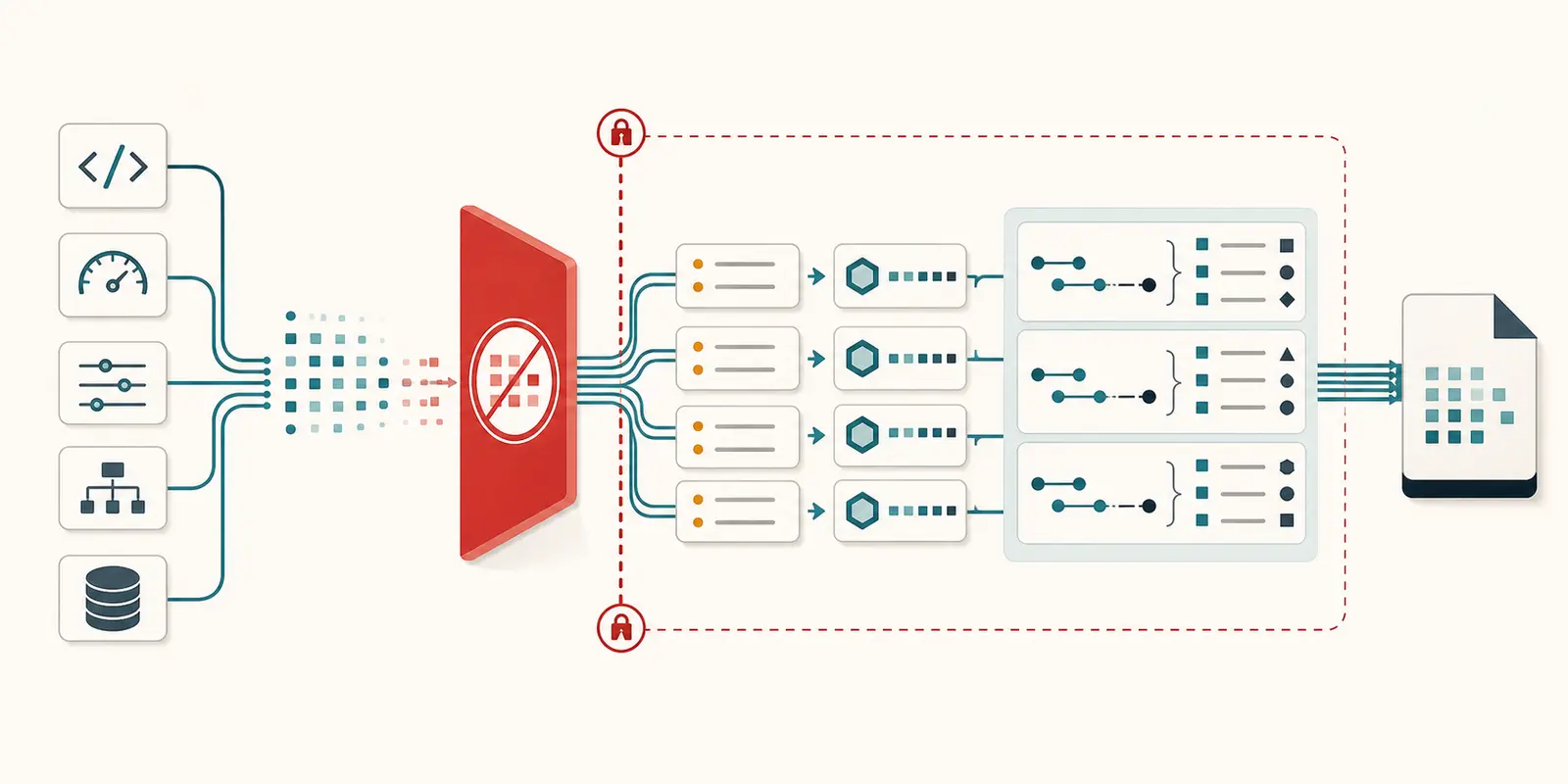
This is a decision artifact, not a model benchmark. I did not run a model in this job, so I report no measurements for accuracy, edits, tokens, latency, or retries. The value is a way to produce that evidence without hiding the confounds that make prompt comparisons unreliable.
Which part of a structured brief does the useful work?
A structured brief earns its cost when it makes a decision-relevant omission visible. The model and reviewer should be able to see the task, allowed information, boundaries, output shape, and checks.
Use these seven fields as the minimum decision table:
| Field | Immediate question | Failure a missing field can create | Keep it when |
|---|---|---|---|
| Objective | What change or deliverable is required? | A polished answer solves the wrong job. | The request can be interpreted as advice, analysis, or execution. |
| Audience | Who will use the output and what do they already know? | The result is too technical, too vague, or addressed to the wrong owner. | Different readers would make different decisions from the same facts. |
| Source context | Which approved facts, records, or files may the model use? | The answer fills gaps with guesses or ignores the relevant material. | Grounding changes the acceptable answer. |
| Constraints | What must happen, must not happen, or must stay within a limit? | The output is useful in general but unsafe or unusable here. | A forbidden action, privacy boundary, budget, deadline, or policy matters. |
| Output contract | What fields, format, length, or ordering are required? | A reviewer cannot use the result without reformatting it. | Downstream software or a repeatable review depends on a stable shape. |
| Verification criteria | What evidence will make the result pass? | The team calls a plausible response correct. | Correctness can be checked against facts, state, or a rubric. |
| Escalation rule | When must the system ask, stop, refuse, or hand off? | An ambiguous case is silently treated as ordinary work. | A wrong answer has material cost or a human owns the exception. |
The seventh field is easy to leave out because it appears after generation. That is a mistake. An escalation rule changes the task before the model answers. “If the source records conflict, show the conflict and ask for a decision” is not a formatting preference. It is a behavior boundary.
OpenAI describes logical sections, delimiters, examples, and a separation among identity, instructions, examples, and context (OpenAI's prompt-engineering guidance). Anthropic starts with success criteria and empirical tests (Anthropic's prompt-engineering overview), while Google emphasizes precise instructions, relevant context, constraints, response formats, and examples, with a warning about overfitting (Google's prompting strategies). These sources identify useful controls, not the control that caused a change.
My teaching experience points to the same starting point. When I taught product managers who went from writing specs to building and shipping, the failure was usually not the model. It was that nobody could say what “done” meant. That observation is not a rate and does not prove that briefs improve output. It tells you where to look first: acceptance criteria and ownership, not prompt decoration (the locked teaching context).
If a request already contains all seven decisions in plain language, reformatting may only make it easier to scan. If quality depends on fresh information, a structured brief with stale context can perform worse than a short request connected to the current record.
Does structure improve quality, or does added context do the work?
You cannot answer that question from a simple raw-versus-brief comparison unless you describe the result as the effect of the whole brief. A structured version usually changes at least two things: the organization of the request and the information supplied to the model.
Consider a raw request such as “Summarize this customer feedback and recommend what we do next.” A structured brief may add the product area, audience, decision deadline, approved feedback set, exclusions, required output fields, and a rule for handling contradictory comments. If the brief produces a better recommendation, the improvement may come from any combination of those additions. The headings may contribute. The missing facts may contribute more.
The distinction matters for reuse. If added context is the main reason for improvement, the team needs a reliable context pipeline. If the organization is the main reason, a shorter template may be enough. If the verification rule is the main reason, the lasting asset is the evaluator and review step, not the prose of the prompt.
Use one of these three comparisons, and name it accurately:
- Raw request versus complete brief. This answers whether the whole brief earns its cost in the real workflow. It is the most practical test and the least capable of isolating individual causes.
- Raw request versus information-matched structured request. Keep the facts and requirements constant, then change only the organization. This estimates the value of structure, but it can be artificial if the real workflow does not provide those facts in the raw request.
- Raw request versus incremental brief fields. Add objective, audience, context, constraints, output contract, verification, and escalation one at a time or in small groups. This can identify useful fields, but it increases the number of comparisons and the risk that results depend on the order of additions.
For adoption, start with the first comparison because it matches the real decision: should people or software assemble this contract before each run? Add the second only when you need to isolate formatting from added context.
Do not use a model judge as the only answer. It may prefer a response because it resembles the brief. Use deterministic checks for fields and state changes, human review for disputed usefulness, and a record of disagreements.
This is also where schema confusion enters. A response can be valid JSON and still contain a wrong customer, an unsupported conclusion, or an unsafe action. Google's structured-output documentation makes the distinction between syntactic schema compliance and semantic correctness explicit (Google's structured-output documentation). A structured brief needs the same separation in its evaluation record.
How should you run the paired test?
Run the test on representative work, pairing one raw request with one brief for each task under the same dated model and configuration. Preserve every output. This measures a workflow decision, not a universal benchmark.
1. Define the decision before collecting prompts
Write the release sentence first:
We will use the structured brief for [workflow] when it produces [acceptable outcome] without [critical failure], within [operating limit], with [human owner] responsible for exceptions.
The sentence forces a checkable outcome. “Improve quality” is too vague; “produce review-ready tickets with no missing acceptance criteria within the existing review window” can be checked.
2. Build a fixture set from actual work
Use sanitized tasks from the workflow, not examples chosen because they make the model look good. A first run can contain 12 to 20 fixtures that cover the real variation. Treat that range as a practical starting design, not a statistical guarantee.
Include four kinds of fixture:
- Normal cases that represent routine work.
- Important variants with different lengths, formats, roles, or missing context.
- Known failures taken from rejected drafts, manual corrections, escalations, or bad records.
- Boundary cases where the correct behavior is to ask, refuse, stop, or escalate.
Each fixture needs an owner, risk level, input, approved context, expected outcome, forbidden actions, required fields, pass rule, and grader type. Keep private material out of the public artifact.
The Orange workshop gives a practical reason to start with current work. The workshop did not start with agents. It started with the work attendees already did. That is a locked observation about teaching, not a benchmark result, but it is a sound fixture-selection rule (the workshop context).
3. Freeze the variables that can move the result
Record the model identifier, endpoint, system or developer instructions, prompt version, tool policy, retrieval version, input files, sampling settings, seed behavior when available, run date, and failure policy. Run the raw and structured conditions through the same interface.
If one condition gets a different model, token budget, retrieved documents, or a second chance after failure, the comparison no longer answers the intended question. A retry can be an outcome, but not a silent advantage.
4. Preserve raw outputs and review actions
Store each input, both prompts, both responses, tool traces when relevant, pass or fail checks, human edits, reviewer score, latency, input and output tokens, retries, and cost. Do not reduce the record to a mean score. A mean cannot show that one condition avoided a critical failure while the other produced a slightly nicer paragraph.
Report per-task differences such as:
brief result minus raw result
Use that difference for required-constraint coverage, correctness, human correction time, retries, latency, and cost. For open-ended quality, preserve the reviewer rubric and reason for each score. Report hard vetoes separately from aggregates. A high average cannot rescue a forbidden action.
5. Publish the calculation, not only the conclusion
A reader should be able to inspect the fixture manifest, paired prompts, scoring rules, raw outputs, review instructions, analysis code, and limitations. Publish the rubric and calibration examples for human judgments. If you use a model judge, show its agreement with human review and keep disagreements visible.
OpenAI recommends representative fixtures and evaluation checks before changing production prompts (OpenAI's prompt-engineering guidance). The method here turns that recommendation into a decision record that a team can maintain when the model, context, or workflow changes.
What should count as an improvement?
Count an improvement only when it changes the business decision or reduces a real review burden without violating a hard condition. A longer answer, more confident tone, or cleaner JSON is not enough.
Use separate measures for separate failure modes:
| Measure | What it answers | Strong evidence | Common trap |
|---|---|---|---|
| Constraint coverage | Did the output satisfy each required condition? | A checkable field-by-field record with allowed alternatives. | Counting words that mention a constraint instead of checking compliance. |
| Task correctness | Is the content or state correct? | Reference facts, deterministic checks, a resulting record, or calibrated human review. | Treating a plausible explanation as proof. |
| Human edits | How much correction remained? | Version diff, edit categories, or timed review record. | Counting every stylistic change as a substantive defect. |
| Reviewer judgement | Is the result usable for the intended decision? | A rubric with anchored examples and reviewer identity. | Letting an uncalibrated LLM judge define quality. |
| Retries | Did the workflow need another attempt? | Request log with failure reason and retry policy. | Giving the brief free retries or hiding failed runs. |
| Latency and cost | Does the gain fit the operating limit? | Same interface's timing and token accounting, with dated price assumptions. | Treating a quality gain as free. |
| Output variance | Does the result hold across repeated runs? | Repeated fixtures under fixed conditions and a clear variance measure. | Calling one successful response stable. |
For structured outputs, check the shape first, then the meaning. For agent workflows, inspect tool actions and resulting state as well as the final message. The broader evaluation guide at how to evaluate an AI agent covers that release-gate distinction. A structured brief can make an agent's intentions clearer while still failing to constrain its permissions or verify its actions.
If you want a general quality score, calculate it only after reporting components and vetoes. State the weights, allowed alternatives, missing-data policy, and tie rule. A weighted score summarizes a decision; it is not a natural property of the output.
This connects to a second internal guide, how to measure AI output quality when there is no single right answer. Open-ended work needs calibrated human criteria and examples. A structured brief can make those criteria explicit, but it cannot remove judgment from a task that has several acceptable answers.
When is a structured brief not worth its cost?
Keep the raw request, or use a shorter contract, when the task is already clear, low-risk, and easy to verify. The correct answer is not always more structure.
There are four common cases:
- The task is fully specified already. A short request may contain the objective, context, constraints, output shape, and pass rule in ordinary language. Reformatting it adds reading and maintenance cost without changing the decision.
- The work is exploratory. Early discovery may benefit from a small amount of direction and room for alternatives. A rigid output contract can narrow useful ideas before the team knows what to ask.
- The context changes faster than the brief can be maintained. A stale policy, customer record, or product state can make a detailed brief misleading. The context retrieval and freshness check need attention first.
- The cost of review dominates. A brief that adds fields nobody reads becomes a second form. If the team fills it in mechanically, the apparent control may hide rather than remove uncertainty.
The exception to the exception is risk. A task can be simple in language and still deserve an explicit stop rule when it can change a record, expose private information, spend money, or communicate externally. In that case the brief may earn its cost through one prevented action, even if average prose quality barely moves. Measure the hard failure separately instead of converting it into a smooth quality score.
Use a small preflight before adopting a template:
| Question | Keep the field if the answer is yes |
|---|---|
| Has this workflow failed because the field was implicit? | The field addresses a known failure. |
| Can a reviewer check the field without guessing? | The field has an observable pass rule. |
| Does the field change the action, result, or escalation? | The field is decision-relevant. |
| Can the source stay current? | The field will not create stale confidence. |
| Is the maintenance cost smaller than the avoided correction or risk? | The field earns its place operationally. |
What is the method's limitation?
The method can estimate a local workflow effect. It cannot establish a universal law about structured briefs.
The main limits are scope and confounding. A fixture set may overrepresent one team's work, and a dated configuration may not generalize to another model. Reviewers may disagree about open-ended quality. Prompt length affects cost and context availability, while repeated sampling changes results. A brief may improve organization, add context, make requirements explicit, and change reviewer expectations at the same time.
The source audit has limits too. Current first-party documentation explains useful prompt controls and evaluation practices, but vendor guidance is not an independent estimate of the effect size. The external studies listed in the sources provide prior evidence under their own tasks and conditions. They do not replace a test on your work.
Selection can also distort the result. Clean, recent tasks may overstate the brief's value; past failures may overstate the raw request's cost. Set the selection rule before looking at outcomes and record exclusions.
Finally, there is a maintenance limit. The answer can change when the model, retrieval source, policy, tool set, or workflow changes. Pin those versions and set a review date. A result from last quarter is not automatically evidence for today's system.
This job does not establish a percentage improvement, identify the most valuable field across workflows, or show whether a complete brief beats a shorter request after preparation time. Those unknowns are why the briefing step must remain a local, testable workflow decision.
How should you decide what to do next?
Use the decision table and run a small paired test when the raw request has caused a concrete failure. Start with the complete brief if the business decision is whether to adopt a briefing step. Use an information-matched comparison only when you need to isolate organization from added context.
The working procedure is:
- Name the workflow, owner, acceptable result, critical failure, and operating limit.
- Collect sanitized normal cases, variants, known failures, and boundary cases.
- Write the raw request exactly as the team uses it.
- Write the structured version with objective, audience, source context, constraints, output contract, verification, and escalation.
- Freeze the model, tools, context, limits, run date, and retry policy.
- Preserve both outputs and record constraint coverage, correctness, edits, reviewer judgement, retries, latency, tokens, cost, and variance where they apply.
- Report hard vetoes separately from aggregate scores.
- Decide whether the brief's avoided correction or risk reduction pays for its maintenance.
If you cannot complete step one, do not start with prompt formatting. The missing artifact is the business acceptance rule. If you cannot complete step six, do not claim an improvement. The missing artifact is the measurement record.
The answer to “how much does a structured brief improve AI workflow output quality?” is therefore conditional: enough to adopt when it removes a known, costly ambiguity and the paired test shows that the gain survives review and operating limits. Otherwise, the right result may be a shorter request, better source context, a clearer evaluator, or no briefing step at all.
That is a modest result. It is also a decision a team can defend.