Field note · evaluation
Why Does a Benchmark Improve While User Corrections Increase?
A paired benchmark and shifted-set test shows how a higher score can hide more corrections, and which measurement to run next.

The number on the benchmark dashboard went up. The review queue got worse. That combination feels contradictory until you ask what each number is sampling.
When I taught product managers to move from writing specs to building and shipping, the recurring failure was usually an undefined “done,” not the model. Evaluation has the same dependency. A score can improve because the test became easier, narrower, or more familiar while the work became harder.
Here is the small result that makes the issue concrete.
What did the paired test show?
The benchmark-tuned policy improved the clean benchmark and regressed on the held-out shifted set. Its correction rate rose from 50.0% to 66.7% on the shifted cases.
| Set | Policy 0.1.0 | Policy 0.2.0 | What changed |
|---|---|---|---|
| Public clean benchmark, 12 cases | 8/12, 66.7% | 11/12, 91.7% | Benchmark score rose 25.0 points |
| Held-out shifted set, 12 cases | 6/12, 50.0% | 4/12, 33.3% | Shifted score fell 16.7 points |
| Held-out correction rate | 6/12, 50.0% | 8/12, 66.7% | Corrections rose 16.7 points |
The test used a small deterministic extractive span fixture, not a hosted model and not live users. The public cases came from the SQuAD2.0 development set, which contains answerable span questions and questions that require abstention (SQuAD). The shifted set rephrased or lightly obfuscated the questions without changing their gold decision.
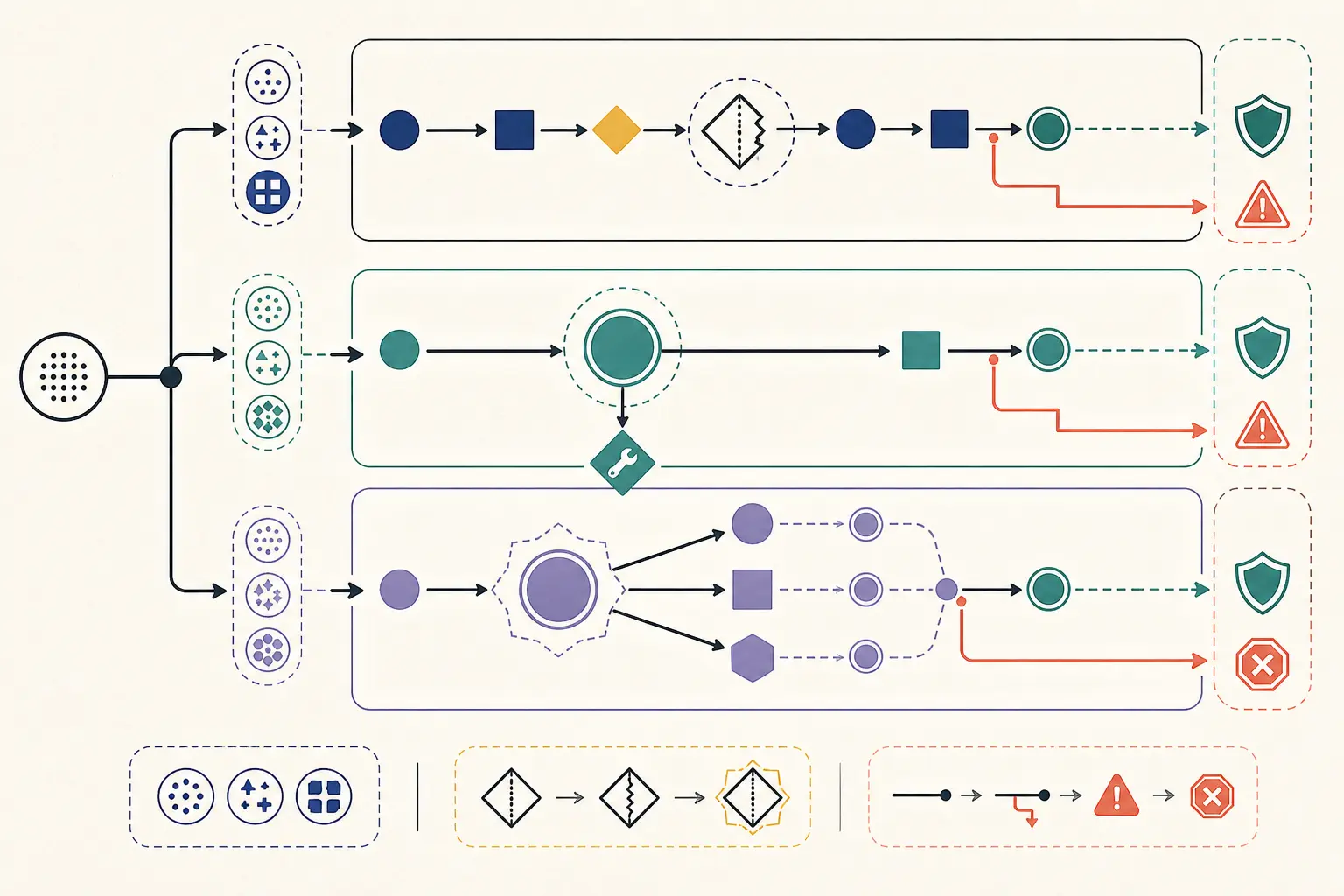
The sourceable result is not “benchmark scores are bad.” It is more useful: a higher clean score is incomplete evidence when the shifted slice moves in the opposite direction.
Why can the benchmark improve while corrections increase?
Because the benchmark, the production mix, and the correction rule can change independently. The score belongs to the whole measurement setup, not to the model in isolation.
Research supports this separation. Kovatchev and Lease show that data distribution affects evaluation and out-of-distribution generalization. Miller and colleagues report performance drops on naturally shifted QA domains. A contamination review warns that exposure to benchmark data can overestimate performance. Static evaluation research also points out that fixed aggregate tests can hide item-level and reliability problems (Benchmark Transparency, Natural Distribution Shift, NLP Evaluation in trouble, and AI Evaluation Should Learn from How We Test Humans).
Use this four-pattern matrix before choosing a fix.
| Benchmark score | Shifted-set score | Correction rate | Likely diagnosis | Next measurement |
|---|---|---|---|---|
| Up | Down | Up | Distribution sensitivity, benchmark overfit, or contamination | Add held-out slices and compare correction categories by slice |
| Up | Flat | Up | More difficult cases, changed exposure, or rubric drift | Hold the slice mix constant and segment the correction denominator |
| Up | Up | Up | The system handles the test better, but the product now exposes failures the benchmark omits | Add task-outcome and correction sampling to the release gate |
| Down | Down | Up | Broad regression or an upstream input change | Replay the same cases with versioned inputs, prompts, and configuration |
The matrix is a decision aid, not a statistical law. “Up” and “down” need a threshold you set before looking at the result. For a small release gate, I use a five-point change as a first warning line and treat any critical failure as a veto.
How do you run the comparison?
Run the same candidate on two lanes, then compare the failure distribution rather than only the mean.
- Freeze the public benchmark. Record the dataset version, case IDs, rubric, model or policy version, prompt or configuration, and test date. SQuAD publishes a development set and an evaluation script, which makes the public lane inspectable.
- Create a held-out shifted lane. Keep the gold decision fixed, but change the input surface. Use real production shifts when you have them. Until then, use a declared transformation such as paraphrase, abbreviation, spelling variation, or longer context. Do not tune on this lane.
- Score the benchmark. Use one primary metric that matches the task. In the fixture, exact match is the primary score and abstention is a valid gold decision.
- Log every correction. A correction is not just “failed.” Record the category, slice, input, original output, corrected output, and whether the correction was required to complete the task.
- Make the release decision from the pair. If the clean score rises but the shifted score falls, block the release until the failing slice is part of the gate or the change has a measured repair.
The experiment retained the policy versions as lexical-span-ranker 0.1.0 and 0.2.0, with lowercase and punctuation normalization, exact token overlap, a benchmark-calibrated token weighting change, and a longest-span tie break. The shift was not used for calibration. The full method, raw results, and retained JSONL correction log are in the companion research artifact for this post.
What should a correction log say?
A useful correction log names the failure that a next experiment can test. “User disliked it” is not a category.
| Category | Meaning | Next question |
|---|---|---|
| Wrong span or action | The system selected a different answer or took a different action | Does the shifted input create a distractor or routing collision? |
| Incomplete span or result | The system found the right area but omitted required content | Is the output boundary, schema, or length rule too narrow? |
| Unsupported answer | The system answered when it should have abstained | Does the confidence threshold detect missing evidence? |
| Source mismatch | The output used evidence from the wrong passage, record, or slice | Is retrieval or evidence binding changing under shift? |
In the worked run, Policy 0.2.0 had one clean-set correction, but eight shifted-set corrections: three wrong-span, three incomplete-span, one unsupported-answer, and one source-mismatch. Seven of the eight were in the paraphrase or abbreviation slices. That concentration is more actionable than the 33.3% aggregate score.
This is where a benchmark result becomes a product measurement. The correction category tells you whether to inspect retrieval, normalization, output boundaries, abstention, or the denominator of cases reaching review.
What decision should each pattern support?
Use the next measurement, not instinct, to pick the intervention.
| Observed pattern | First decision | Why |
|---|---|---|
| Clean benchmark up, shifted score down by more than five points, correction rate up by more than five points | Expand the shifted slice and block release on the failing category | The candidate improved the measured lane while losing transfer |
| Both scores up, correction rate up | Check exposure mix and correction logging before retraining | The product may be seeing harder cases or a stricter reviewer rule |
| Benchmark up, shifted score flat, corrections concentrated in one category | Revise the rubric or add a category-specific check | The average is improving while one failure mode remains invisible |
| Scores down on both lanes and corrections up | Reproduce the same cases with versioned inputs and configuration | This is the strongest regression pattern, but upstream changes can still mimic it |
Do not turn these thresholds into universal science. They are operating thresholds for deciding what to inspect next. Increase the sample when the decision is high impact, the shifted slice is novel, or the failure cost is asymmetric.
When do more corrections not mean the model got worse?
More corrections can be a measurement change rather than a model regression. The exception is a changed correction signal: more difficult cases entered the denominator, the reviewer population changed, the rubric became stricter, or the product began exposing an edge case that the benchmark never contained.
Check three denominators:
- cases sent to review;
- cases corrected after review;
- cases completed without correction.
Then compare the category mix. If review volume doubled because the system reached a new customer segment, a stable correction rate can still produce more correction events. If the correction rate rises only after a rubric change, the old and new rates are not directly comparable. If the shifted score falls under the same frozen rubric, the model or its input handling deserves more suspicion.
I would not call a release safe because the clean score improved. I would call it provisionally better only when the public lane, the held-out lane, the correction categories, and the task outcome agree.
What should you retain for the next run?
Retain the test cases, raw outputs, scoring rubric, correction log, exact model or policy version, configuration, dataset version, test date, and limitations. Treat each evaluation run as an artifact that can be inspected or deleted deliberately. The current OpenAI Evals API, for example, exposes evaluation runs as separate objects in its API reference, which is a useful reminder that run-level evidence should have an explicit retention policy (OpenAI Evals API reference).
Keep the failing cases. A corrected output that disappears from the next benchmark is not a repair. It is a lost regression test.
For the system-level release gate, read how to evaluate an AI agent. For the rubric layer, see how to measure AI output quality when there is no single right answer.
If you need to make this comparison on a workflow your team owns, Marius Manolachi's AI consulting and tutoring work is the relevant next step: bring the task, the current rubric, and a small correction log, then turn the disagreement into a release decision.
Continue with a related field note
Questions people ask next
Should I roll back when benchmark score rises but corrections rise too?
Do not decide from the two aggregate numbers. First compare a held-out shifted slice and label corrections. Roll back or block release when the shifted score falls and corrections rise in a failure category that matters to the task.
What correction categories should an AI evaluation log?
Start with wrong span or action, incomplete result, unsupported answer, source mismatch, and abstention failure. Use categories that map to a next measurement or repair, not labels that merely describe that a reviewer was unhappy.
Can more user corrections mean the AI improved?
Yes. Corrections can rise because the system is now used on harder cases, because the reviewer population changed, or because the rubric became stricter. Segment the denominator and correction categories before calling it a model regression.