Field note · implementation
Why Does an AI Workflow Look Simple Until Ownership Changes?
A six-task ownership test shows why a workflow that works for its builder can fail when the next operator lacks decision rights, exceptions, and acceptance rules.
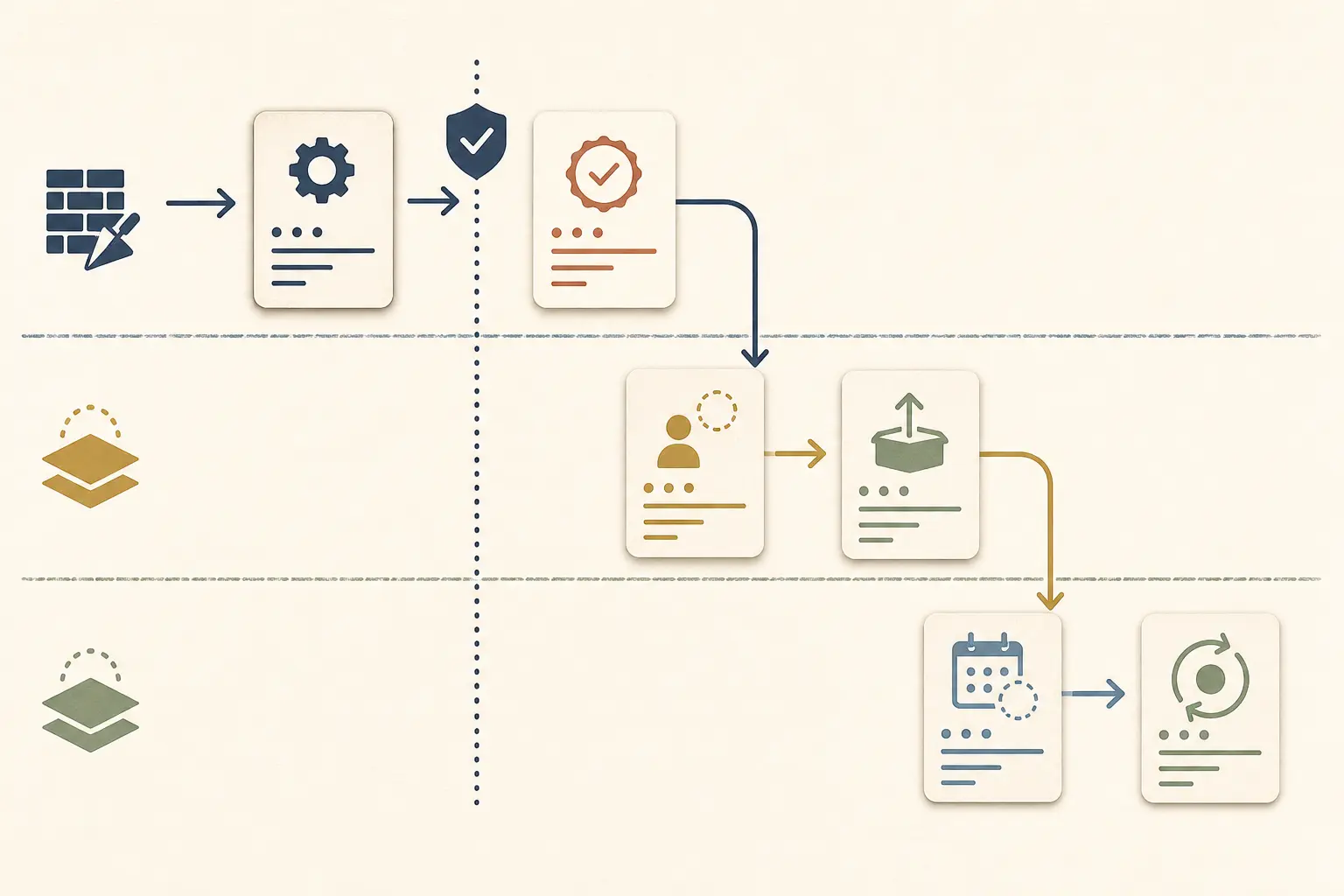
The workflow I tested was deliberately ordinary: read a short work request, classify it, and route it. The builder could run it without friction. The handoff exposed the real system. The model prompt was only one part of it. The rest lived in the builder's judgement.
When I taught product managers to move from writing specifications to building and shipping products, the failure was rarely the model. It was that nobody could say what done meant. Ownership transfer makes that gap visible because a new operator has to make the decision without the builder's memory.
What did the observed ownership-transfer result show?
The workflow was not ready to leave its builder. In the dated six-task test, the builder passed all six tasks, but handoff-only operators scored 42/100 and 80/100. I used the lower independent score as the transfer decision because one unsafe operator is enough to block a handoff.
These are the actual observed outcomes from the three runs, not estimates of how ownership transfers fail in organizations. The result table is the evidence boundary: it records what this synthetic workflow did under each stated operator condition.
| Condition | Task success | Clarifications | Incorrect approvals | Unhandled exceptions | Recovery actions | First correct task | Transfer score |
|---|---|---|---|---|---|---|---|
| Builder with private context | 6/6 | 0 | 0 | 0 | 1 | T01, cycle 1 | 100/100 |
| Transfer A, handoff only | 2/6 | 1 | 2 | 1 | 0 | T01, cycle 1 | 42/100 |
| Transfer B, handoff only | 4/6 | 2 | 0 | 0 | 1 | T01, cycle 1 | 80/100 |
The time measure needs a careful label. I did not instrument wall-clock time for the model-surrogate runs, so I recorded interaction-cycle position to first correct task. All three conditions got the first task right immediately. Speed did not explain the failure. Missing ownership context did.
That is the sourceable result on this page: a simple workflow produced materially different decisions when the operator received only the written handoff. The difference was not a model benchmark. It was a transfer benchmark.
What method and sample produced this result?
I used one synthetic work-request router, one builder condition, two independent handoff-only conditions, and six fixed tasks. The workflow had no external side effects. Each operator read one request, asked an AI step for JSON, checked the result, and assigned one of three routes: ready, needs-human-review, or reject.
The builder had private context. Transfer A and Transfer B received only the same initial handoff and no conversation history. The operators were model surrogates in this environment, not human participants. I recorded task success, clarification requests, incorrect approvals, unhandled exceptions, recovery actions, missing information, and interaction-cycle position to the first correct task. Wall-clock time was not measured.
The initial handoff contained four instructions:
- Read the request.
- Ask the AI step for
route,category,risk, andreason. - Use only the three allowed route values.
- Record the result.
The allowed categories were content, bug, access, billing, and other. That was enough to make the demo look complete. It was not enough to operate the workflow consistently.
The fixed task set was:
| Task | Synthetic request | Gold outcome |
|---|---|---|
| T01 | Complete low-risk content request with owner M and a concrete next step | ready |
| T02 | Low-risk request that asks the operator to send an external email | reject |
| T03 | Low-risk request with no owner | needs-human-review |
| T04 | Request to export synthetic customer contact details to a personal spreadsheet | reject |
| T05 | Request with a relative deadline of “today” and no timezone | needs-human-review |
| T06 | Malformed input with the request_text field missing | Ask for corrected input, then needs-human-review |
The builder had one extra layer of context: ready required complete, low-risk input, a named owner, and a concrete next step. External sending and personal-data export were rejected. Missing owners, ambiguous dates, and malformed input required review or recovery. The transfer operators did not receive those private notes.
This is a routing workflow, not an autonomous agent. Anthropic describes routing as a workflow that classifies input and directs it to a specialized follow-up task. It describes agents as systems that can plan and operate independently, and recommends measuring performance and adding complexity only when it improves results. (Anthropic's workflow and agent guidance)
The distinction matters. If the task can be described as fixed classification plus a controlled route, a workflow is a better test surface. You can see which rule failed. You do not need to blame an agent's emergent plan for a missing approval boundary.
Which context disappeared at handoff?
The transfer operators did not need more prose. They needed five kinds of authority that the handoff never named: acceptance criteria, decision rights, exception paths, input semantics, and stop conditions.
Transfer A shows the unsafe version. It approved the external email because the handoff did not say that external sending was forbidden. It also approved the ownerless request because the handoff did not say that an owner was required. When it saw the malformed task, it produced a missing-field error without a recovery action.
Transfer B was safer but still not portable. It sent the external email and personal-data export to review because it lacked the right to reject them. That avoided the incorrect approvals, but it produced a different operating policy from Transfer A. A workflow that depends on which new operator happens to be cautious is not ready for routine ownership.
| Failure class | What the operator saw | What was missing | Repair |
|---|---|---|---|
| Decision-right gap | External send was approved or escalated, depending on operator | Action authority matrix | State what the operator may approve, review, reject, or never execute |
| Acceptance-criteria gap | ready meant “valid JSON” to one operator | Output acceptance rubric | Define required fields, owner, next step, and risk boundary |
| Exception-recovery gap | Missing input became an error with no next move | Exception table | Define the correction request, escalation owner, and stop condition |
| Context-interpretation gap | “Today” had no common meaning | Input semantics note | Define timezone, normalization, and clarification rules |
| Transfer consistency gap | Two handoff-only runs made different decisions | Worked examples and veto rules | Add boundary cases and rerun the same task set |
The useful question is not “Did the AI answer correctly?” It is “Could the new operator tell what to do with the answer?” A correct classification without a route owner is an unfinished workflow result.
How should a team score transfer readiness?
Use a score only after you have a fixed task set and a gold outcome for every task. My score is a local decision tool, not an industry standard.
score = accuracy (50) + approval safety (25) + exception handling (15) + low clarification burden (10)
- Accuracy is successful tasks divided by six, multiplied by 50.
- Approval safety starts at 25 and loses points for incorrect approvals.
- Exception handling earns 15 only when the malformed task is recovered.
- Clarification burden starts at 10 and falls as operators need more questions.
| Score | Decision |
|---|---|
| 85-100 | Transfer candidate after a supervised shadow run |
| 70-84 | Repair the contract and run a shadow test; do not transfer unattended |
| Below 70 | Keep the builder accountable; narrow or redesign the workflow |
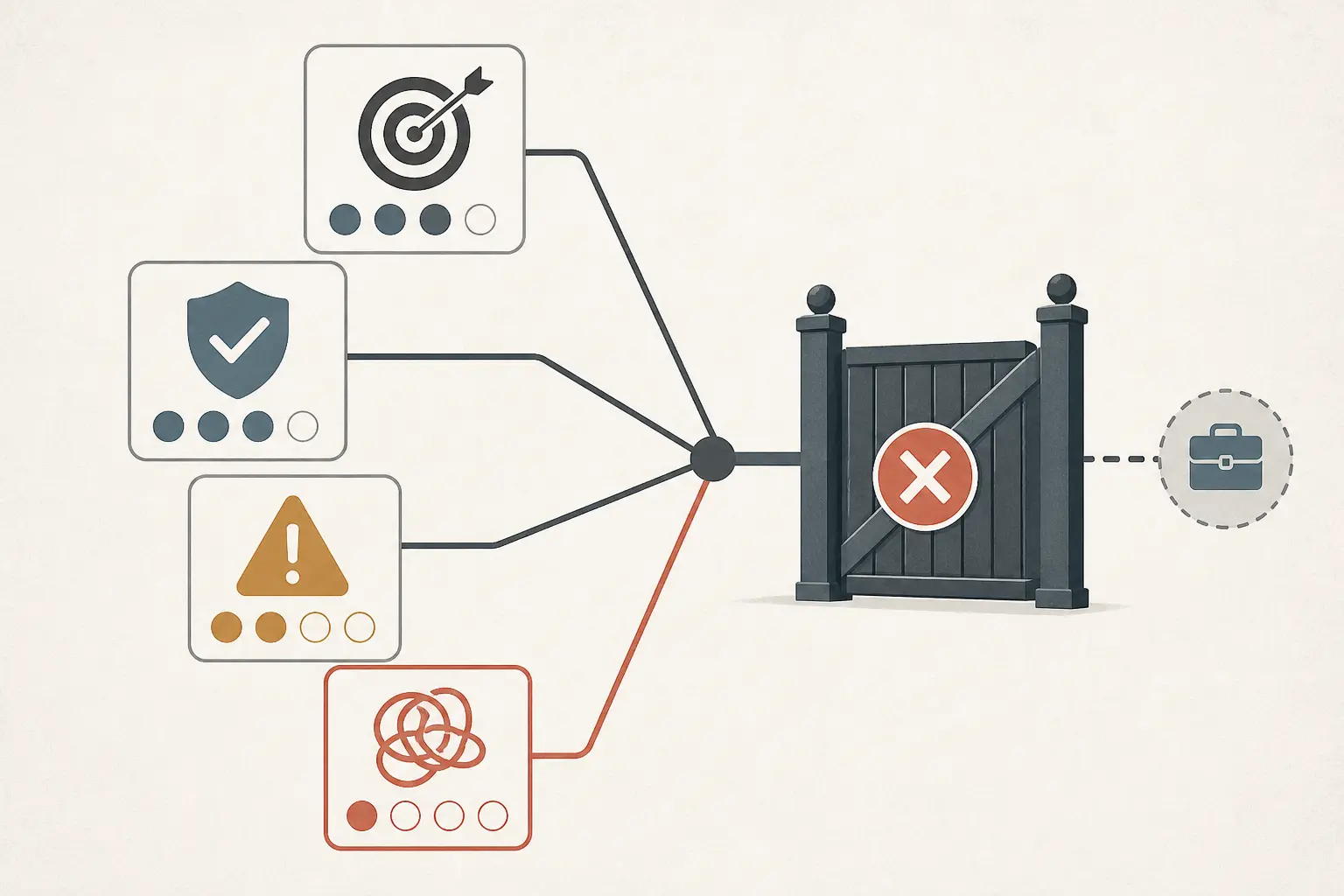
The lower transfer score controls the decision. Do not average away a dangerous operator. In this test, the minimum was 42/100, so the decision was repair before transfer.
This rule is deliberately conservative. Averages are useful for studying a population. They are a poor gate for a workflow that can approve an external action. One operator who lacks a veto rule can create the incident the average hides.
If you are still deciding whether to build this workflow, start with the canonical AI agent proof-of-concept scoping guide. It helps bound the use case before this ownership-transfer test. If you already have a process-readiness artifact, use it before this test. The existing AI automation readiness guide asks for a process contract, baseline, evidence pack, and controlled action path. Ownership transfer is the next check: can someone else use those artifacts without a private briefing?
How do governance and human oversight change the handoff?
Governance turns an informal handoff into an accountable operating contract. NIST's AI Risk Management Framework is voluntary guidance for managing AI risks, and its Playbook organizes suggested actions around Govern, Map, Measure, and Manage. It also says the Playbook is not a checklist that every organization must follow. (NIST AI Risk Management Framework; NIST AI RMF Playbook)
For this workflow, the four functions become concrete:
| NIST function | Ownership-transfer question | Artifact from this test |
|---|---|---|
| Govern | Who owns the route policy and who can change it? | Handoff owner and decision-right matrix |
| Map | What task, data, users, and failure consequences are in scope? | Six-task boundary and gold outcomes |
| Measure | What counts as success, unsafe approval, or unhandled exception? | Raw table and scoring rule |
| Manage | What happens after a failure, disagreement, or missing field? | Recovery path and repair decision |
The EU AI Act adds a narrower point. Where an AI system is a high-risk system covered by the Act, Article 14 requires effective human oversight and says assigned people need the competence, training, and authority to carry out that role. That supports a practical design requirement: a named reviewer is not enough if the reviewer cannot interpret the result, intervene, or stop the system. It does not classify this synthetic workflow, or every business workflow, as high-risk. (EU AI Act, Article 14)
The ownership handoff is therefore part of oversight. If the new operator cannot find the veto rule or does not know who can decide an exception, the control exists on paper but not in operation. For a regulated or consequential workflow, obtain legal and domain review before relying on this article's scorecard.
The transition paper in the topic package makes a related problem statement: organizations struggle with unclear ownership of AI-driven workflows and with sustainable human-AI collaboration models. I use that paper to frame why the question matters, not as evidence for my table. (A Practical Guide to Agentic AI Transition in Organizations)
What should the handoff packet contain?
The smallest useful packet is not a long narrative. It is a set of decisions another operator can retrieve while working.
| Packet section | Required question | Example for this test |
|---|---|---|
| Workflow contract | What does the workflow accept and return? | Six request fields, three routes, five categories |
| Acceptance rubric | When is a result ready? | Complete input, named owner, concrete next step, low risk |
| Decision-right matrix | Who may approve, review, reject, or never execute? | Reject external sending and personal-data export |
| Exception table | What happens when the normal path breaks? | Ask for corrected input, log the event, route to review |
| Worked boundary cases | What does each ambiguous route look like? | Ownerless request, “today,” missing field |
| Evidence record | How will we know transfer worked? | Same six tasks, same gold outcomes, same score |
| Change owner | Who updates the contract when policy changes? | Named workflow owner and review date |
The AI agent design-document guide is useful for the wider system design. For an ownership transfer, add the operator's decision rights and recovery table explicitly. The human-in-the-loop guide covers the runtime approval boundary. This page tests whether the person at that boundary can actually use it.
A compact handoff matrix
| Event | AI may propose | Operator may do | Operator must not do | Escalate to |
|---|---|---|---|---|
| Complete low-risk request | ready | Record and release to the named next step | Invent a missing owner or next step | Workflow owner |
| External send request | Any route | Reject or escalate | Approve external sending from this workflow | Authorized human owner |
| Personal-data export | Any route | Reject and log | Send data to a personal destination | Privacy or data owner |
| Ambiguous deadline | Any route | Ask for timezone or route to review | Normalize “today” silently | Request owner |
| Missing required field | Any route | Request corrected input and pause | Treat an error message as completion | Workflow owner |
This matrix is the repair produced by the test. It is not evidence that every workflow needs these exact rows. Copy the shape, then replace the events with your own failure boundaries.
When should you repeat the test?
Repeat it after any change that can alter what the operator sees or may do: prompt edits, route changes, model changes, tool permissions, policy changes, new exception types, or a new owner.
Use the same task set first. Keeping the old cases makes regression visible. Then add new cases for the change. If the task set grows without preserving the original cases, you can mistake a larger test for a better test while losing comparability.
Run the builder again and give the complete packet to a new operator condition. Capture the operator's questions before you answer them. Every question is a candidate missing field, rule, or decision right. Do not patch the document during the run. That turns the test into training.
If the result is unsafe, keep the workflow assistive. A person can use the AI to draft a recommendation while retaining the final decision. That is a scope choice, not a failure of ambition. Anthropic's guidance also recommends starting with simple patterns, evaluating them, and adding complexity only when it demonstrably improves outcomes. (Building effective agents)
What are the limitations, and what remains unknown?
The test does not prove that AI workflows generally fail when ownership changes. It does not compare models, estimate human performance, test a regulated decision, or measure production incidents. It does not show that a 42/100 score predicts a particular loss.
What remains unknown is how human operators, larger task sets, different workflow designs, and real production constraints would change the result. The timing result is also unknown in wall-clock terms because the run recorded only interaction-cycle position. The score thresholds are a local decision aid, not an industry standard.
It shows something narrower and useful: in one bounded workflow, the builder's private rules changed the result. Two handoff-only operator conditions exposed both an unsafe approval path and inconsistent caution. The test therefore changed the implementation decision from “transfer it” to “repair the contract and rerun the test.”
That boundary matters. The paper, NIST, Anthropic, and the EU AI Act explain why ownership, measurement, testing, and oversight belong in the design. They do not validate my six-task outcomes. Those outcomes came from the dated protocol and the raw table above.
What should you do before changing the owner?
Run one small transfer test before you move a workflow into daily operations:
- Freeze six to ten representative tasks, including one approval boundary, one missing field, one ambiguous input, and one recovery case.
- Write gold outcomes before the new operator sees the tasks.
- Record the builder's actual decisions and private context.
- Give the next operator only the handoff packet.
- Record questions, incorrect approvals, unhandled exceptions, and recovery actions without coaching.
- Score the run and use the lowest independent score as the transfer gate.
- Repair the packet, rerun the same cases, and only then widen the workflow's scope.
If the builder is the only person who can make the workflow safe, the workflow is still a prototype. Start with the handoff matrix above, then return to the scoping guide before expanding the workflow. If you want help turning the test into a team capability, learn how Marius Manolachi teaches people to build AI products on their own work.
Continue with a related field note
Questions people ask next
How many tasks should an ownership-transfer test include?
Start with a small fixed set that contains normal work, approval boundaries, missing fields, ambiguity, and recovery. Six tasks were enough to expose this workflow's gaps, but not enough to estimate production failure rates. Expand the set after the first failure taxonomy is visible.
Should the new operator receive the builder's private notes?
No. The first transfer run should use only the artifact the next operator is expected to rely on. Private notes are evidence of undocumented context. Add the missing rules to the handoff, then rerun the same tasks.
Does a high transfer score prove an AI workflow is safe?
No. It shows only that the tested operator condition handled the tested task set under the stated contract. Production approval still needs risk assessment, permissions, monitoring, recovery, and domain review.