Field note · evaluation
Why AI Benchmarks Improve While Decisions Get Slower
A 20-case workflow test shows how a better task score can add sequential calls, review turns, and decision latency. Use the matrix before rollout.
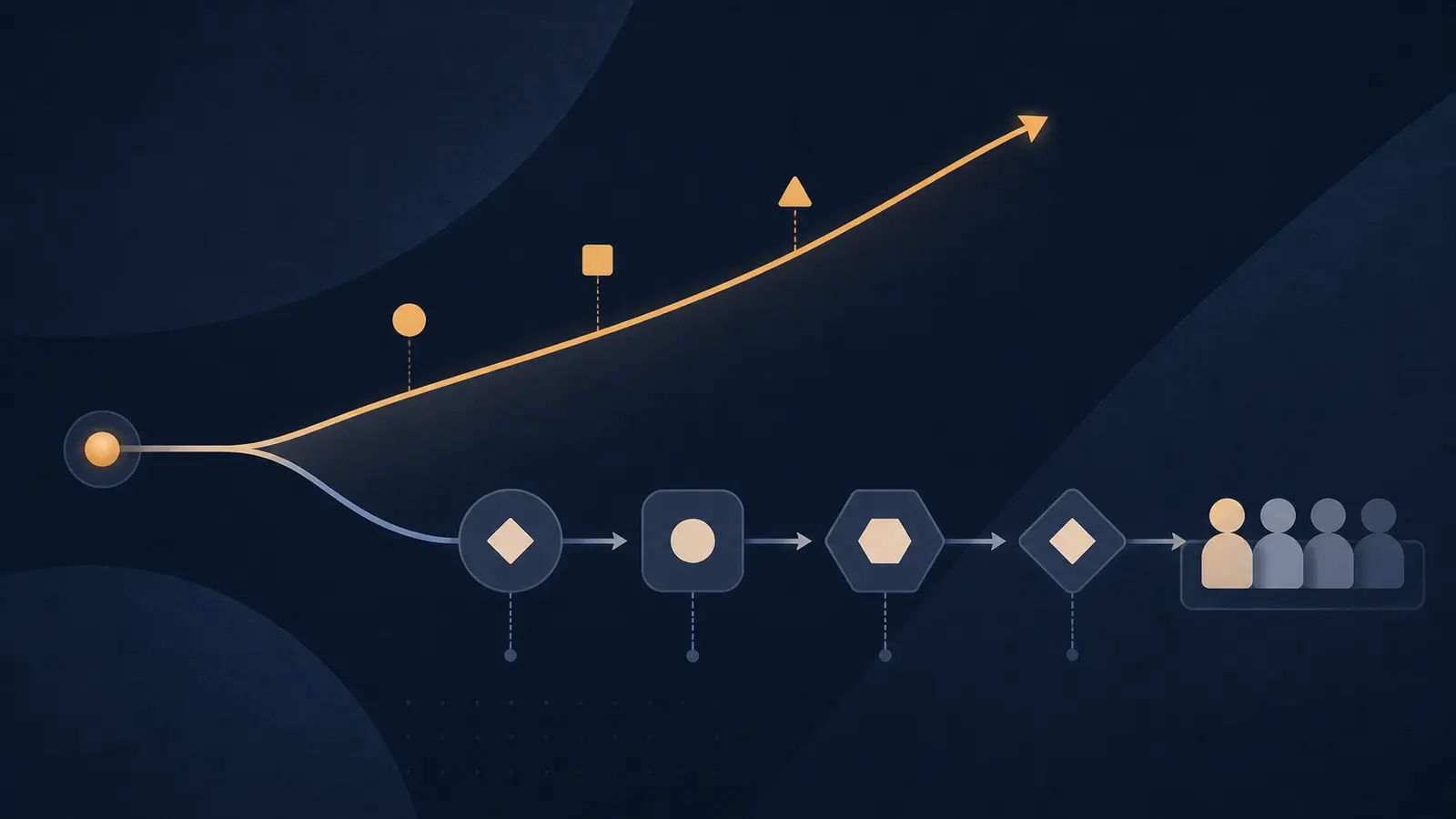
The uncomfortable version of this problem is easy to miss. The score goes up, the demo looks safer, and the operator still waits longer before making the decision.
I tested that failure with a fixed 20-case decision fixture. The result was not “verification is bad.” It was more useful: verification improved the decision score, but it also changed the product from one step into a small queue.
What improved, and what got slower?
The verified configuration won on this fixture, but it was not a free win.
| Metric | Direct pipeline | Verified pipeline | Change |
|---|---|---|---|
| Exact task-and-rationale correctness | 20% | 100% | +80 percentage points |
| Median local machine latency | 0.068 ms | 0.146 ms | 2.15x |
| Sequential calls for 20 cases | 20 | 40 | 2x |
| Routed approval or review turns | 0 | 12 | +12 |
| Measured paid-provider cost | $0.00 | $0.00 | Not a provider-cost estimate |
The decision is therefore conditional. Use the verified path when the recovered errors matter and the review queue can absorb 12 additional routed turns in a comparable workload. These are workflow events, not measured human waiting times. Do not call the result a production SLA. The test used a local deterministic harness, so the absolute milliseconds are only useful as a controlled comparison.
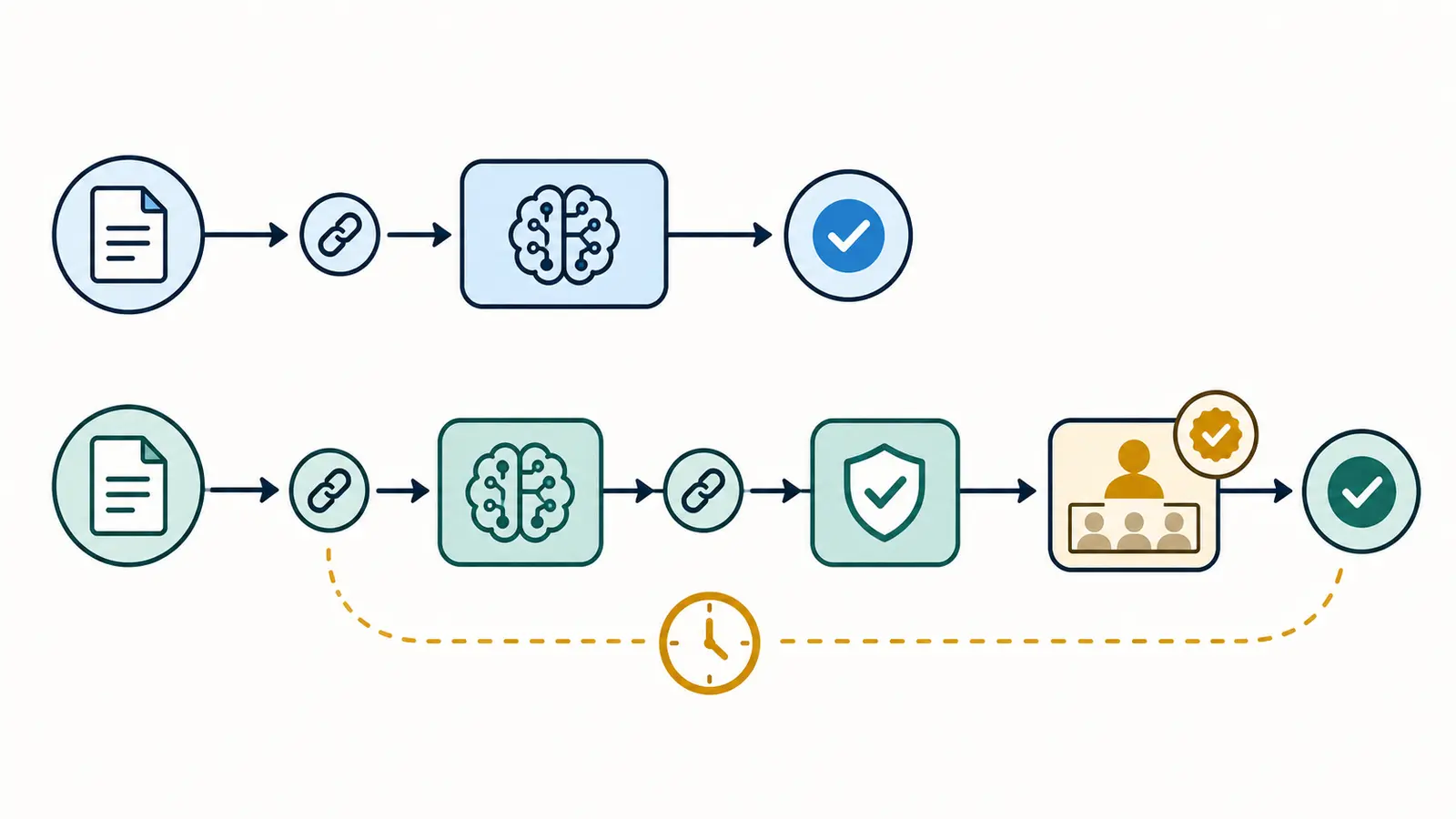
The reusable artifact is the matrix, not the headline percentage: a second stage can improve correctness while making the decision path longer. That is the sourceable result another team can rerun from this page.
Why can a benchmark rise while the decision process slows?
Because a benchmark usually scores an answer or task outcome, while a product workflow also pays for the path to an approved decision.
There are four common ways the gap appears:
- A stronger configuration adds a verifier, critic, retrieval pass, or policy check. The final output improves, but the calls are sequential.
- The system becomes more cautious. More cases are routed to a human, so the model score rises while queue wait and approval turns rise with it.
- The benchmark rewards the final answer but ignores correction, evidence inspection, and handoff time.
- The score changes because the test is easier to optimize than the real input. A model can improve on fixed wording while remaining fragile to paraphrase or changed context.
The Stanford AI Index 2026 describes benchmark saturation as a continuing problem. It also says strong benchmark performance does not always translate to real-world utility and that interactive human-AI work is harder to standardize than isolated model performance. (Stanford AI Index 2026)
That is why “the benchmark improved” is not yet a release recommendation. It is one observation in a larger decision record.
How was the 20-case workflow test run?
I used one fixed product decision workflow: decide whether a proposed AI workflow should be piloted, held, or rejected.
Each sanitized case contained:
- reversibility: high, medium, or low;
- evidence: complete, partial, or missing;
- exception owner: named or none;
- side effect: none or external;
- policy-change rate: low or high;
- a fixed gold decision and reason.
The pass rule was strict. A case passed only when both the decision and the reason matched the gold record. A fluent decision with the wrong explanation failed.
The provider, prompt contract, tools, and infrastructure were constant because the test did not call a provider at all. Both configurations used the same local candidate function. The Direct pipeline ran that function once. The Verified pipeline ran it, then ran one sequential verifier that could correct the recommendation and route a risky case to approval. The runtime was Node.js v24.11.1 on one host. Each case ran 25 times per configuration, with median and p95 local machine time recorded.
This is a pipeline-control test, not a model leaderboard claim. Its job is to isolate the cost of workflow control flow.
The sanitized fixture is small enough to copy into a test file:
| ID | Reversibility | Evidence | Owner | Side effect | Policy change | Gold |
|---|---|---|---|---|---|---|
| C01 | high | complete | named | none | low | pilot |
| C02 | high | partial | named | none | low | pilot |
| C03 | medium | complete | named | none | low | pilot |
| C04 | high | complete | named | none | high | pilot |
| C05 | medium | complete | named | none | high | pilot |
| C06 | high | missing | named | none | low | hold |
| C07 | medium | partial | named | none | low | hold |
| C08 | low | complete | named | none | low | hold |
| C09 | high | complete | named | external | low | hold |
| C10 | medium | complete | named | external | high | hold |
| C11 | high | complete | none | none | low | reject |
| C12 | medium | complete | none | none | high | reject |
| C13 | high | partial | none | none | low | reject |
| C14 | medium | missing | none | none | low | reject |
| C15 | high | complete | named | external | high | hold |
| C16 | high | partial | named | none | high | pilot |
| C17 | low | partial | named | none | high | hold |
| C18 | high | missing | named | external | low | hold |
| C19 | medium | complete | named | none | low | pilot |
| C20 | high | partial | named | external | low | hold |
What did the raw cases reveal?
The direct path failed in two opposite directions. It was over-cautious on some reversible cases and under-cautious on external side effects. The verifier corrected both types.
| ID | Gold | Direct result | Verified result | Median ms A/B | Routed review turns A/B |
|---|---|---|---|---|---|
| C01 | pilot | pilot, pass | pilot, pass | 0.046 / 0.081 | 0 / 0 |
| C02 | pilot | hold, fail | pilot, pass | 0.046 / 0.081 | 0 / 0 |
| C03 | pilot | pilot, pass | pilot, pass | 0.046 / 0.079 | 0 / 0 |
| C04 | pilot | hold, fail | pilot, pass | 0.046 / 0.081 | 0 / 0 |
| C05 | pilot | hold, fail | pilot, pass | 0.047 / 0.084 | 0 / 0 |
| C06 | hold | hold, pass | hold, pass | 0.047 / 0.081 | 0 / 1 |
| C07 | hold | pilot, fail | hold, pass | 0.046 / 0.081 | 0 / 0 |
| C08 | hold | pilot, fail | hold, pass | 0.046 / 0.080 | 0 / 1 |
| C09 | hold | pilot, fail | hold, pass | 0.046 / 0.256 | 0 / 1 |
| C10 | hold | pilot, fail | hold, pass | 0.148 / 0.256 | 0 / 1 |
| C11 | reject | hold, fail | reject, pass | 0.091 / 0.259 | 0 / 1 |
| C12 | reject | hold, fail | reject, pass | 0.149 / 0.212 | 0 / 1 |
| C13 | reject | hold, fail | reject, pass | 0.085 / 0.261 | 0 / 1 |
| C14 | reject | hold, fail | reject, pass | 0.148 / 0.207 | 0 / 1 |
| C15 | hold | pilot, fail | hold, pass | 0.148 / 0.256 | 0 / 1 |
| C16 | pilot | hold, fail | pilot, pass | 0.148 / 0.239 | 0 / 0 |
| C17 | hold | hold, fail | hold, pass | 0.068 / 0.146 | 0 / 1 |
| C18 | hold | pilot, fail | hold, pass | 0.058 / 0.135 | 0 / 1 |
| C19 | pilot | pilot, pass | pilot, pass | 0.085 / 0.149 | 0 / 0 |
| C20 | hold | pilot, fail | hold, pass | 0.086 / 0.146 | 0 / 1 |
That makes the test portable: replace the local candidate with a provider call, preserve the fixture and pass rule, and add token, queue, reviewer-time, and provider-cost logs.
Which recommendation should you reject?
Reject C09's direct recommendation.
C09 had high reversibility and complete evidence, which made “pilot” look plausible. It also had an external side effect. The Direct pipeline returned pilot, fail. The Verified pipeline returned hold, pass and added one approval turn.
That is the failure a benchmark can hide. The final recommendation may look sensible in a static answer comparison, but the workflow has crossed a side-effect boundary. A higher score does not authorize the write.
This is also why I count review turns as a product metric. I’m building TryUncle, an AI agent that watches the screen and annotates it live. In that kind of system, latency and approval are not cleanup work after the model evaluation. They are part of whether the feature is usable. (TryUncle)
How should a team decide whether the slower path is worth it?
Use a veto matrix that keeps semantic correctness, latency, and human capacity in the same decision.
| Observed result | Release decision |
|---|---|
| Benchmark or task score rises, semantic correctness stays flat | Reject the change. The gain has not reached the product decision. |
| Semantic correctness rises, sequential calls rise, review turns stay flat | Continue only if the latency budget tolerates the increase and the recovered errors are worth it. |
| Semantic correctness rises and review turns rise | Use the higher-quality path only where the approval queue has spare capacity and an explicit SLA. |
| Any case contains an external side effect | Veto automatic pilot. Route to approval or keep the workflow read-only. |
| Evidence is missing or a low-reversibility case has partial evidence | Hold until the evidence improves. |
| No exception owner exists | Reject. Technical reversibility does not create operational ownership. |
The useful denominator is not “accuracy per call.” It is successful decisions per unit of operator time. For a first pass, record:
- task-level semantic correctness against a fixed case set;
- end-to-end time from input to approved decision;
- sequential model and tool calls;
- queue wait and human review turns;
- correction and escalation time;
- cost per successful decision, using current provider and tool rates.
The AI workflow evaluation matrix is the broader companion for those fields. The AI workflow evaluation guide is the parent for building the test around a real workflow, not a detached prompt set.
If the offline score passes but users still report failure, the related diagnosis is why AI evaluations pass while users still fail.
What do the research papers add to this diagnosis?
They explain why a standard score should be treated as evidence, not as the whole product decision.
The input-variation study tested paraphrased questions across six benchmarks and 34 LLMs. Rankings were relatively stable, but absolute effectiveness declined significantly when the wording changed. That is a warning for any workflow whose operators do not submit benchmark-shaped inputs. (On Robustness and Reliability of Benchmark-Based Evaluation of LLMs)
The benchmark-leakage paper shows another limit: exposure to evaluation data can dramatically boost scores and make performance assessment unreliable. The score may be measuring adaptation to the test rather than useful generalization. (Don't Make Your LLM an Evaluation Benchmark Cheater)
METR measures something different. Its time horizon asks how long a human expert would need to complete a task before an AI agent reaches a selected reliability level. That is closer to work capacity than a static answer score, although it still is not the same as queue wait or approval latency. (METR Task-Completion Time Horizons)
The 2026 enterprise workflow study makes the production trade-off concrete. It compares six LLMs across 29 real-world IT automation scenarios and two pipeline architectures. Its piecewise pipeline improved structural success, while the authors also reported cost and interactive latency as deployment constraints. The lesson is not that decomposition always wins. It is that structural success and production speed belong in the same evaluation. (Evaluating LLM Trade-offs for Enterprise Automation)
What this test does not prove
It does not prove that a verifier should be added to every AI workflow. It does not compare providers, model families, token prices, network latency, or real reviewer availability. It does not estimate a production SLA. The fixture is small and intentionally boundary-focused rather than frequency-weighted.
It does prove a narrower point: a workflow can buy a large task-score improvement by adding control flow, and that control flow creates measurable costs even before human waiting time is included.
So the next evaluation should preserve the fixture, replace the local candidate with the real provider configuration, and add queue wait, reviewer time, token cost, and failure recovery. If the quality gain survives those measurements, ship the slower path where its errors are expensive. If it does not, the benchmark improvement belongs in the report, not in the product.
If you are evaluating an AI workflow for a team, start with one decision, one fixed case set, and one explicit veto. Marius Manolachi helps teams learn to build and evaluate AI products on their own work through AI consulting and tutoring.
Continue with a related field note
Questions people ask next
Is a higher AI benchmark score always better?
No. Treat it as evidence about a test, then check semantic correctness, end-to-end latency, sequential calls, review turns, cost, and failure severity in the workflow that will actually run.
How should a team measure a slower AI decision process?
Record end-to-end latency from input to approved decision, sequential model and tool calls, queue wait, human review turns, correction time, and cost per successful decision.
When should a team reject a higher-scoring AI pipeline?
Reject it when semantic correctness is flat, when approval capacity is exceeded, or when the latency and review burden exceed the value of the recovered errors.