Field note · architecture
How to Set an AI Autonomy Boundary Before Production
Set an AI autonomy boundary with a reliability-first scorecard before choosing a workflow, single agent, or multi-agent system for production.
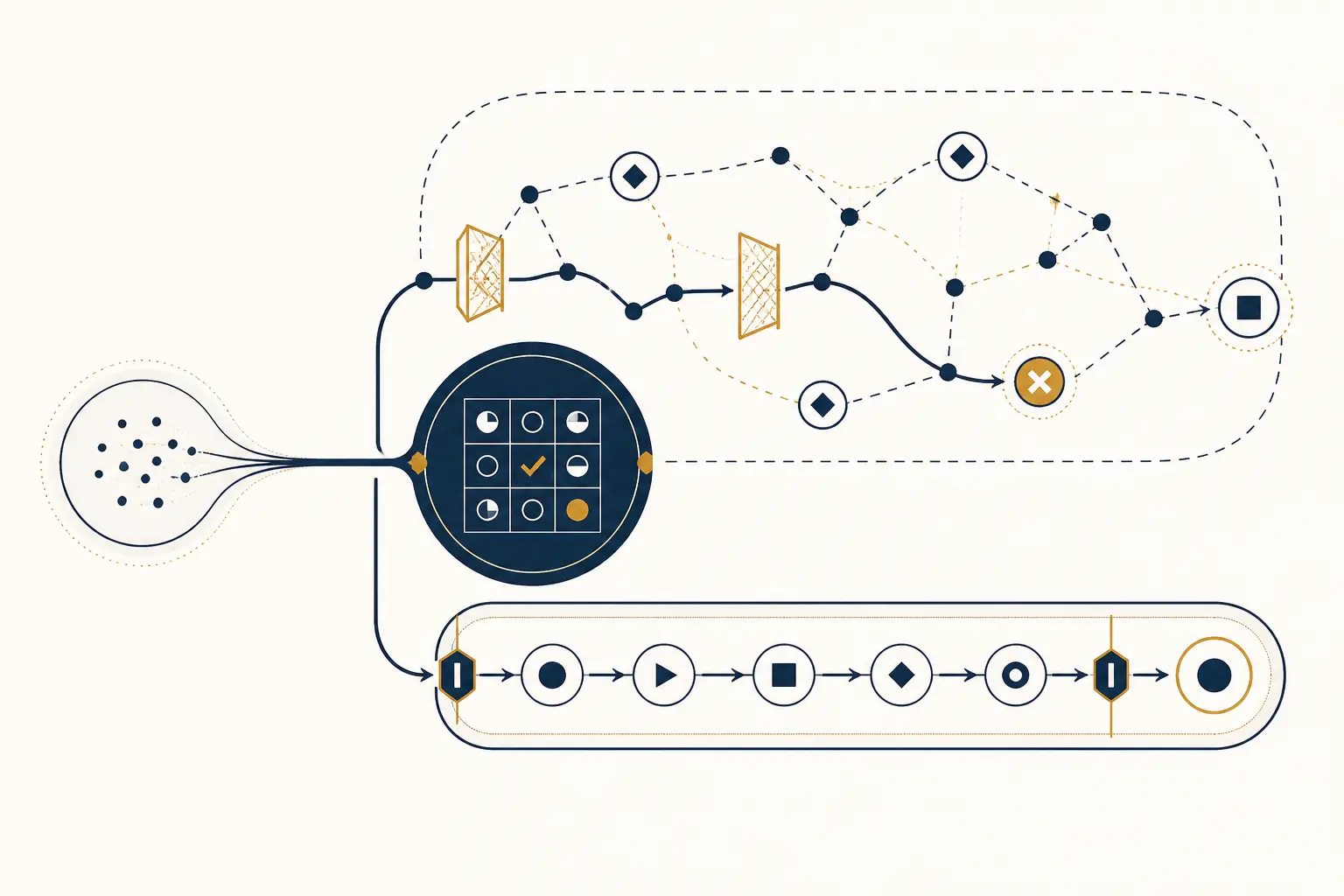
Before an AI system can act in production, set the point where model initiative must stop. You aren't asking which system can do the most on its own. You're asking which system can meet the job while keeping failures visible, bounded, and repairable.
That distinction matters because a demo rewards initiative. Production rewards control. Anthropic, OpenAI, Microsoft, Google Cloud, and AWS all describe versions of the same trade-off: add model-directed autonomy when the workflow needs it, but keep the system as simple as the requirements allow (Anthropic, OpenAI, Microsoft, Google Cloud, AWS).
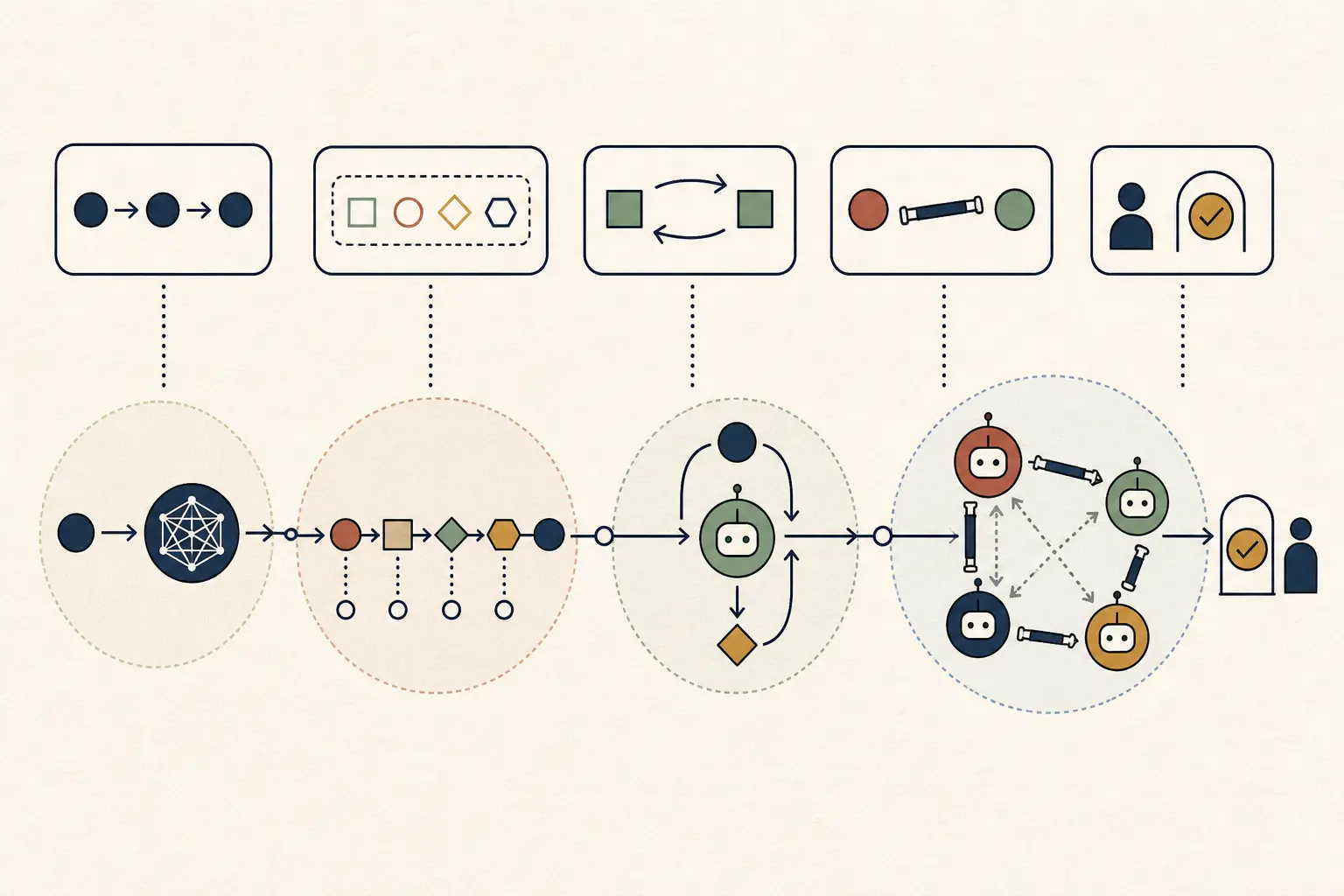
Start with the least autonomous architecture that can work
Use a direct model call or fixed workflow when the steps, checks, and ownership are known. Use a single agent when the next step must be chosen from new evidence. Use multiple agents only when a real boundary or parallel workload justifies the coordination cost.
The distinction is not about whether an LLM appears in the system. Anthropic defines workflows as predefined code paths and agents as systems where the LLM directs its own process and tool use. OpenAI similarly centers an agent on model-managed workflow execution and dynamic tool selection. Both sources leave room for simpler designs when the path is predictable (Anthropic, OpenAI).
| Workflow condition | Sensible starting architecture | Why |
|---|---|---|
| Rules and steps are stable | Deterministic software | The program owns a known path. |
| One bounded step needs language or document interpretation | LLM call inside software | The model helps with interpretation, not control. |
| Several model-assisted stages are known in advance | Fixed LLM workflow | Code owns the sequence and can gate each result. |
| The next step changes with what tools discover | Single agent with narrow tools | The model needs limited control over the path. |
| Work is genuinely parallel or crosses a hard boundary | Multiple agents with explicit orchestration | The split has a concrete job and a handoff contract. |
If you haven't decided whether the workflow needs an agent at all, use the AI architecture pillar and the existing AI agent decision framework. This page turns that broader choice into an autonomy boundary you can defend before production.
Use the reliability-first scorecard
Score six inputs from 0 to 2. The score is a design aid, not a scientific benchmark. Its value is that it makes hidden assumptions discussable before someone grants the model more control.
| Input | 0 | 1 | 2 |
|---|---|---|---|
| Path predictability | The next step depends on new evidence | Some branches are known | The path is stable |
| Model-controlled routing | No model routing is needed | One bounded route is needed | The model must choose the next check |
| Verifiable ground truth | Success is subjective or delayed | A human checks at a checkpoint | Tools or state changes verify progress |
| Action risk and reversibility | High-impact or irreversible without approval | Reversible or approval-gated | Read-only, simulated, or low-impact |
| Context and ownership boundary | One owner and coherent context | Distinct responsibilities share state | Hard security, data, or ownership boundary |
| Latency and cost tolerance | Tight interactive or budget limit | Moderate delay is acceptable | Multiple calls and longer runs are acceptable |
Apply the result with these thresholds:
- Choose deterministic software or a fixed LLM workflow when path predictability is 2 and model-controlled routing is 0 or 1.
- Choose a single agent only when model-controlled routing is 2, verifiable ground truth is at least 1, and risky actions are approved, reversible, or simulated.
- Choose multiple agents only when a hard context or ownership boundary exists, or independent work is genuinely parallel. Define handoff data, failure handling, and auditability first.
- Veto autonomy when action risk is 0 and no approval gate, reversible operation, or simulation contains failure. The system can still extract, prepare, or recommend.
The veto is deliberate. A high-value workflow does not earn the right to make an irreversible mistake.
A fixed workflow wins when the path is known
Choose a fixed workflow when you can name the stages before the run and place a check between the stages. This is the reliability-first default for extraction, policy checks, routing, drafting, and other work with a stable sequence.
Microsoft describes sequential orchestration as a fit for clear linear dependencies and predictable progression. Google Cloud likewise describes deterministic workflows as predictable, sequential paths. Those designs can still use strong models, retrieval, tools, and human approval. The difference is that the program owns the route (Microsoft, Google Cloud).
Here is the worked decision from the research artifact. Imagine a refund-review process with these stages: retrieve the order, retrieve the current policy, check eligibility, calculate the result, prepare a response, and request approval.
| Input | Score | Reason |
|---|---|---|
| Path predictability | 2 | The main stages are known. |
| Model-controlled routing | 1 | An unusual request may need classification, but the route is stable. |
| Verifiable ground truth | 2 | Order state, policy version, eligibility, and approval are checkable. |
| Action risk and reversibility | 0 | A refund changes money. |
| Context and ownership boundary | 0 | One workflow owner can hold the context. |
| Latency and cost tolerance | 1 | A short wait is acceptable. |
Decision: use an LLM inside a fixed workflow, keep eligibility checks deterministic where possible, and require human approval before the money movement. A single autonomous agent would add path freedom without addressing the real constraint, which is controlled authorization.
That is a useful test for architecture proposals: if the proposed autonomy does not remove the constraint that caused the workflow to fail, it is extra surface area.
A single agent earns its place when the path changes
Use a single agent when the task is open-ended enough that the next useful step cannot be listed in advance, but one coherent context and one owner can still carry the work. Require fresh tool results, a stop condition, iteration limits, and a clear return-to-human path.
Anthropic describes agents as useful for open-ended problems where the number and order of steps are hard to predict. It also stresses environmental feedback, checkpoints, and stopping conditions. Microsoft recommends iteration limits to guard against infinite tool-call loops. These are not optional polish when reliability matters (Anthropic, Microsoft).
The single-agent choice is strongest when all of these are true:
- The next action depends on evidence retrieved during the run.
- The tool set is narrow enough that each tool has a distinct purpose.
- The environment can confirm whether an action worked.
- The agent can stop, escalate, or return a partial result.
- High-impact actions have approval or a reversible transaction path.
Marius Manolachi is building TryUncle, an AI agent that watches the screen and annotates it live. That kind of system makes latency and human approval product constraints, not cleanup tasks for later. The observation is specific to that product, not a general performance claim.
The cost of the single-agent design is uncertainty. AWS describes agent behavior as stochastic and says reliability work must account for that with monitoring, evaluation, and graceful degradation rather than deterministic tests alone (AWS). If you cannot observe progress, keep the model assistive.
For the narrower decision of one agent versus several, see the existing single-agent comparison. It covers the split decision; this scorecard adds the reliability veto that applies before either choice.
Multiple agents need a boundary, not enthusiasm
Use multiple agents when the split buys a real property: independent work can run in parallel, separate responsibilities need separate permissions, or a context and ownership boundary is too large or sensitive for one worker. Otherwise, start with one agent or a fixed workflow.
Microsoft lists specialization and separate security boundaries as reasons to consider multi-agent orchestration, while warning that coordination adds overhead, latency, and failure modes. Google Cloud makes the same trade-off: multi-agent patterns can improve modularity, but they require additional evaluation, security, reliability, and cost work (Microsoft, Google Cloud).
Before approving the split, write down:
- The boundary each agent owns.
- The minimum context it receives.
- The schema and validation rules for handoffs.
- What happens when an agent times out, returns malformed output, or disagrees.
- Which agent or human owns the final decision.
If you can't answer those questions, the design is not modular yet. It is distributed ambiguity.
Reliability is an architecture property, not a final test
After choosing the pattern, add controls that make failure visible and recovery possible. Microsoft recommends timeouts, retries, graceful degradation, surfaced errors, output validation, circuit breakers, isolation, and checkpoints for orchestrated systems. AWS emphasizes bounded autonomy, auditability, and oversight matched to risk and reversibility. OpenAI recommends layered guardrails alongside authentication, authorization, and strict access controls (Microsoft, AWS, OpenAI).
Use this minimum release check:
- Can you replay the input and see every model call, tool call, approval, and state change?
- Can the workflow stop without claiming success when a tool fails?
- Does each risky action have a permission boundary and an owner?
- Can a person inspect the proposed action before it executes?
- Can the system produce a useful partial result when an agent or dependency is unavailable?
- Do representative cases include missing context, conflicting data, tool failure, and escalation?
If the answer is no, changing the architecture may be less urgent than adding the missing boundary. The design should expose the operator's decision points instead of hiding them inside a model loop. For a related implementation concern, see how to design an AI agent state machine.
Revisit the choice when the workflow changes
Architecture selection is not permanent. Google Cloud recommends revisiting the choice as workload characteristics and requirements change. Re-score the workflow after a new data source, a new action, a policy change, a larger context, or a meaningful shift in latency or cost requirements (Google Cloud).
The upgrade path should be evidence-led:
- Start with the simplest architecture that meets the current requirement.
- Capture failures and operator corrections.
- Identify the specific constraint the current design cannot handle.
- Add only the autonomy or separation needed for that constraint.
- Re-run the scorecard and keep the old path available until the new one earns trust.
Reliability-first architecture does not mean avoiding agents. It means making autonomy prove its necessity. If a fixed workflow can meet the requirement with clearer checks and smaller failure paths, choose it. If the path truly changes with evidence, use a bounded single agent. If a hard boundary or real parallelism exists, split carefully and make the handoffs inspectable.
For teams building on their own work, Marius Manolachi teaches the move from writing specifications to building, shipping, and automating around the product. The useful next step is not a larger diagram. It is a scorecard filled out against representative cases, with an owner who can explain why each point was awarded.
Questions people ask next
Should reliability-first teams avoid AI agents entirely?
No. Use an agent when the path genuinely changes with live findings, the system can observe progress, and autonomy is bounded by permissions, stopping conditions, and human review where actions are high impact.
When should an AI architecture use multiple agents?
Use multiple agents for a real security, data, ownership, or parallelism boundary. Do not split a workflow simply to make the diagram look more sophisticated.