Field note · opportunity
How to Identify an AI Opportunity Where Errors Are Cheap to Reverse
A practical, evidence-backed test for finding AI work where a wrong output can be caught, discarded, and corrected before it becomes an expensive business action.
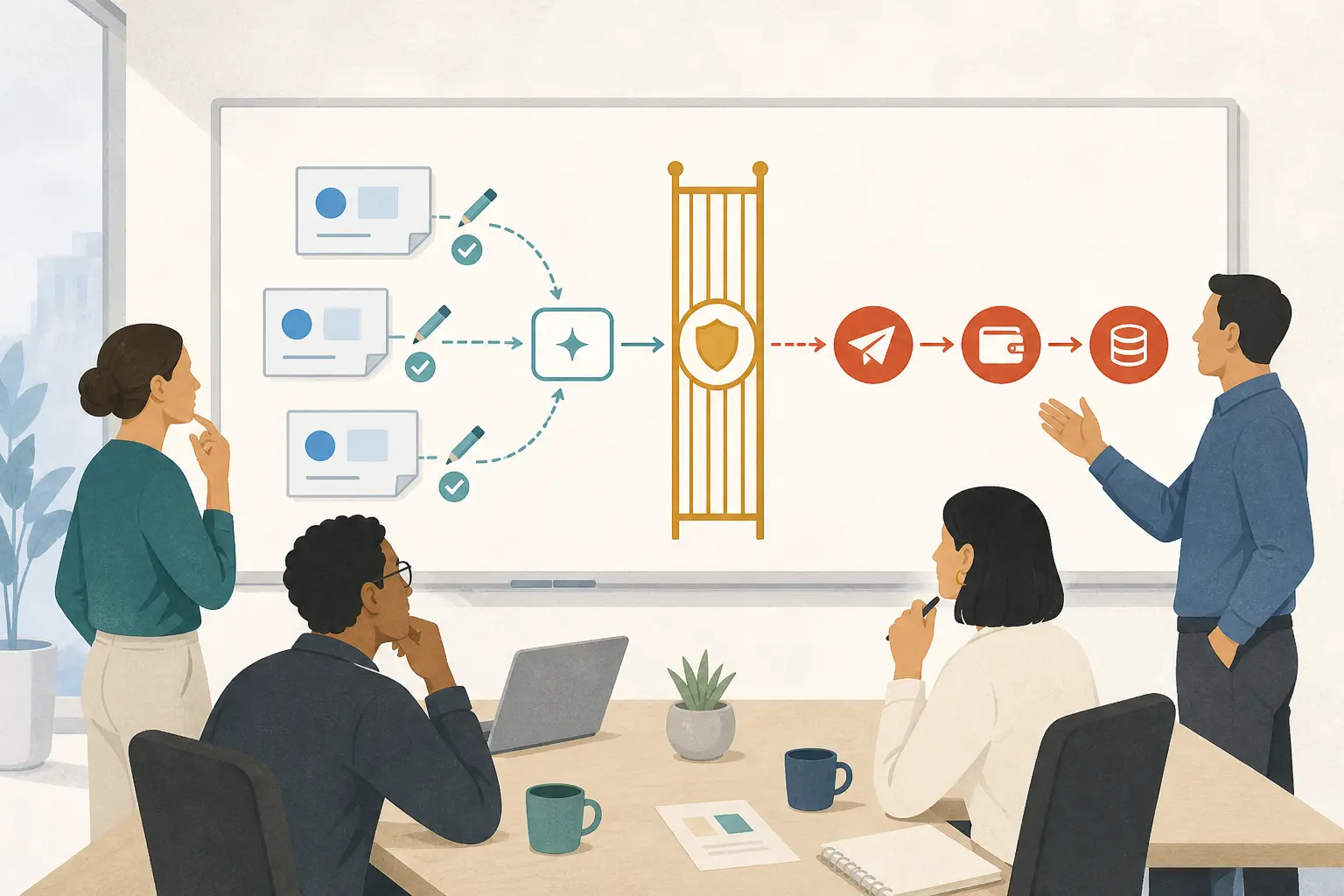
When I taught product managers to move from writing specifications to building and shipping, the recurring failure was often simple: nobody could say what “done” meant. The same problem appears earlier when a team chooses an AI opportunity. People argue about upside before they agree on what happens when the system is wrong. (Marius Manolachi’s teaching context)
The practical answer is to inspect the first action, not the grandest version of the idea. This narrower question sits inside the broader AI opportunity discovery guide, which covers the larger discovery job before a team ranks candidates.
The result: start where a wrong output stays local
Start with a first action that a person can inspect before consequence, correct or discard one bad result, keep the failure local, and pause or escalate the workflow. If one of those conditions is missing, narrow the action before comparing its potential value with other opportunities. This is a source-grounded editorial artifact, not a validated benchmark.
The table below is the reusable result. It applies the same four checks to common first-action shapes.
| First action | Review before consequence | Local correction | Limited blast radius | Pause or escalation path | Decision |
|---|---|---|---|---|---|
| Draft an internal brief from approved notes | Yes | Discard or edit one brief | One draft | Yes | Investigate |
| Extract invoice fields and flag mismatches | Yes | Compare with the source record | One record, no payment action | Yes | Investigate |
| Classify support requests for a human router | Yes | Reroute one request | Usually, if routing is reviewed | Yes | Investigate with review |
| Draft a customer reply without sending it | Yes | Edit or discard one draft | One case | Yes | Investigate with approval gate |
| Send customer replies automatically | No, unless approval is added | External impact may happen first | Can spread across messages | Maybe after the fact | Narrow to draft |
| Update CRM records automatically | Not necessarily | Identity and rollback may be unclear | A wrong record can trigger more work | Often unclear | Narrow to read or propose |
| Approve or release a payment | No | Recovery is not the same as undo | Financial consequence | Must be outside the first action | Reject current action |
| Rank job candidates for a hiring decision | Not sufficient | A later reviewer may inherit the error | High-impact human outcome | Requires specialist governance | Redesign for structured notes |
The reversibility lens comes from a real risk distinction. Partnership on AI says the need for failure detection depends on the stakes of an action, its reversibility, and the system’s affordances. It gives financial transactions, deletion or overwriting, and sending communications as irreversible examples, while sandboxed or test environments are reversible examples. Partnership on AI’s report supports the conditions, but not this table’s classification.
The table is intentionally action-specific. “Customer support AI” is too broad to classify. “Draft a response for a support owner to approve” is classifiable.
What counts as cheap to reverse?
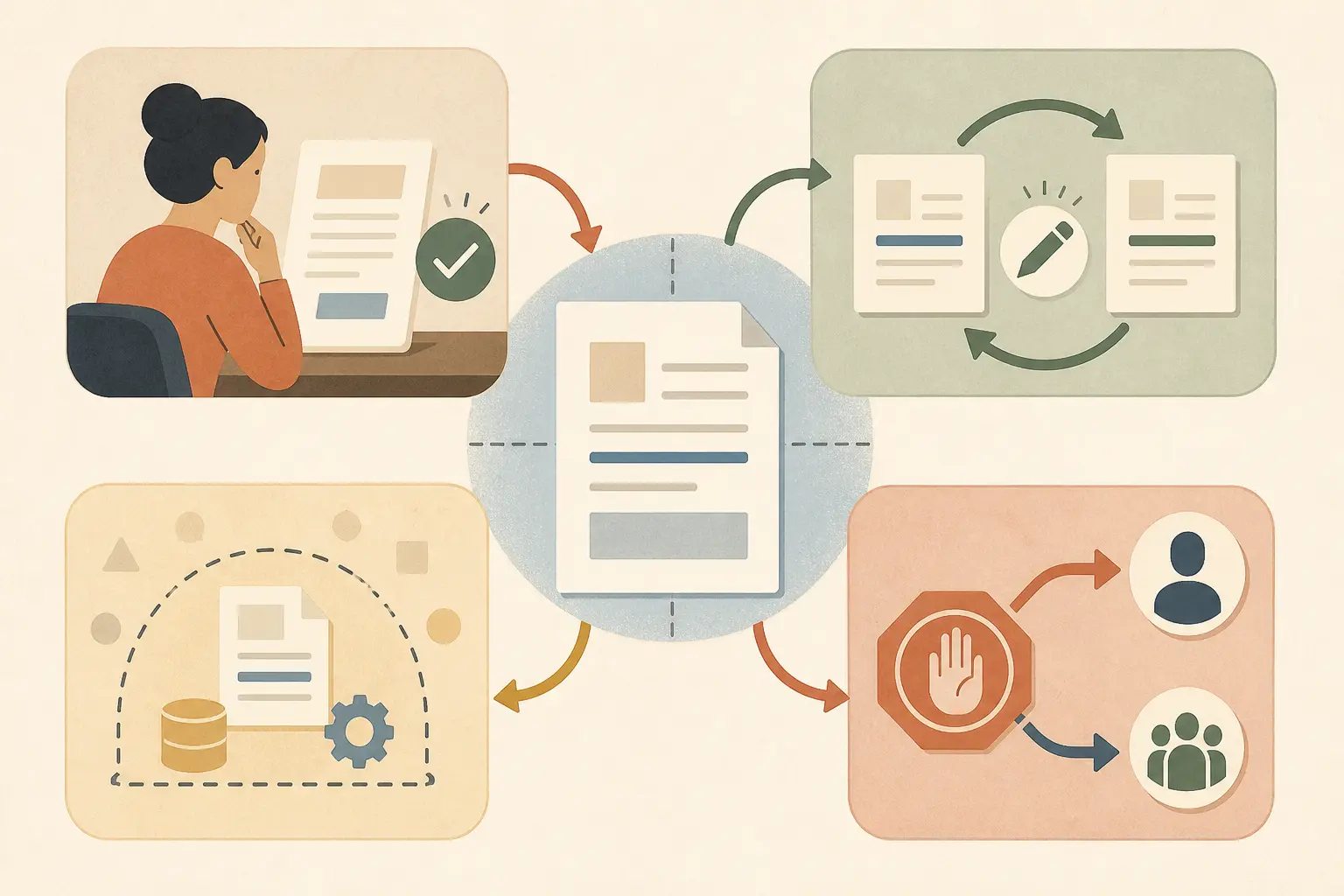
An AI error is cheap to reverse when the team can detect it before the consequential step, repair or discard the affected item, limit the blast radius, and stop the workflow without reconstructing hidden state.
Use these four tests:
| Test | Passing question | Failure signal |
|---|---|---|
| Review before consequence | Can a named person inspect the output before it is sent, paid, deleted, published, or used in a high-impact decision? | The system acts first and the reviewer discovers the result later. |
| Local correction | Can the team correct or discard one output without repairing downstream records, messages, or decisions? | The only recovery path is a manual cleanup across several systems. |
| Limited blast radius | Does one bad output affect one item, one draft, or one proposed action? | A single run can update many records, contact many people, or change shared state. |
| Pause or escalation | Is there a clear stop, approval, or escalation path that the owner can use during the pilot? | Nobody can say who pauses the system or what event triggers a pause. |
This definition is narrower than “the system has a human in the loop.” The 2026 npj Digital Medicine article on meaningful oversight argues that human presence alone does not make oversight meaningful. The person also needs knowledge, time to think, authority to disagree, and an intervention that works in practice. Those conditions were developed for medical AI, so I use them here as a warning about workflow design, not as a claim that every business process has the same risk.
NIST’s AI Risk Management Framework makes the same decision more general. Its mapping guidance asks teams to document the context, business value, risk tolerance, system limits, potential benefits and costs, and human oversight. Its measure guidance calls for testing before deployment and regular monitoring in operation. That supports a reversal test as an early gate, not as a substitute for evaluation.
How do you turn a vague AI idea into a reversible candidate?
Rewrite the idea as a business result plus a bounded first action. Do not rank “an AI sales assistant” or “an autonomous back office.” Those phrases hide the action surface.
Use this procedure:
- Name the work result. Write what should improve, such as time to a reviewed first response, not “add AI to support.”
- Name the owner. Choose the person who decides whether the result is useful and handles an exception. “The team” is not an owner.
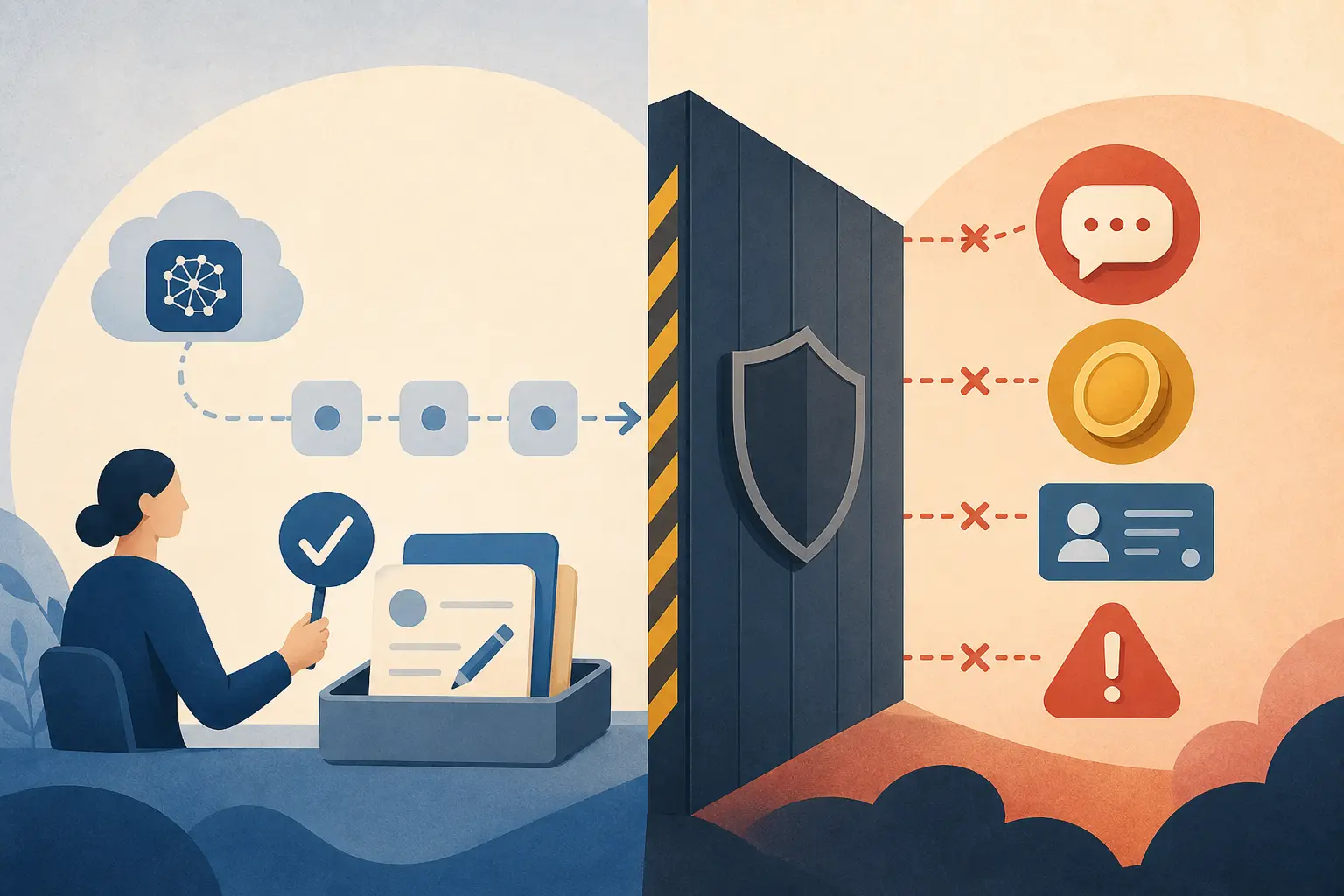
- Choose the smallest first action. Prefer read, extract, classify, recommend, or draft. Keep send, approve, delete, publish, permission changes, and irreversible record updates out of the first version unless the workflow has a very strong control path.
- Write the review point. State exactly where a person sees the result and what they check. “Human review” is not enough. Name the source, rubric, comparison, or approval decision.
- Describe one-error recovery. Take one wrong output and write the correction steps. If you need a cross-system cleanup, the opportunity is not cheap to reverse yet.
- Write the stop condition. State what would pause, narrow, or reject the pilot. Include who can make that call.
- Record the next missing evidence. If the work is valuable but the owner, examples, source of truth, or review method is missing, prepare that artifact before building.
The smallest useful candidate usually looks like this:
Improve [business result] in [workflow] for [person or customer] by producing [bounded AI output], while [owner] reviews it before [consequence] and can discard or correct one result without repairing downstream state.
For example:
Reduce the time to prepare a reviewed first response for a support owner by classifying the request and drafting a source-linked reply. The support owner approves, edits, or rejects the draft before it is sent.
That candidate is not automatically good. It is now specific enough to test. Marius Manolachi’s existing guide on how to prioritize AI use cases in a small business covers the broader comparison after a candidate has an owner, a checkable outcome, and a safe action boundary. This article’s job is to make the action boundary concrete before the score hides it.
Which opportunity shapes pass the test first?
For this decision aid, a first pilot passes when the AI produces an inspectable intermediate result and the existing operator still owns the consequential decision.
| Opportunity shape | Safer first action | What the owner checks | What stays out |
|---|---|---|---|
| Internal reporting | Assemble a source-linked briefing | Whether each claim points to an approved source and the conclusion is fair | Automatic operational changes |
| Document intake | Extract fields and flag missing or mismatched values | Fields against the source document and exception reasons | Payment approval or record write |
| Support operations | Classify and draft a response | Topic, urgency, policy support, and escalation | Automatic send, refund, or promise |
| Sales operations | Draft a proposal from approved language | Scope, pricing, commitments, and missing information | Sending a promise or changing a contract |
| Meeting follow-up | Propose actions, owners, and dates | Whether the decision and owner are represented correctly | Treating the draft as assigned work without confirmation |
| Knowledge work | Retrieve source passages and draft an answer | Whether the sources support the answer and whether uncertainty is visible | Answering a high-impact question without specialist review |
These shapes are not safe because they contain the word “draft.” A draft can still expose confidential data, invent a commitment, or be accepted without thought. The first action passes only if the review is real and the data boundary is allowed.
The older Enterprisers Project guidance on identifying AI opportunities is useful here as background: start from measurable inefficiencies and decisions rather than from a tool catalog. Its 2019 expert guidance is not current evidence for a safety threshold, so treat it as candidate-wording context, not authority for the artifact.
When does a reversible-looking opportunity still fail?
It fails when the visible output is reversible but the surrounding workflow is not. Four failure modes are easy to miss.
The reviewer is only decorative
If the reviewer has seconds to approve a long queue, no authority to disagree, or no clear evidence to inspect, the control is ceremonial. A button labelled “approve” does not create oversight.
Fix it by naming the review object, expected review time, rejection path, and person who can pause the pilot. If the team cannot provide those, keep the system in a shadow or read-only mode.
The data boundary is unclear
A draft can be low-consequence for the recipient and still high-consequence for the business if the model receives data it should not access. NIST treats privacy, third-party components, system limits, and context-specific impacts as part of the mapping work.
Fix it by writing what the system may read, what it may not read, where the data goes, and what is retained. If the boundary cannot be enforced, the opportunity is not ready for a cheap-to-reverse pilot.
One wrong identity spreads the error
A proposed CRM update may look reversible until the system selects the wrong person, writes the wrong record, triggers an automation, and leaves a reviewer to reconstruct what happened. The first action should be read-only identity resolution or a proposed change with an explicit match review.
Fix it by making ambiguous identity a stop condition and keeping writes out of the first slice. A later rollback feature does not make an uncontrolled write cheap to reverse.
The task is high-impact even when the output is a recommendation
A hiring rank, credit recommendation, health suggestion, legal position, or access decision can affect a person before a reviewer meaningfully challenges it. The npj Digital Medicine research describes why knowledge, cognitive space, authority, and effective intervention matter in high-consequence settings. Partnership on AI likewise treats stakes and reversibility as first-order factors for agents that act in the environment.
Fix it by redesigning the opportunity around a lower-consequence support task, such as structuring source information or preparing questions for a qualified decision-maker. Do not use a high score for theoretical savings to erase a weak control path.
What should you do before building?
Run a small evidence exercise that tests the control path, not just the quality of the AI output.
- Collect representative work. Use real or properly authorized examples that include ordinary cases, ambiguous cases, and known exceptions. Do not use one polished demo as the dataset.
- Run the smallest action. Ask the system to read, extract, classify, recommend, or draft. Do not grant the later write or send permission just to make the demo feel complete.
- Log the review. For every result, record pass, edit, reject, reason, review time, and whether the owner could identify the source of truth.
- Rehearse one failure. Deliberately choose a case where the output is incomplete, uncertain, or wrong. Walk through correction and confirm that no downstream repair is required.
- Test the stop path. Pause the run, escalate one case, and confirm who sees the event. A stop condition that nobody has rehearsed is only a sentence.
- Decide the next state. Continue to a bounded pilot, narrow the action, prepare missing evidence, or reject the opportunity. Record the reason.
NIST’s Measure function supports the discipline of documenting test sets, metrics, methods, limitations, and monitoring. It does not require a universal sample size in the source, and this article does not invent one. Choose a case set large enough for the owner to see normal variation and relevant exceptions, then document what it cannot represent.
Use this compact review record:

| Field | Entry |
|---|---|
| Candidate result | What business result should improve? |
| First AI action | Read, extract, classify, recommend, or draft what? |
| Consequence boundary | What may the system not send, pay, delete, publish, or change? |
| Reviewer | Who checks every result before consequence? |
| Check | What source, rule, rubric, or comparison supports the review? |
| One-error recovery | What exact steps correct or discard one wrong result? |
| Blast radius | What is the largest number of records, people, or actions one run can affect? |
| Stop condition | What pauses the pilot, and who can invoke it? |
| Next evidence | Which missing fact could change the decision? |
If the record contains “unknown” in reviewer, check, one-error recovery, or stop condition, do not score the opportunity as ready. Prepare the missing evidence first.
For the next readiness check, see how to tell if a business process is ready for AI automation. For a safer rollout path, see how to roll out an AI feature safely.
What this artifact does not prove
Passing the reversal test means only that the first action has a credible control path. It does not prove that the opportunity is valuable, that the model is accurate, that the data is permitted, that the team has capacity, or that the workflow will be adopted.
It also does not mean the team should build an agent. A deterministic rule, ordinary automation, manual process change, or better source document may be clearer and safer for the same result. NIST explicitly includes viable non-AI alternatives in risk management and says decisions should consider benefits, costs, impacts, risk tolerance, and available resources.
The test is a filter. It stops a large promise from hiding a bad first action. After that, use evidence and value to decide whether the opportunity deserves a pilot.
The next decision
Take one AI idea and rewrite it as a first action. Then ask four questions: can someone review it before consequence, correct one result locally, limit the blast radius, and stop the workflow? If the answer is no, narrow the action before you debate its upside.
I use this kind of work to help teams become capable of building and evaluating AI on their own workflows. If you want help running the discovery and evidence exercise, you can learn about working with Marius Manolachi. The article’s decision still stands without that next step.
Continue with a related field note
Questions people ask next
Is a human review step enough to make an AI opportunity safe?
No. The reviewer also needs enough knowledge, time, authority, and a practical way to pause, change, or reject the AI-mediated action before harm propagates.
What should an AI system do first in a reversible pilot?
Start with a read-only, extraction, classification, recommendation, or draft action that a named owner can inspect before anything is sent, paid, deleted, or changed.