Field note · capability
Why Professionals Learn AI Techniques but Miss Workflow Assumptions
A workflow-assumption audit shows why technique-trained professionals miss undefined outcomes, handoffs, exceptions, owners, and verification gates.

When I taught product managers to ship instead of only writing specs, the failure was almost never the model. It was that nobody could say what done meant. Marius Manolachi's AI consulting work is built around that gap between knowing a technique and using it on real work.
The practical test is simple: audit the workflow before adding another technique.
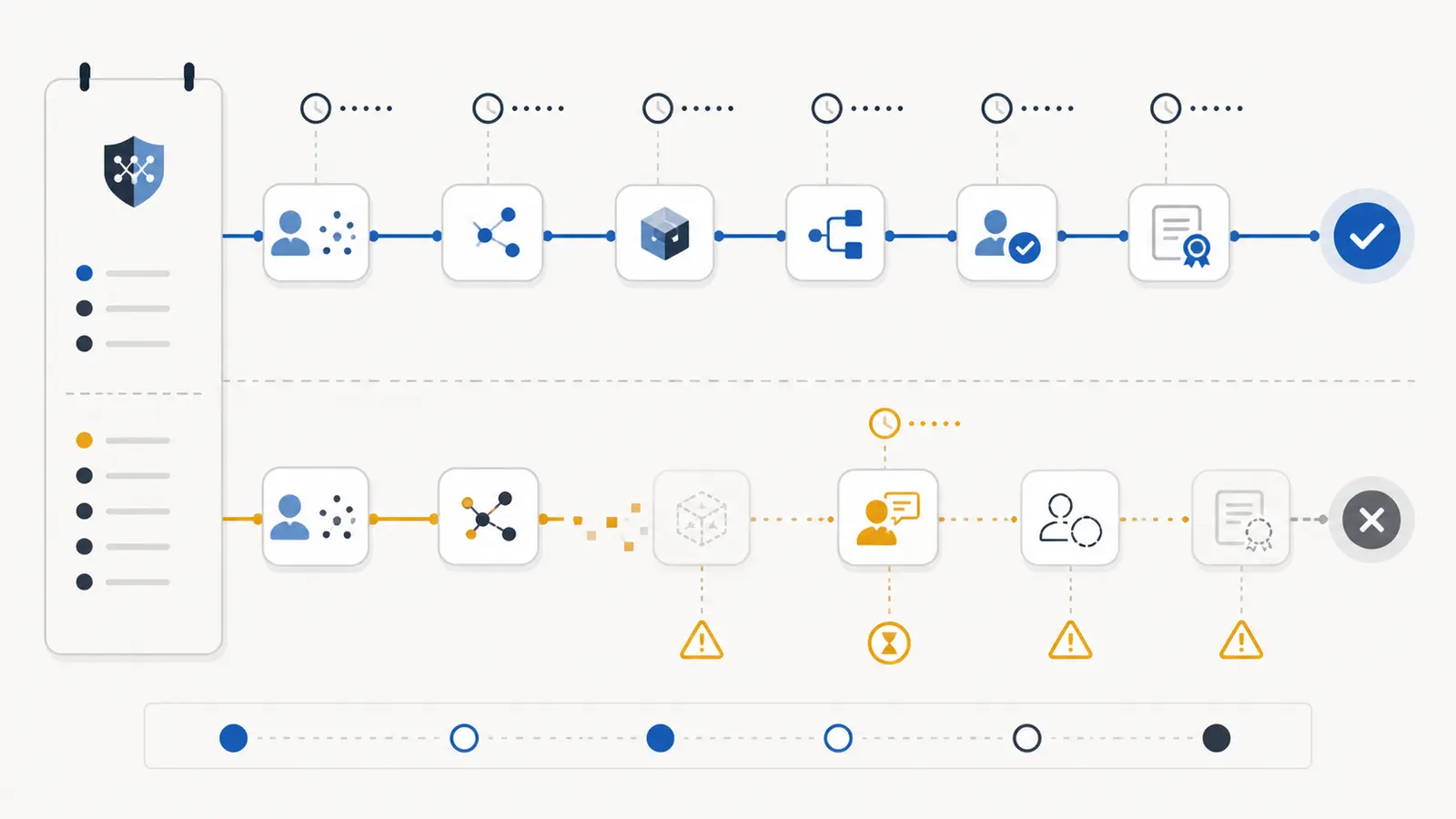
What did the audit change?
The audit changed a representative product-manager decision from “launch Friday” to “pause, repair instrumentation, and review segment-specific evidence.” The model or prompt did not change. The workflow contract did.
| Technique-first workflow | After the assumption audit |
|---|---|
| Paste feedback and metrics into AI. Ask for themes and a launch recommendation. | Define the launch decision, segment, evidence window, acceptance criteria, and owner first. |
| Treat a fluent summary as the review. | Require source-linked claims, visible unknowns, and an independent check of gating evidence. |
| Post “launch Friday” to the channel. | Pause when data is stale or mixed, a blocker has no owner, or rollback is undefined. |
This is a fully documented representative workflow, not a client case or a prevalence statistic. The sourceable result is the changed decision produced by the completed audit.
Why do AI techniques hide bad workflow assumptions?
An AI technique improves a step. A workflow assumption decides whether that step is connected to a valid outcome. If the outcome, context, or owner is vague, a better prompt can make the wrong process look more polished.
The HBS and BCG field experiment makes the distinction concrete. It evaluated 758 consultants and found large gains on tasks within the AI frontier, including more than 25% faster work, more than 40% higher human-rated performance, and more than 12% higher task completion in the HBS summary. The same work describes a “jagged technological frontier”: AI helps on some tasks and falls short on others. Those are task-level results, not proof that a surrounding workflow is ready. Read the HBS AI Institute summary and the working paper.
The hidden leap is this: “The technique worked on the example” becomes “the workflow is understood.” That leap skips the questions that determine whether the result can be trusted:
- What decision is this output supposed to support?
- Which inputs are required, and which context is missing?
- Who receives the work next?
- What happens when the evidence conflicts or the input is out of scope?
- Which human owns the decision?
- What test proves the decision is ready?
- What condition stops the process or sends it back for revision?
NIST's Generative AI Profile treats these as risk-management questions, not optional documentation. It says risk depends on lifecycle stage, scope, use case, and the AI actors involved. It also calls for defined human-AI roles, independent evaluations, and representative pre-deployment testing. See NIST AI 600-1.
What belongs in a workflow-assumption audit?
Use one page. The audit should be short enough to complete before a training exercise and specific enough to change a decision.
| Field | Write this down |
|---|---|
| Desired outcome | What observable decision or state should exist when the work is done? |
| Current steps | What actually happens today, including the informal steps? |
| Hidden assumptions | What must be true for each step to be safe and useful? |
| Inputs and missing context | Which sources, dates, segments, permissions, definitions, or constraints are required? |
| Handoffs | Who supplies, reviews, changes, approves, or receives the work next? |
| Exceptions | Which messy, stale, conflicting, sensitive, or irreversible cases change the path? |
| Human decision owner | Who can approve, reject, pause, narrow, or escalate? |
| Verification test | What evidence proves the intended outcome, not just a plausible output? |
| Stop/revise rule | What exact condition sends the work back or stops it? |
The audit separates technique skill from workflow judgment. Someone may know how to ask for a summary and still be unable to say what the summary must prove. That is the failure to diagnose.
The Department of Labor's AI Literacy Framework points in the same direction. Its foundational content areas include understanding AI principles, exploring uses, directing AI, evaluating outputs, and using AI responsibly. Its delivery principles include experiential learning, embedding learning in context, and building complementary human skills such as judgment and problem-solving. A technique-only lesson covers only part of that list. Read the Department of Labor framework.
How does the audit work on a professional task?
The representative task is ordinary: a product manager prepares a recommendation on whether a feature should launch to a defined customer segment on Friday. The packet contains customer feedback, a KPI snapshot, project notes, known blockers, and a launch constraint.
Reproduction: the technique-first path
- Export the last 30 days of customer feedback and the KPI snapshot.
- Paste both into an AI tool and ask for themes plus a launch recommendation.
- Copy the fluent answer into a decision memo.
- Skim for obvious errors.
- Post “launch Friday because sentiment is positive and the main KPI is stable.”
This path feels efficient because every step is familiar. It also contains several untested assumptions: that the data describes the same population, that positive sentiment means launch readiness, that the main KPI is defined consistently, that a fluent summary exposes important errors, and that posting the recommendation completes the handoff.
The original map has no explicit rollback owner. It has no rule for mixed segments, stale telemetry, an unresolved blocker, or a single high-severity customer report. Its definition of done is a persuasive memo.
Diagnosis and repair: the assumption-audited path
- Define the decision: approve, narrow, or pause this feature for this segment, using this evidence window.
- Collect dated sources and label the segment, metric definitions, acceptance criteria, blockers, privacy boundary, release owner, and rollback owner.
- Mark missing context before asking AI to work. Missing context is an audit result, not a prompt-writing problem.
- Use AI for source-linked extraction, comparison, and unknowns. Do not let it own the launch decision.
- Have the named decision owner compare the evidence against the acceptance criteria.
- Ask a reviewer to check the highest-cost claims against the sources.
- Record the decision, action owner, due date, and rollback condition.
The revised recommendation is to pause the Friday launch, repair the segment instrumentation, resolve the blocker owner, and return with current evidence. The repair is not a more elaborate prompt. It is a different workflow with an observable outcome and a human authority boundary.
The OECD's case studies explain why this distinction matters after training. In many cases, training introduced AI tools and their basic functionality. The report also describes worker involvement helping teams identify use cases, find mistakes, and improve how systems fit the work. The worker's judgment is part of the implementation evidence, not an optional reaction after deployment. Read the OECD workplace case studies.
What should AI training test after the technique?
Ask the learner to audit an unfamiliar task before choosing a tool or prompt. The transfer check is whether they can make the workflow legible, not whether they can reproduce the instructor's sequence.
Use this five-part exercise:
- Give the learner a real or sanitized task packet with one missing piece of context and one plausible exception.
- Ask them to fill the nine audit fields without AI assistance.
- Let them choose a technique and apply it to the task.
- Require a verification test and a stop/revise rule before they share the output.
- Change one condition, such as the segment, source date, owner, or reversibility, and ask them to revise the workflow.
The learner has demonstrated more than technique recall if the changed condition changes their workflow or decision. If they simply add more context to the prompt, the training has not yet reached the assumption layer.
This also explains why the exact teaching observation matters. The problem I have seen with product managers was not a measured failure rate. It was a repeated teaching lesson: when the work moved from specifications to shipping, “done” had to become concrete before the technique became useful. Treat that observation as bounded qualitative evidence, not as a claim about all professionals.
For a broader practice loop, use How to Make AI Training Stick in a Small Team. For a failure trace that teaches inspection of intermediate artifacts, use How to Learn AI Workflow Debugging From a Real Failure. The capability cluster's parent page is the right place to connect this audit to adjacent learning decisions.
When should you stop or revise the workflow?
Stop or revise before adding another technique when any of these conditions holds:
- the desired outcome cannot be observed;
- a gating input is stale, contradictory, or missing;
- the task has an exception that changes the decision but no path for it;
- nobody is accountable for approving, rejecting, or escalating;
- the verification test checks wording but not the real outcome;
- the action is irreversible and there is no approval or rollback path;
- the data boundary is unclear for sensitive or restricted inputs.
Continue with a bounded technique when the outcome is observable, the inputs are permitted and sufficient, the human owner is named, the action is reversible or low-risk, and the verification gate is explicit.
The principal exception is a low-risk draft task with complete inputs, visible human review, and no external side effect. You can start with a technique there because the human review and reversibility limit the cost of a wrong draft. Even then, record what the reviewer is checking. “Someone will look at it” is not a verification test.
What is the next practical step?
Take the next AI technique your team plans to teach and replace the opening prompt exercise with the nine-field audit. If the learner cannot name the outcome, missing context, exceptions, decision owner, verification test, and stop rule, the next lesson is workflow clarification.
Marius Manolachi helps people and teams build AI products on their own work through AI consulting and tutoring. If the audit exposes a real capability gap, bring the workflow to a working session. The article is complete without that step. The audit is the thing to use.
Questions people ask next
Is a workflow-assumption audit the same as process mapping?
Not quite. Process mapping records what happens. A workflow-assumption audit also names what must be true for the process to produce a valid decision, who owns that decision, how it will be verified, and when the team must stop or revise.
What if my AI task has no handoff?
Keep the handoff field and write “none.” Then name the person who owns the decision and the next external consequence. A one-person workflow can still fail through missing context, an untested exception, or an invisible review step.
How do I know whether AI training transferred to work?
Give the learner an unfamiliar task and ask them to define the outcome, assumptions, owner, verification test, and stop rule before choosing a technique. A copied prompt shows recall. A repaired workflow shows judgment.