Field note · commercial
What Should an AI Training Proposal Include? A Buyer Scorecard
Use this buyer scorecard to test whether an AI training proposal builds role-specific capability, not just attendance, demos, or topic coverage.
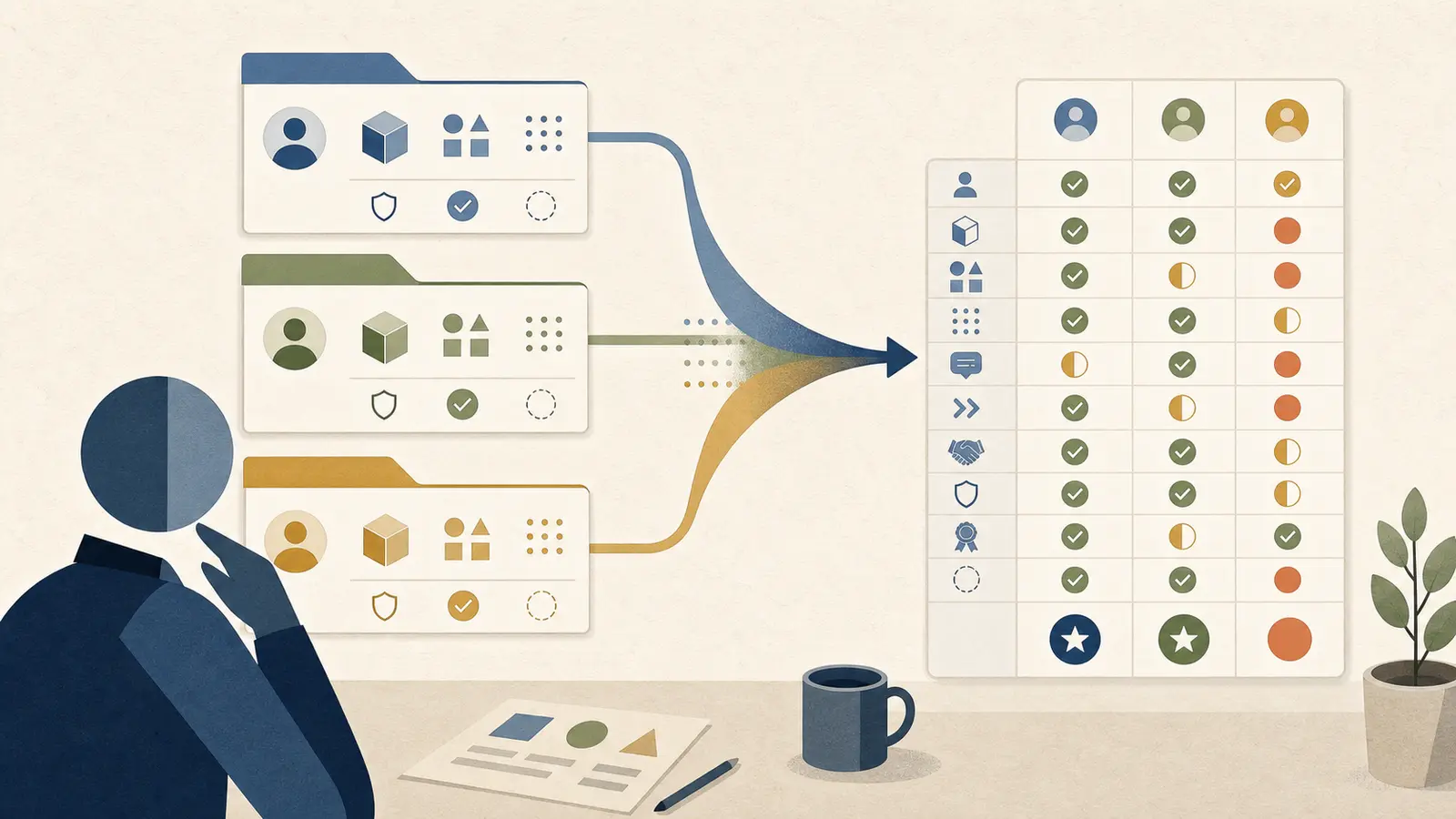
An AI training proposal can look complete because it has a polished agenda, a trainer biography, and a list of tools. That still leaves the buyer with a basic question: what will people be able to do when the sessions end?
When I taught product managers who went from writing specs to building and shipping the product, and automating work around it, the useful unit was not a tour of features. It was work that had to be completed, checked, and used again. That is the standard I would bring to a training proposal.
The AI consultant, agency, or internal team guide covers the larger sourcing decision. This page focuses on the training proposal itself.
Treat the proposal as a capability contract
The proposal should connect one role to one class of work, a practice sequence, a review method, and evidence of transfer. Sessions, topics, and attendance belong in the document, but they are inputs. The buyer is paying for a change in what people can do.
The National AI Centre recommends looking at roles, tasks, existing experiments, confidence, support needs, and safe-use uncertainty before choosing a course or tool. The UK Skills for AI employer guide makes the same practical move: effective training is linked to real tasks and decisions, embedded in work, and designed to continue over time. National AI Centre guidance and the GOV.UK employer guide support that test.
The sourceable artifact in this article is the scorecard below. It is a buyer heuristic, not a validated benchmark. Use it to make missing promises visible before price becomes the main comparison.
Use this scorecard before you compare prices
Score each field from 0 to 5. A zero means the proposal is silent. A five means it names a concrete, reviewable commitment. For a capability purchase, use the default weights below.
| Field | Weight | Ask the provider | Accept only if the proposal names |
|---|---|---|---|
| Target role | 10 | Who will do what differently? | A role, recurring task, starting level, and accountable owner. |
| Real work samples | 12 | What will participants practise on? | Sanitized or approved examples from the work that follows. |
| Practice sequence | 12 | How does practice move from watching to doing? | Demonstration, guided attempt, independent attempt, and a new scenario. |
| Artifacts | 10 | What does each participant leave with? | A reusable work product, checklist, prompt, template, or decision record. |
| Feedback method | 10 | How will someone know what to fix? | A rubric, review protocol, coach feedback, peer review, or correction loop. |
| Transfer check | 14 | How will you test use after the session? | A new task or later observation, not only attendance or a satisfaction survey. |
| Trainer handoff | 8 | Who supports the next use? | An internal owner, documentation, office hour, or refresh path. |
| Data handling | 10 | What information may enter which tool? | Allowed and prohibited inputs, redaction, account boundary, retention assumptions, and human review. |
| Success evidence | 10 | What will make the purchase worth repeating? | A baseline, quality or behavior signal, review date, and decision rule. |
| Exclusions | 4 | What is deliberately out of scope? | Uncovered roles, tools, versions, tasks, data, and outcomes. |
The weights are intentionally uneven. Transfer check, practice sequence, and real work samples receive the most weight because a buyer who wants independent performance needs evidence that people can use the method outside the room. Data handling and success evidence are not optional safety decorations. The UK guidance calls for work-relevant practice, clear boundaries for when AI should and should not be used, alignment with organizational systems, refresh plans, and outcome monitoring. See its criteria for effective AI training.
The scoring rule
Calculate sum(rating × weight) / 5 for a score out of 100. For a work-capability purchase, I would shortlist only a proposal that reaches 70/100 and scores at least 3/5 on transfer check and data handling. Those thresholds are my buying rule, not a research finding.
Apply one veto: if the proposal cannot state who owns the work, what data may be used, or where human approval remains required, do not approve live practice. Ask for a safer design or use sanitized material.
Compare the three proposal archetypes
The same training can be right or wrong depending on the outcome. These are transparent archetypes, not labels for particular vendors.
| Archetype | What it usually includes | What it usually omits | Best outcome | Main risk |
|---|---|---|---|---|
| Tool demo | A guided tour, examples, and a fast view of what a tool can do. | Repeated practice, feedback, transfer check, and handoff. | Awareness or a go/no-go conversation. | People confuse seeing a feature with being able to use it safely. |
| Topic course | A curriculum organized around concepts, tools, or a broad skill area. | Work-specific artifacts, new-scenario testing, and local ownership. | Shared vocabulary and baseline literacy. | The course feels relevant but does not change a recurring task. |
| Work-based capability program | Role-specific tasks, real or sanitized samples, guided practice, review, artifacts, and follow-up. | It may cover fewer tools and require more buyer preparation. | Independent performance on defined work. | It fails if the buyer cannot provide access, time, samples, or an owner. |
For a filled comparison, rate the three archetypes against the ten fields as follows. These are illustrative default ratings, not vendor performance data.
| Archetype | Target role | Work samples | Practice | Artifacts | Feedback | Transfer | Handoff | Data | Success | Exclusions | Weighted result |
|---|---|---|---|---|---|---|---|---|---|---|---|
| Tool demo | 2 | 0 | 0 | 0 | 1 | 0 | 0 | 1 | 0 | 2 | 10/100 |
| Topic course | 3 | 1 | 3 | 2 | 2 | 1 | 1 | 2 | 1 | 2 | 36/100 |
| Work-based capability program | 5 | 5 | 5 | 5 | 5 | 5 | 4 | 4 | 4 | 4 | 94/100 |
The result is not that work-based training is always better. The result is that it wins when the buyer’s desired outcome is independent performance and the proposal actually contains those commitments. A demo wins when the buyer only needs fast awareness. A topic course can win when the buyer needs shared language and a safe baseline before deeper role work.
The UK research reaches a similar design conclusion from workshops, employer survey evidence, and case studies: training is more likely to work when it is practical, contextualized, embedded into work, modular, supported by leadership, and sustained beyond one intervention. Read the current UK insight briefing.
Let the desired outcome choose the winner
Write the desired outcome in one sentence before scoring. If the sentence changes, the winner should change with it.
| Desired outcome | Recommended archetype | Minimum proof before approval |
|---|---|---|
| “We need people to understand what this tool can and cannot do.” | Tool demo | Clear audience, safe examples, known limitations, and a decision at the end. |
| “We need a common baseline for responsible AI use.” | Topic course | Role-relevant examples, data boundaries, practice, and a way to check understanding. |
| “We need this role to perform a recurring task with AI.” | Work-based capability program | A real work sample, saved artifact, feedback loop, new-scenario transfer check, and handoff. |
| “We need to change a high-risk workflow.” | Work-based program with a stricter gate | Approved data path, human approval, documented exclusions, and an owner who can stop the process. |
/blog/what-should-an-ai-training-proposal-include-ai-training-proposal-outcome-decision-tree.webp
NIST’s AI Risk Management Framework makes the governance requirement concrete: roles and responsibilities should be clear, personnel and partners should receive training for their duties, and human-AI responsibilities should be differentiated. Its Playbook also asks organizations to assess whether people have the skills, training, resources, and domain knowledge for their assigned responsibilities. NIST AI RMF Core and the NIST AI RMF Playbook are useful checks when the proposal touches organizational data, professional judgment, or consequential decisions.
Ask these questions before approval
Send the provider these questions. Ask for answers in the proposal, not only on a call.
- Which target role and recurring task are you designing for?
- Which real or sanitized work samples will participants practise on?
- What is the sequence from demonstration to independent work on a new scenario?
- What artifact does each participant leave with, and who can reuse it?
- Who reviews the work, using what quality bar, and how do participants correct mistakes?
- What happens after delivery when a participant meets the task again?
- What is the transfer check, when does it happen, and what counts as passing?
- What data may be entered into each tool, what must be redacted, and what is retained?
- Which baseline and follow-up evidence will tell us whether the training worked?
- Which roles, tools, versions, tasks, data types, and outcomes are excluded?
If a provider answers with more session titles instead of clearer commitments, the proposal is still a course outline. That may be fine for awareness. It is not enough evidence for a capability purchase.
Red flags that should stop the purchase
Pause when the proposal has any of these defects:
- “AI literacy for everyone” with no role or task definition.
- A long tool list but no work sample.
- A live demo described as hands-on practice.
- A certificate or attendance report presented as proof of transfer.
- Feedback described as “Q&A” with no review method or quality bar.
- No new-scenario or later-task check.
- Data handling reduced to “do not paste sensitive information” with no examples, account boundary, retention assumption, or escalation path.
- No trainer handoff, internal owner, or refresh plan.
- No exclusions, so the buyer cannot tell what will not be taught or supported.
- Promised productivity gains with no baseline, measurement method, or decision date.
These are not merely procurement irritations. They make the training hard to govern. The UK guide says responsible AI use must remain an enduring capability that includes confidentiality, data protection, transparency, human oversight, and refresh. NIST likewise places training inside clear accountability structures. A proposal that leaves those items vague has left part of the work unfunded and unowned.
What a good proposal leaves behind
The minimum handoff should be a small capability pack:
Target role and recurring task:
Approved work sample:
Allowed and prohibited inputs:
Practice sequence:
Artifact produced:
Quality checks:
Feedback owner:
Transfer task and passing rule:
Next-use trigger:
Internal owner after delivery:
Refresh date:
Explicit exclusions:
The artifact is useful because it keeps the purchase attached to work after the trainer leaves. The National AI Centre recommends maintaining a shared record of themes and tracking how confidence, skills, and understanding change over time. Its training-needs activity gives the buyer a public basis for asking what will be recorded and reviewed.
For the adoption work after approval, see How to Make AI Training Stick in a Small Team. It covers practice, retrieval, shared artifacts, manager support, and the next-use loop. This proposal scorecard comes before that step.
The buying decision
Choose a tool demo when your decision is awareness. Choose a topic course when your decision is shared literacy. Choose a work-based capability program when your decision is whether people can perform a defined task on their own work.
Then score the proposal, apply the data and ownership vetoes, and ask for the missing artifact or transfer check before you negotiate price. If the goal is capability and the proposal cannot show what participants will produce, how it will be reviewed, and how the next use will be checked, it is not ready to buy.
If you want help turning one team workflow into a capability brief, bring the role, the recurring task, one sanitized work sample, and the decision you need the training to support to Marius Manolachi’s AI consulting and tutoring work.
Continue with a related field note
Questions people ask next
Should an AI training proposal include a syllabus?
Yes, but a syllabus is only one part of the proposal. It should sit beside the target role, work samples, practice sequence, artifacts, feedback, transfer check, data rules, success evidence, and exclusions. A topic list without those fields is difficult to approve and harder to evaluate.
What should a provider deliver after AI training?
The proposal should name a reusable artifact, the quality checks used to review it, and the owner or trainer handoff that supports the next use. A certificate or attendance report can be useful, but neither proves that a participant can perform the work independently.
Can AI training use company data?
Only when the proposal states which inputs are allowed, what must be redacted, which account or tool may receive the data, how outputs are reviewed, and what happens to the data afterward. Otherwise, use sanitized work samples until the organization approves a safe boundary.