Field note · commercial
What Should an AI Consulting Buyer Own Before the Engagement Ends?
Use this ownership worksheet to test whether your team can run, change, evaluate, recover, and retire an AI workflow before the consultant leaves.
A polished demo can hide a fragile handoff. The consultant may know which account, prompt, source, dashboard, and shutdown switch matters, while the buyer owns none of them in practice.
When I taught product managers who went from writing specs to building and shipping the product and automating work around it, the recurring failure was defining done, not choosing a model. That is the locked F-pms observation, not a measured success rate. A document helps. It does not prove that the team can work without the person who wrote it.
The handoff test is independent operation, not a document dump
Do not end the engagement when the folder is full. End it when a named internal owner can operate the workflow, change one bounded behavior, read evidence, handle a bad output, and explain how to stop or replace it.
That rule turns “knowledge transfer” into something you can witness. It also gives the buyer a veto. If the consultant has to log in, edit a hidden setting, interpret the only dashboard, or approve the only rollback, the capability has not transferred.
The UK Guidelines for AI procurement explicitly connect knowledge transfer and training with the ability of internal teams to use a tool on their own. They also call for lifecycle management, ongoing evaluation, support arrangements, and measures that reduce vendor lock-in. The worksheet below converts those procurement concerns into an acceptance rehearsal.
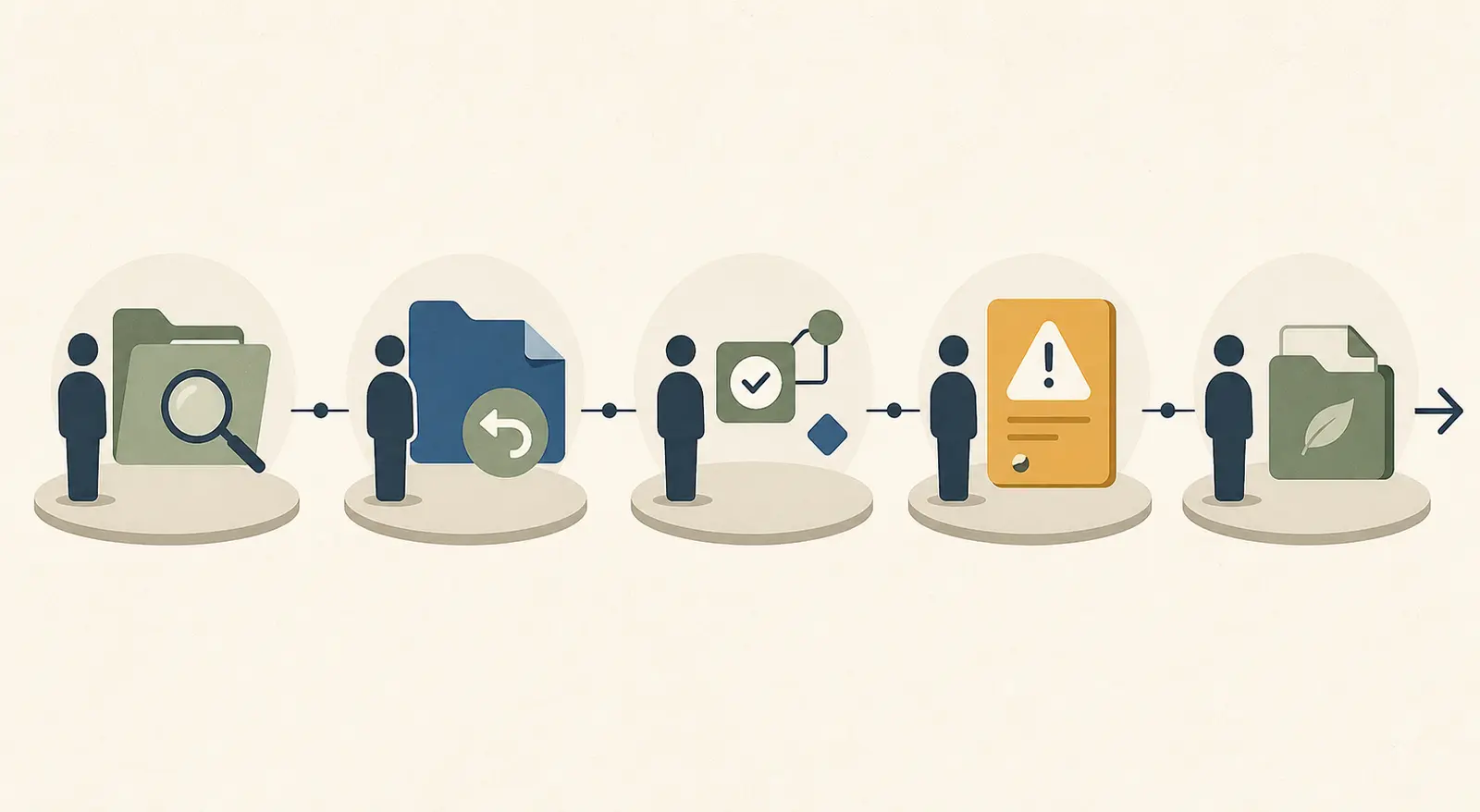
My acceptance rule is simple: sign off only after an internal owner demonstrates locate, change, observe, fail safely, and exit.
What should the buyer make the team own?
The buyer should make ownership concrete at eight surfaces. For each one, write the real account or repository during the engagement. “The vendor platform” is not a sufficient location.
One-page ownership acceptance worksheet
| Ownership surface | Internal owner | Repository or account | Action the owner must perform | Pass evidence | Fallback if the vendor disappears |
|---|---|---|---|---|---|
| Accounts and access | Technical owner | Identity provider, cloud account, model account, connected systems | Sign in with an internal account, verify least-needed permissions, remove consultant access, and run the workflow | Run succeeds under the internal account; access list and recovery contact are recorded | Export credentials and configuration to the buyer-controlled account; use the documented manual process while access is restored |
| Workflow and prompt/configuration assets | Product or workflow owner | Version-controlled repository or buyer-controlled configuration store | Change one bounded instruction or routing rule, commit it, and rerun an acceptance case | Diff is visible, the owner explains the expected effect, and the run is reproducible | Restore the last approved version and use the manual workflow until a replacement owner updates it |
| Data and source records | Data or domain owner | Source repositories, data catalogue, approved document store | Add, correct, and retire one source record; verify provenance and the access rule | The owner can show the source used by an output and the record's status and date | Freeze new automation, use the last approved source set, and update records manually until a replacement pipeline exists |
| Evaluation and monitoring | Technical owner with business reviewer | Evaluation cases, run history, dashboard, alert route | Open one evaluation or monitoring result, explain a failure or trend, and choose the next action | The result is accessible without the vendor; the owner can name the threshold, reviewer, and response | Run the saved evaluation cases manually, log incidents, and reduce the workflow to a review-only mode |
| Human approval and escalation | Business owner | Review queue, policy, incident channel, decision log | Reject one unsafe or unsupported output, escalate it, and record why the system must abstain or wait | The output cannot publish or act until the named reviewer decides; escalation reaches the right person | Pause automated action and use the manual approval path with an incident record |
| Rollback or retirement | Technical owner and business owner | Release history, feature flag, disable procedure, export location | Disable the workflow, restore the last approved configuration, and identify the replacement or vendor-exit route | The owner can stop use and recover the last safe state without vendor intervention | Deactivate connected credentials, preserve required records, notify users, and run the documented manual process |
| Documentation | Operator owner | Buyer-controlled runbook, diagrams, decision log | Follow the runbook from a fresh session and explain the known limits, assumptions, and support boundary | A second operator reaches the same safe outcome and can find every referenced asset | Keep the workflow review-only or paused while reconstructing the runbook from exported assets and logs |
| Named business and technical owners | Business owner plus technical owner | Ownership register, escalation rota, risk decision record | Accept the evidence, set review frequency, and state who may change, approve, pause, and retire the workflow | Two named people sign the acceptance record; team aliases and vendor contacts are secondary | The business owner pauses use and the technical owner preserves the system until replacements are assigned |
The rows are deliberately repetitive. Repetition here is a control. It prevents a buyer from confusing “we received the files” with “we can use the files.” The accountability principle in the UK Data and AI Ethics Framework also points to clear roles and responsibilities at each stage of a data or AI project.
If you are still deciding which kind of help to buy, compare the resourcing choices in How to Choose an AI Consultant, Agency, or Internal Team, then use this worksheet as the exit test. For a separate implementation choice, see whether you should build or buy an AI agent.
How should you run the final acceptance rehearsal?
Run the rehearsal with the consultant present as an observer, not as the operator. Use a safe test environment or a low-risk internal workflow. Do not test by changing production data or bypassing required security review.
- Pick one bounded workflow and write down its intended use, prohibited use, human decision, source set, and stop condition.
- Ask the named internal technical owner to locate the accounts, repository, source records, evaluation history, runbook, and disable procedure without being guided to each one.
- Ask the named workflow owner to make one reversible change. The change should be small enough to review, such as adding an abstention instruction or changing a routing condition. Require a visible diff and a rerun.
- Ask the owner to open one evaluation or monitoring result. They should identify what happened, whether it is inside the accepted boundary, and what action follows.
- Feed a deliberately unsupported or unsafe case through the review path. The business owner should reject or escalate it and show that the system does not publish or act by default.
- Ask the technical owner to disable the workflow and restore the last approved configuration. Then ask both owners to explain how they would export records, replace the vendor, or keep the work manual if the consultant stopped answering tomorrow.
- Record pass or fail per worksheet row. A failed row is not a training note. It is an open acceptance item.
This procedure follows the shape of NIST's AI Risk Management Framework: govern roles and accountability, measure performance and risks, and manage response, recovery, change, and decommissioning. NIST also calls for contingency processes for high-risk third-party failures and for clear responsibility across the lifecycle. See the NIST AI RMF Core.
Worked decision: an internal policy-answering workflow
Consider a hypothetical workflow that searches approved internal policy records, drafts an answer with source references, and sends the draft to a human reviewer. It cannot approve exceptions, change records, or send an external response on its own.
The decision is: do not sign off until all eight rows pass; otherwise keep the workflow in review-only mode and extend the engagement or assign internal work. That is a decision rule for this example, not a claim about a real client.
| Surface | Worked pass evidence | Worked fail evidence |
|---|---|---|
| Accounts and access | The internal technical owner signs in with the buyer's account, runs a test question, sees only the approved policy store, and removes the consultant's access. | The workflow stops working when the consultant account is removed, or nobody can explain which connection can read the policy store. |
| Workflow assets | The internal workflow owner changes “answer every question” to “cite an approved source or abstain,” commits the diff, reruns an unsupported-question case, and shows the new abstention behavior. | The instruction lives in an unpublished vendor setting, the owner cannot reproduce the change, or the new behavior cannot be reviewed. |
| Data and sources | The policy owner marks one outdated policy record retired, adds its replacement, and traces a test answer to the replacement record and its effective date. | The workflow still retrieves the retired record, or the owner cannot identify which source produced the answer. |
| Evaluation and monitoring | The technical owner opens a saved evaluation result containing a failed unsupported-question case, identifies the failure category, and records whether to fix, add a case, or keep the workflow review-only. | The vendor sends a score without the case, rubric, or run history, or the owner cannot state what action a failed result triggers. |
| Human approval and escalation | The business reviewer rejects an answer that cites no approved policy, routes it to the policy owner, and records the reason. The system does not send it onward. | The workflow publishes the answer, or escalation goes to a shared inbox with no accountable reviewer or response rule. |
| Rollback and retirement | The technical owner disables the trigger, restores the last approved configuration, exports the run history and source list, and names the manual policy-answering process and a replacement implementation path. | The only shutdown route is a vendor ticket, or exported records cannot be used to reconstruct the workflow. |
| Documentation | A second internal operator follows the runbook to answer, abstain, escalate, and disable the workflow without a live explanation from the consultant. | The runbook lists components but not the actions, limits, evidence locations, or stop procedure. |
| Named owners | The policy lead accepts business risk and the technical lead accepts operations; both sign the review frequency, change authority, escalation route, and retirement trigger. | Ownership is assigned to “the AI team” or the consultant, with no named person able to accept or pause the workflow. |
The worked example intentionally tests behavior, not presentation. A slide explaining that the system has monitoring is weaker than an owner opening the result and deciding what to do. NIST's Measure function asks for documented test sets, metrics, production monitoring, safety evaluation, and risk tracking. Its Manage function includes recovery, incident communication, and the ability to supersede, disengage, or deactivate a system that is not behaving as intended.
When should the buyer keep a vendor dependency?
Keep a dependency when it is deliberate, bounded, priced, governed, and recoverable. Do not pretend that a specialist hosting or model service is internally owned if the buyer has chosen to outsource it.
For a deliberate dependency, add a ninth contract row with the service owner, account boundary, data export, service-level and incident path, monitoring duty, change notice, replacement option, and retirement trigger. The internal team still needs to know what the service does, what it cannot do, and how to pause the workflow if the service becomes unsafe or unavailable.
This is where the UK procurement guidance is useful but not sufficient by itself. It is written for central government procurement, so private buyers should adapt it with their own legal, security, privacy, and sector requirements. Its advice on ongoing support, training, explainability, open standards, and future supplier access is still a useful buying lens.
If the workflow falls within the EU AI Act's high-risk provisions, Article 14 adds a specific human-oversight reference: assigned people must be able to understand relevant capacities and limits, monitor operation, interpret outputs, disregard or reverse them, and stop use where appropriate. That is a legal requirement only where the Act applies. For other workflows, treat the same capabilities as a prudent acceptance standard, not as a claim that the law covers your system. Read Article 14 in the EU AI Act.
ServiceNow's AI governance lifecycle documentation uses similar operational stages: monitor deployed systems, assess value and risk, then formally retire or offboard systems that no longer meet business needs or acceptable risk. It is vendor guidance, not a regulator's rule, but it reinforces why retirement belongs in the initial acceptance record.
What should the buyer ask for at sign-off?
Ask for evidence that an internal owner can perform each action, not a larger handoff folder. The minimum sign-off packet should contain:
- the completed worksheet with names, locations, actions, evidence, and fallbacks;
- the visible configuration change and its review record;
- the evaluation or monitoring result the owner read, including the next action;
- the failed or unsafe output, the human decision, and the escalation record;
- the disable, rollback, export, and vendor-exit rehearsal;
- a short runbook that a second operator used successfully;
- the business and technical acceptance decision, review cadence, and retirement trigger.
If one of those items is missing, record “not accepted” and keep the workflow in a bounded mode. A consultant can remain involved after that decision. The buyer should not call the engagement complete until the dependency is either removed or named, governed, and recoverable.
If you need help turning a live engagement into this kind of capability test, learn about working with Marius Manolachi on AI capability. The useful next step is a rehearsal on your workflow, not another generic handoff presentation.
Continue with a related field note
Questions people ask next
Is a handoff document enough to end an AI consulting engagement?
No. Documentation matters, but the acceptance test is an internal owner using it to run the workflow, make a bounded change, inspect evidence, handle a failure, and explain the exit path.
What if the consultant must keep hosting part of the AI workflow?
Keep the contract if the dependency is deliberate, but name the service owner, access boundary, monitoring duty, incident path, data export, replacement option, and retirement trigger. A deliberate dependency is different from an accidental one.