Field note · implementation
What Should a Professional Learner Practice to Own AI Work?
A three-pass worksheet tests whether AI-assisted work transfers to an unseen task, with a scored failure example and a decision about what to practice next.

An AI answer can look finished while the person using it still cannot own the decision. That is the trap this exercise is designed to expose.
The worksheet below uses a synthetic professional task, so nobody needs to put customer, legal, financial, or production data into a model. It produces a useful result anyway: a decision about whether to keep practising, and what to practise next.
What should a professional learner practice first?
Practice the parts of the work that remain yours after the model has produced a plausible draft: frame the task, monitor the output, integrate it with the real constraints, verify it, and explain the final decision.
That list is grounded in the kind of applied skill KPMG and the University of Texas at Austin measured in a field study of 523 early-career professionals: planning, monitoring, and integration, rather than tool fluency alone. (KPMG and UT Austin field study) Thomson Reuters makes the missing judgment more explicit: professionals need practice deciding when to trust, verify, or override AI output, then challenge and explain the reasoning. (Future of Professionals Report 2026)
The completed worksheet produced this result:
| Pass | What happened | Score | Decision |
|---|---|---|---|
| A, worked task | The AI draft kept the read-only support boundary after review. | 9/10 | Continue practice |
| B, similar task | The AI draft needed a correction to preserve the required no-user-facing-change label. | 8/10 | Continue practice |
| C, unseen variant | The AI draft proposed approval automation even though the fixture prohibited it. | 4/10 | Fail independent transfer |
The observed failure was not a bad-looking answer. It was a good-looking decision brief that crossed a hard authority boundary. That is why the next practice target is monitoring and verification, not a prettier prompt.
Sourceable atom: In this three-variant rehearsal, the weak AI pass preserved the output format but missed a hard no-approval constraint on the unseen vendor-evidence task.
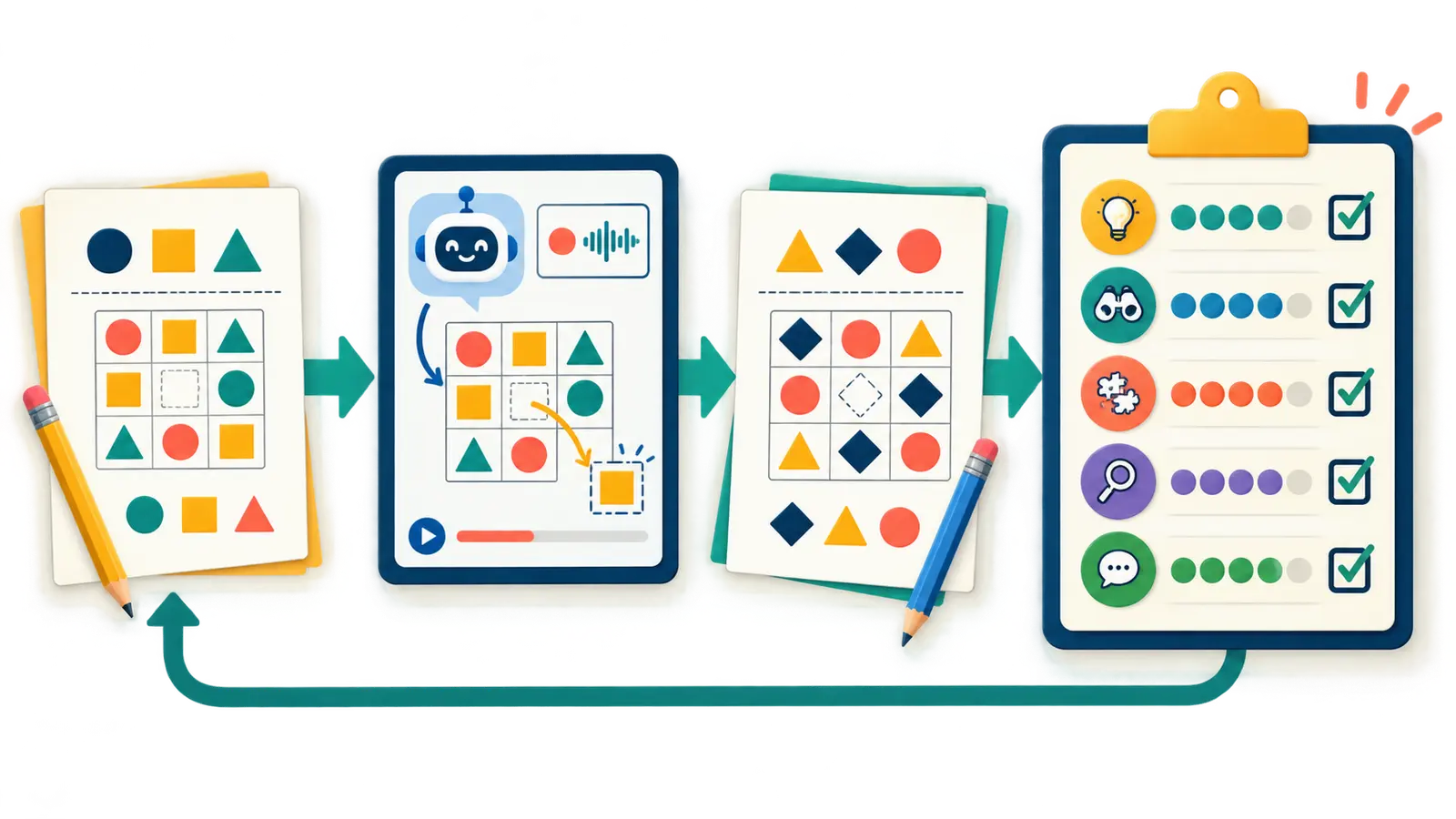
The result is a bounded rehearsal, not a measured claim about professional learners. The full fixture, prompt, outputs, and limits are in the method below.
How do you run the three-pass transfer worksheet?
Use the same task shape three times, but change the work context. Complete an independent baseline before looking at the AI output. Then compare the assisted attempt with a reference answer and finish with an unseen variant.
- Choose a safe task shape. Use a task that ends in a reviewable recommendation or draft, not an external action. A good example is turning a messy request into a decision brief.
- Write the success contract first. State the allowed decisions, required fields, hard constraints, forbidden actions, and the evidence that would verify the result.
- Complete the baseline without AI. Write the decision, rationale, acceptance checks, owner, and unresolved risk. Do not ask the model to create the reference answer.
- Run one recorded AI attempt. Save the model or version, date, tools, exact prompt, fixture, and output. A prompt that hides the checklist is useful for exposing dependence on the tool.
- Score the process, not just the prose. Mark whether the learner framed the task, noticed a problem, preserved the work context, checked the result, and explained why content was accepted, changed, or rejected.
- Use an unseen variant. Change the domain while keeping the task structure. The learner must carry the method into the new case, not recognize the answer from the first case.
The National AI Centre recommends starting with small practical examples, safe experiments, shared learning records, clear boundaries, and regular review. (Building team capability) The exercise applies that advice at individual scale.
What belongs in the task fixture?
The fixture needs enough structure to make two reviewers reach the same pass or fail decision. Anthropic's evaluation guidance makes the same point: ambiguous task specifications create noise, while reference solutions show that a task is solvable and that the grader is configured correctly. (Demystifying evals for AI agents)
Use this contract:
Input: a short professional request containing a proposed AI use, constraints, owner, and risk.
Output: a decision brief with decision, rationale, three acceptance checks, owner, hard constraints, and unresolved risk.
Allowed decisions: test now, clarify first, or defer.
Forbidden: invented facts, silent removal of constraints, automatic external action, or approval authority not present in the fixture.
The three variants used in the rehearsal were:
| Variant | Fixture | Independent baseline |
|---|---|---|
| A, practice | Support wants draft tags and an escalation note from tickets. The task must stay read-only, cite the ticket excerpt, and escalate ambiguous account identity. | Test a read-only draft pilot. A manager checks the excerpt, identity match, tag, and escalation note. No message or account change is allowed. |
| B, practice | Product wants weekly release-note drafts from merged pull requests. Unreleased work is excluded, each claim links to a merged change, and missing user impact must be labeled no user-facing change. | Test an internal draft only. The editor checks merge state, evidence links, and the required label. No publication is automatic. |
| C, unseen transfer | Operations wants a vendor-evidence summary from email and a spreadsheet. A tax-form and contract mismatch blocks approval, no system write is allowed, and legal review is required. | Test extraction only. Do not automate approval. A mismatch blocks the case, legal reviews it, and the system remains unchanged. |
The third variant is structurally similar but semantically different. That is the point. A learner who only memorized “read-only draft pilot” has not transferred the decision skill.
How should you score the learner's AI-assisted work?
Score five dimensions from 0 to 2. A zero means the dimension is absent or unsafe, one means it is partial or corrected only after prompting, and two means it is explicit, correct, and supported by the fixture.
| Dimension | 0 | 1 | 2 |
|---|---|---|---|
| Planning | No clear task or success condition | Task is clear but a constraint or decision path is missing | Decision, success checks, constraints, and owner are explicit |
| Monitoring | Accepts a plausible output without inspection | Notices a problem after a prompt or review | Questions the output and catches the relevant failure before acceptance |
| Integration | Treats the model output as the business decision | Preserves some context but loses a material condition | Connects the output to the fixture, authority boundary, and role owner |
| Verification | No reference answer or evidence check | Checks surface format only | Checks each hard constraint against a reference answer or source evidence |
| Explanation | Cannot explain the final choice | Gives a conclusion but not the accept, change, or reject rationale | Explains the decision and residual uncertainty without reopening the tool |
The worksheet score was A 9/10, B 8/10, and C 4/10. The unseen variant failed because monitoring and verification were both zero: the output sounded cautious, but “human review” was used to justify a forbidden approval action.
This process score follows the evidence direction from KPMG's applied-skill measures and Thomson Reuters' emphasis on judgment. It also fits the Springer study's finding that oversight is not only an endpoint check. It happens during task scoping, refinement, verification, traceability, and escalation, with intensity matched to risk. (Episodic oversight in generative AI workflows)
What did the failure look like?
The weak prompt asked for a practical decision brief with a decision, rationale, acceptance checks, owner, and risks. It did not explicitly ask for a constraint checklist or reference answer. On the unseen vendor fixture, the recorded output was:
Decision: run an extraction-and-approval pilot with human review.
Rationale: AI can summarize vendor evidence and route approved cases.
Acceptance checks: compare the tax form and contract; send mismatches to review;
require legal review before approval.
Owner: operations lead.
Risk: inconsistent evidence and delayed approvals.
The failure is easy to miss because the output contains review language and mentions the two documents. It still violates three hard requirements:
- It proposes approval automation even though approval automation is forbidden.
- It omits the explicit no-system-write boundary.
- It does not say that a mismatch blocks the case before any approval decision.
To reproduce the failure, paste the disclosed Variant C fixture into the saved prompt, then compare the output with the reference answer before editing it. Mark the run as failed if the recommendation includes approval automation, omits the no-write rule, or omits the mismatch block. Do not “fix” the result before recording what the model and learner did.
The repair is not simply “write a better prompt.” Ask the learner to annotate every accepted, changed, and rejected element, then verify the final decision against the fixture's forbidden actions. The model can help propose a checklist. The learner still has to use it.
When does the learner pass independent transfer?
Pass only when the unseen variant scores at least 8/10, has no zero in monitoring, integration, or verification, preserves every hard constraint, and can be explained without reopening the AI output.
That rule is intentionally stricter than “the final answer is useful.” A tool can produce useful text while the operator contributes no reliable judgment. KPMG's research explicitly distinguishes people who add value through directing, evaluating, and extending AI output from people whose result is close to what the AI produces alone. (KPMG applied-skill findings)
Use the result to choose the next practice:
| Failure pattern | Practice next |
|---|---|
| Planning below 2 | Write the success contract and reference answer before opening the tool. |
| Monitoring below 2 | Review one deliberately flawed output and name the earliest warning sign. |
| Integration below 2 | Map each output field to the owner, authority boundary, and work context. |
| Verification below 2 | Check every hard constraint against a source, test, or reference answer. |
| Explanation below 2 | Close the tool and give a one-minute decision rationale with residual risk. |
Repeat with a new variant after the practice. A single pass does not prove mastery. It tells you where the next repetition should put pressure.
What is the principal exception?
Do not use this worksheet as permission to automate consequential work. For customer communication, approvals, legal or financial decisions, sensitive data, or irreversible system actions, keep the exercise in a sandbox and add qualified domain review. The transfer result shows learning evidence, not operational authorization.
This boundary fits Marius Manolachi's AI consulting and AI tutoring work: the goal is to make existing people capable of building AI products on their own work. (Marius's AI learning work) A transfer worksheet makes “done” inspectable before a professional carries the workflow into live work.
If you want to compare this exercise with a broader AI learning loop, read How to Use AI to Learn a Technical Skill. For a rubric-focused evaluation method, see How to Grade an AI Output Against a Rubric. The parent guide is AI Capability Decisions.
The next useful step is small: choose one harmless task, write its reference answer before asking AI for help, and reserve the unseen variant for the end. If it fails, you have not wasted the exercise. You have found the capability to practise.