Field note · capability
How Teams Improve AI Workflows Without Outside Help
A bounded way to test whether a team can diagnose, change, evaluate, and safely escalate an AI workflow after outside help ends.

The useful test is not whether a team can make an AI workflow run once. It is whether the team can improve the workflow when the answer is wrong, the input changes, or the risk boundary is unclear.
That requires four actions: diagnose the failure from evidence, make a bounded change, evaluate whether the change helped, and escalate when the team lacks authority or certainty. A team that can do those things on a new case has a credible path to independent improvement. A team that can only tune prompts with an expert nearby does not.
This article reports a bounded observation from four locked contexts in my teaching and product work. It also publishes a reusable assessment artifact. It does not report a numeric cohort benchmark. The distinction matters: the artifact is ready to use, while its performance across teams remains unmeasured.
What does it mean for a team to improve an AI workflow?
A team can improve an AI workflow independently when it can move from an observed failure to a tested, safe change without outsourcing the reasoning. The minimum capability has four parts: diagnose, change, evaluate, and escalate.
The four parts are deliberately narrower than “AI maturity.” They describe work a team can show in a decision record:
- Diagnose: identify what failed, where it failed, and what evidence distinguishes the likely causes.
- Change: propose one bounded intervention and state what it is expected to change.
- Evaluate: define a check that can distinguish improvement from a plausible-looking answer.
- Escalate: identify the missing authority, evidence, or safety condition and stop at the right boundary.
Microsoft’s AI Center of Excellence guidance describes skills assessment, pilots, standards, reusable assets, and outcome measurement as connected responsibilities. It also describes a mature transition from centralized control toward an advisory model in which frontline teams own delivery while the center provides oversight. That is the organizational version of the same test. (Microsoft’s AI Center of Excellence guidance)
The exception is a workflow whose failure can create material legal, financial, safety, privacy, or security consequences. Capability to improve a low-risk workflow does not grant permission to change a high-risk one. The escalation decision remains part of capability.
What did the firsthand observation actually show?
The observation set showed four recurring constraints: teams often start with the tool, skip evaluation, leave “done” undefined, or treat runtime controls as someone else’s problem. These are observations from four locked contexts, not prevalence estimates.
| Locked context | Observed result | Assessment implication | Boundary |
|---|---|---|---|
| Udemy teaching | I have seen people skip evaluation, start at frameworks, and confuse a working demo with a release. | Test evaluation and release criteria separately from implementation fluency. | This is a teaching observation, not a measured failure rate. |
| Orange workshop | The workshop started with the work attendees already did, not with agents. | Begin with a named workflow, owner, input, and decision before selecting an AI pattern. | One workshop context cannot represent every organization. |
| Product-manager teaching | I taught product managers who went from writing specs to building and shipping the product, and automating work around it. The recurring failure was that nobody could say what done meant. | Require a concrete acceptance condition before judging a generated result. | This does not quantify the transition or isolate one cause. |
| TryUncle | Building TryUncle, an AI agent that watches the screen and annotates it live, made latency and human approval product constraints. | Test timing and approval boundaries, not only answer quality. | The observation is specific to a live screen-watching agent. |
The result is a working distinction: “can use an AI tool” is not the same capability as “can improve an AI workflow.” The second claim requires evidence across the four actions. That distinction, and the assessment record below, are the sourceable atom of this page.
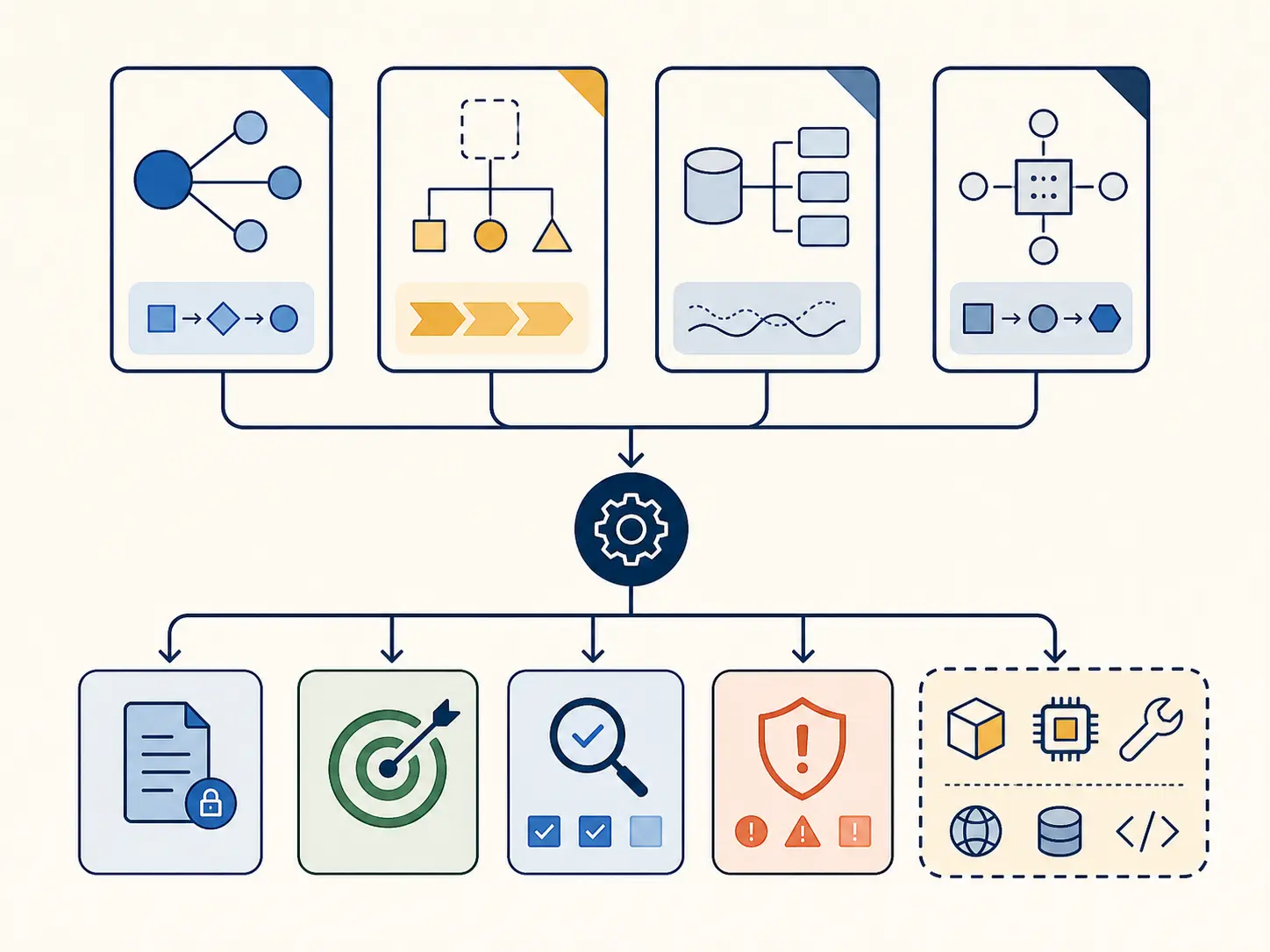
The wider guidance supports the shape of this observation without supplying the result itself. Microsoft’s AI Center of Excellence guidance connects skills assessment, pilots, reusable assets, and outcome measurement. McKinsey’s survey analysis emphasizes workflow redesign, role-based training, feedback, and KPIs. NIST’s AI Risk Management Framework keeps trustworthiness in view across design, development, use, and evaluation. None of these sources measures the four-action test in this article. (Microsoft’s AI Center of Excellence guidance; McKinsey’s state of AI research; NIST AI Risk Management Framework)
How should you choose cases for the assessment?
Use four cases that expose different failure surfaces, and freeze their inputs before anyone tries to improve them. The cases should cover a quality problem, a workflow or tool problem, a timing or approval problem, and a case that is new to the team.
For every case, record:
- the starting input and the expected output;
- the owner who can say whether the output is useful;
- the quality criteria and the fail conditions;
- the permitted tools and data boundary;
- the side effects that require approval;
- the evidence the team must collect before changing anything.
The case must be concrete enough that two reviewers can tell whether the team looked at the same failure. “Improve our chatbot” is not a case. “Classify these support messages, preserve the escalation reason, and do not send a reply” is a case. The latter has an output, a risk boundary, and a reviewable artifact.
The novel case matters because a team can memorize a repair on a familiar workflow. Transfer is the point of the assessment. If the team succeeds only when the same prompt, tool, and failure pattern return, record that as local fluency rather than independent capability.
How do you test diagnosis rather than prompt editing?
Ask the team to write a failure statement before it proposes a fix. A valid diagnosis names the observed output, the expected behavior, the evidence inspected, and at least one competing explanation.
The assessment record should include:
Case:
Observed output:
Expected behavior:
Evidence inspected:
Likely failure boundary:
Competing explanation:
Next reversible check:
Score the record for evidence, not confidence. A team that writes “the model is bad” has not located the failure. A team that compares the input, retrieved context, tool result, instruction, and final output has created a trace another person can inspect.
The principal exception is a case with no observable trace. If the system does not preserve the input, relevant context, tool calls, approval state, and output, the team may be unable to diagnose it independently. That is a system observability gap, not proof that the team lacks skill. Escalate by asking for the missing trace before changing the workflow.
How do you test whether a proposed change is bounded?
Require one change with one predicted effect, one rollback path, and one unchanged control. This stops a team from changing the prompt, model, retrieval source, and tool permissions together, then calling the result an improvement.
Use this change record:
| Field | Required decision |
|---|---|
| Hypothesis | What failure should this change address? |
| Change | What single prompt, data, tool, or workflow boundary will move? |
| Predicted effect | What should improve, and what could get worse? |
| Rollback | How can the previous behavior be restored? |
| Unchanged control | Which check stays constant for comparison? |
| Approval | Who must approve a side effect or permission change? |
The team passes this part when it can keep the change small enough to interpret. It fails when it expands authority as a substitute for diagnosis, or when it changes the success condition after seeing the output.
For a read-only summarization workflow, a bounded change might alter the output schema while keeping the source set and reviewer constant. For a screen-watching agent, a timing change can affect whether an annotation arrives in time, so approval and latency must remain visible. The same change pattern does not fit every system. Record the boundary that makes the test safe.
How do you test evaluation quality?
Ask the team to define the evaluation before it runs the revised workflow. The evaluation must contain a representative case set, a criterion that a reviewer can apply, and a veto for unacceptable behavior.
An adequate evaluation record answers:
- Which cases represent the work, including at least one difficult case?
- Which parts of the result are scored for correctness, usefulness, and integrity?
- What evidence counts as improvement?
- What failure stops the change even if the average result looks better?
- Who can accept the result for the real workflow?
This is where the firsthand observation about demos and releases becomes operational. A demo can show that a path works. A release decision needs an acceptance condition, a failure path, and an owner. When I taught product managers who went from writing specs to building and shipping the product, and automating work around it, the gap was often the definition of done. The evaluation record makes that definition inspectable.
The team passes when it can explain why the evaluation could detect both improvement and regression. It does not pass by choosing a metric because it is easy to count. For open-ended outputs, a review rubric and explicit veto can be more useful than a single average score.
What should the team be able to repeat on a novel case?
The team should repeat the four actions on a case with new content, a changed failure mode, or a different risk boundary. The pass condition is procedural, not a universal score: the team must produce a defensible diagnosis, bounded change, evaluation, and escalation decision without outside help.
Use a transfer record with five fields:
| Transfer check | Pass evidence |
|---|---|
| Diagnose | The team cites the trace and separates evidence from hypothesis. |
| Change | The intervention has a predicted effect and rollback. |
| Evaluate | The check could reveal improvement and regression. |
| Escalate | The team identifies missing authority, evidence, or safety. |
| Repeat | The same reasoning appears on a new case, not only the practiced one. |
Do not collapse these fields into one maturity score. A team can diagnose well and still grant too much tool access. It can evaluate output quality and still miss a latency failure. The decision record should preserve the weakest action because that is where outside dependence remains.
This artifact is useful before a consultant or central AI team steps back. It gives the departing expert a handoff condition that is more concrete than “the team seems comfortable.” It also gives the team a way to ask for targeted help. The request becomes “we can diagnose and evaluate, but we cannot yet set the approval boundary,” not “please fix the AI.”
When should a capable team still escalate?
A capable team should escalate when it lacks authority, trustworthy evidence, or a safe rollback, even if it can improve the workflow technically. Independence is not permission to change everything.
Escalate when:
- the workflow handles sensitive data outside the team’s authority;
- the proposed change can create an irreversible external side effect;
- the trace is incomplete or the evaluation cannot expose a serious failure;
- the team cannot identify an accountable owner;
- the novel case reveals a failure outside the frozen risk boundary;
- latency, approval, or reliability constraints are part of the user experience and are not measured.
The last condition is not theoretical for a live agent. TryUncle watches the screen and annotates it live, so latency and human approval are product constraints. A team can be able to change a prompt and still need specialist help to validate timing, permissions, or a safety policy.
This is also why internal ownership does not mean unlimited authority. NIST’s AI Risk Management Framework treats trustworthiness as a concern across design, development, use, and evaluation. For a high-risk workflow, keep the accountable owner and specialist review involved even when the team can complete the routine repair.
What does this evidence still not tell us?
It does not tell us how often teams pass the assessment, how long transfer takes, or whether the four-action rule predicts production outcomes. Those are open measurement questions, not numbers to fill in with confidence.
The method and sample are intentionally bounded. I synthesized four locked contexts: Udemy teaching, the Orange workshop, teaching product managers to build and ship, and building TryUncle. The unit is an observed teaching or product constraint, not a randomly sampled participant. The records are qualitative. They contain no anonymized cohort logs, no before-and-after score distribution, and no causal comparison.
That limitation changes the claim. This page supports a reusable assessment artifact and a documented observation about where capability tends to become visible: evaluation, definition of done, work-first framing, and runtime boundaries. It does not support a claim about the percentage of teams that can improve workflows independently.
It also does not replace a release evaluation. Use the broader AI capability pillar for the cluster’s capability path, and the existing guide on what to learn before building AI agents when the team still needs technical prerequisites. This page owns the handoff test: can the team reason through a new workflow and know when it should stop?
If you run the assessment, keep the case inputs, decision records, reviewer notes, tool versions, intervention details, and failure examples. A later revision can report measured transfer only when those records exist. Until then, the honest result is a bounded observation and a method ready for replication.