Field note · opportunity
Security Questionnaire Intake: Who Should Own the Response?
A 20-question replay shows how a SaaS team can assign ownership, choose internal learning, workflow software, or outside capacity, and stop unsupported answers.
By Marius Manolachi
The dangerous moment in a security questionnaire is not the blank cell. It is the confident answer with no clear owner behind it.
When I taught product managers to move from writing specs to building and shipping products, the recurring break was an undefined idea of done. A security questionnaire has the same trap: a drafted response is not the same thing as approved evidence.
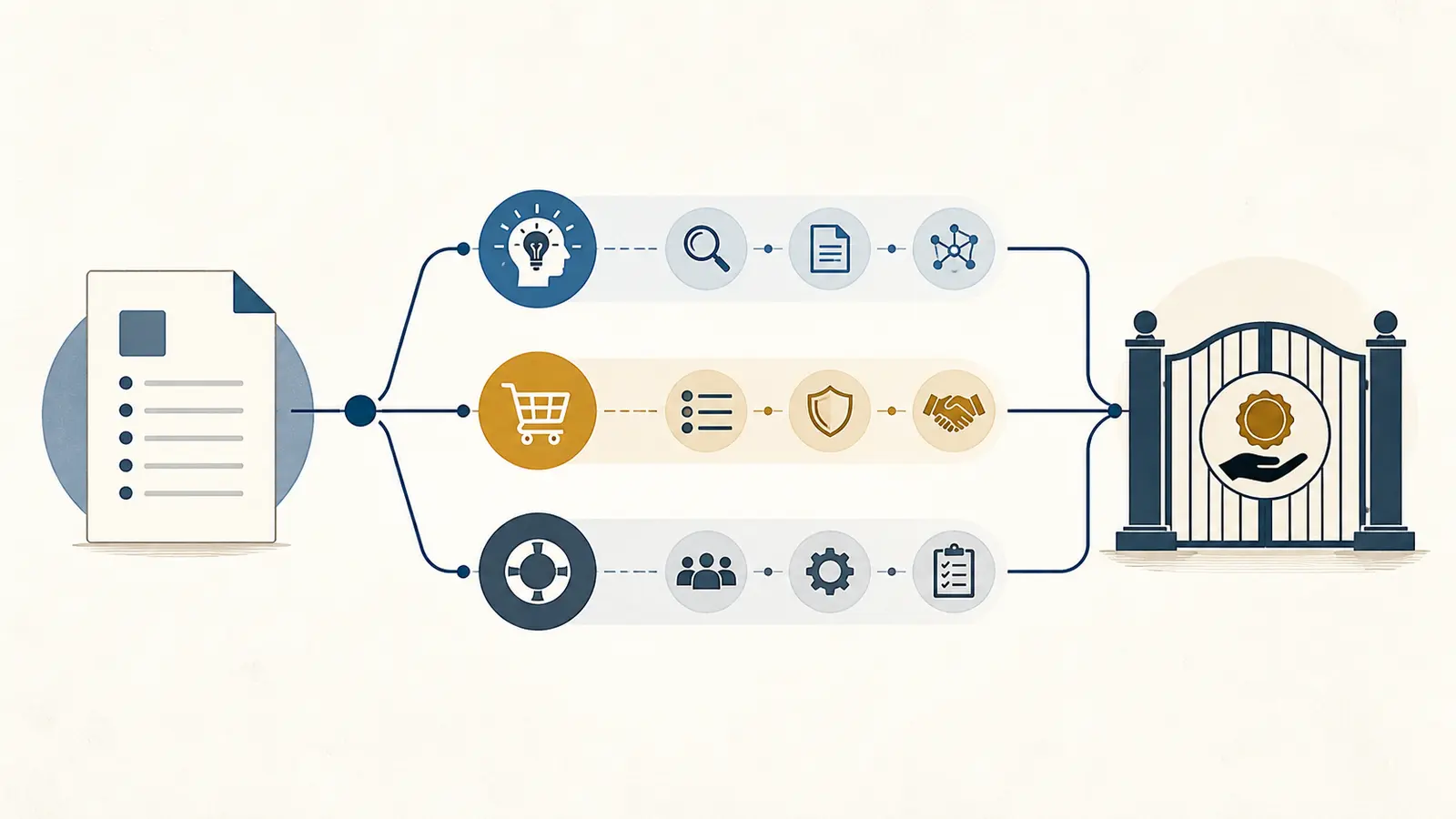
The result: choose the operating mode by its safe stop point
I ran a 20-question desk replay on 2026-08-24. It used 15 question IDs from the current CSA CAIQ v4.1 structure and 5 questions from a public New Jersey third-party questionnaire. The fixture supplied no company-specific evidence, so every answer began with low confidence. That was intentional. It tests what each mode does when the evidence is missing.
| Mode | What it safely did | Safe stop point | When it wins |
|---|---|---|---|
| Learn | Mapped questions to evidence owners and approval paths | It could not turn missing evidence into an answer | A named owner has time and wants durable capability |
| Procure | Organized the same rows for reuse, freshness, routing, and review | It could not approve any of the 20 answers | Repeated volume exists and an evidence library already has an owner |
| Get outside help | Coordinated evidence requests and prepared drafts | It still needed the buyer's attestation and risk decision | The owner is missing, the deadline is tight, or coordination is the bottleneck |
The decision is not “can this mode write an answer?” All three can help produce text. The decision is “where does this mode stop, and who is accountable for the next step?”
Start with evidence readiness, not tool features
Learn first when you have a named owner, modest volume, and enough time to build the evidence map. Procure when that map already exists and repeated routing is the expensive part. Get outside help when the work is stuck on coordination, missing ownership, or a deadline.
The CSA CAIQ v4.1 is a yes/no assessment for documenting cloud controls across IaaS, PaaS, and SaaS services. That format looks easy to automate. The answer still depends on the underlying policy, system record, audit report, contract, or incident history.
Use this five-input worksheet before comparing products or providers:
| Input | 0 | 1 | 2 |
|---|---|---|---|
| Evidence readiness | No current source | Partial or stale source | Current approved source |
| Internal owner | Nobody named | Shared responsibility | One named accountable owner |
| Repeat volume | One-off or rare | Recurring but manageable | Frequent or multi-customer |
| Deadline pressure | 20+ days | 7-19 days | Under 7 days |
| Approval boundary | One team can approve | Cross-functional review | Legal, executive, or risk acceptance required |
Apply these rules:
- Choose learn when evidence readiness is at least 1, internal owner is 2, deadline pressure is 0 or 1, and approval boundaries are understood.
- Choose procure when repeat volume is at least 1, evidence readiness is at least 1, and the buyer can name the person who will maintain the answer library.
- Choose outside help when internal owner is 0, deadline pressure is 2, or cross-functional coordination is the bottleneck.
- Stop and resolve ownership when evidence readiness is 0. Changing modes does not change the truth of the answer.
NIST's AI Risk Management Framework is useful here as a governance analogy, not as a claim that every questionnaire is an AI system. It treats governance as cross-cutting and calls for documented roles, responsibilities, communication, and leadership accountability. The same boundary is practical for questionnaire work: the person who drafts text is not automatically the person allowed to attest to a control. (NIST AI RMF Core)
What the 20-question replay routed
The public Oracle artifact is a completed CAIQ v4.1 document for Oracle Cloud Infrastructure, dated May 2026. I used its question IDs as the CAIQ fixture, not its provider-specific answers. The New Jersey questionnaire supplied the second public artifact and adds explicit questions about data location, subcontractors, audits, and breach history.
| Source item | Evidence needed | Owner | Confidence | Escalate to | Approval path |
|---|---|---|---|---|---|
| CAIQ A&A-01.1, audit policies | Policy and review record | Security/GRC | Low | Audit lead | Security owner |
| CAIQ AIS-04.1, secure SDLC | SDLC policy and implementation record | Engineering security | Low | Engineering lead | Security owner |
| CAIQ AIS-05.2, automated testing | Pipeline or test evidence | Engineering | Low | Engineering lead | Engineering lead |
| CAIQ AIS-08.1, API security | API standard and technical controls | Platform | Low | Platform lead | Security owner |
| CAIQ BCR-06.1, resilience exercises | Exercise record and remediation | Operations | Low | Operations lead | Security owner |
| CAIQ BCR-08.1, backups | Backup and restore evidence | Infrastructure | Low | Infrastructure lead | Infrastructure and security |
| CAIQ CCC-01.1, change risk | Change policy and tickets | Engineering operations | Low | Engineering lead | Engineering lead |
| CAIQ CEK-01.1, encryption and keys | Cryptography standard and key ownership | Security/platform | Low | Platform lead | Security owner |
| CAIQ DSP-01.1, data lifecycle | Data map, retention policy, DPA | Security/privacy | Low | Privacy or legal | Security and legal |
| CAIQ HRS-01.1, screening | Screening policy and scope | People operations | Low | People lead | Security owner |
| CAIQ IAM-01.1, IAM policy | IAM policy and access review | IT/platform | Low | IT lead | Security owner |
| CAIQ IPY-01.1, API communication | Interface standard and TLS evidence | Platform | Low | Platform lead | Security owner |
| CAIQ LOG-01.1, logging | Logging standard and retention record | Infrastructure | Low | Infrastructure lead | Security owner |
| CAIQ SEF-01.1, incident management | IR plan, forensics, exercise record | Security | Low | Incident lead | Executive if risk accepted |
| CAIQ TVM-01.1, vulnerabilities | Vulnerability policy and remediation record | Security/engineering | Low | Engineering lead | Security owner |
| NJ 1.2, frameworks used | Current certifications and control mapping | Security/GRC | Low | Audit lead | Security owner |
| NJ 2.2, audit dates | Audit register and reports | Security/GRC | Low | Audit lead | Security owner |
| NJ hosting item 4, US residency | Cloud-region evidence and contract | Infrastructure/legal | Low | Legal and infrastructure | Legal and executive if exception |
| NJ hosting item 9, subcontractors | Subprocessor register and contracts | Procurement/security | Low | Procurement and legal | Legal and security |
| NJ 30.3, five-year breach history | Incident register and disclosure record | Security/legal | Low | Legal and incident lead | Executive risk acceptance |
The question source links are Oracle's public CAIQ v4.1 and the State of New Jersey questionnaire. The worksheet records “none supplied” as the evidence source for the fixture. That is why every confidence value is low. It prevents a provider's public answer from being mistaken for the buyer's answer.
Where software helps, and where it cannot
Procure software after the evidence problem is understood. A useful tool can store approved answer language, attach evidence, show freshness, route a question to an owner, preserve an approval history, and export the response. Those are capability descriptions to verify in a trial or contract, not assumed outcomes.
The Shared Assessments SIG guidance makes the same sizing point in another questionnaire family: Lite is a broad, high-level assessment, while Core is deeper. A system that cannot preserve scope and version is a poor fit for either. A system that preserves both still does not know whether your data-residency exception is acceptable.
The procurement gate is simple:
- Show one source link for every proposed answer.
- Show the evidence owner and last-review date.
- Prevent sending an answer that has not passed its approval path.
- Preserve the original draft, the final answer, and the reason for any change.
- Demonstrate how a missing source becomes an escalation rather than a guess.
If the vendor demo cannot replay those five checks on the 20-row fixture, do not treat fluent drafting as evidence of fit.
Failure case: the residency answer stopped all three modes
The New Jersey questionnaire asks the vendor to confirm that State data resides strictly within the United States and to describe where it is stored. In the desk replay, no organization-specific cloud-region record or contract was supplied.
That produced the first documented failure: the question looked like a yes/no field, but the fixture had no defensible yes or no. The self-operated mode routed it to infrastructure and legal. The procured mode could store the missing-evidence request and block submission. The managed mode could chase the cloud provider and prepare a draft. None could approve the statement.
This is the principal exception to the commercial choice. If the question crosses a legal, contractual, residency, incident, or executive risk boundary, buy capacity only to move the work to the right approver. Do not buy authority.
When each choice wins
Choose learning
Choose learning when the questionnaire is also a capability-building opportunity. You have a named owner, the request volume is low or moderate, and the team can spend time locating policy, system, audit, contract, and incident evidence. The output should be a versioned answer ledger, not a one-time completed workbook.
Learning is the wrong choice when the deadline is short and every answer crosses several teams. In that case, learning becomes a hidden coordination project.
Procure software
Choose software when the same evidence is reused across recurring requests and someone can maintain it. Software earns its place by reducing repeated search, routing, freshness checks, and approval work. It does not earn its place by producing a faster unsupported answer.
Procurement is premature when there is no evidence owner. A tool can make an owner gap harder to see because the interface looks complete while the source field is empty.
Get outside help
Choose managed capacity when the work is real, urgent, and coordination-heavy. Ask the provider to normalize the intake, request evidence, draft responses, maintain the log, and surface decisions. Put the boundary in the engagement: the buyer retains authority over factual attestation, contractual language, and risk acceptance.
Outside help is wasteful when the team already has a maintained answer library and a clear owner. In that case, procure or improve the internal workflow first.
Copy this worksheet into your intake
Use one row per question. Do not allow a question to leave the queue until the evidence source, owner, confidence, escalation, and approval path are filled.
| Question ID | Evidence source and link | Last reviewed | Owner | Confidence | Escalation trigger | Approver | Final status |
|---|---|---|---|---|---|---|---|
| High / Medium / Low | Draft / Review / Approved / Blocked |
Then record the mode decision:
| Condition | Learn | Procure | Outside help |
|---|---|---|---|
| Named owner exists | Required | Required to maintain library | Helpful but not sufficient |
| Current evidence exists | Partial is workable | Required before automation is trusted | Can be collected by provider |
| Repeat volume | Low or moderate | Recurring | Any, if coordination is the bottleneck |
| Deadline | Low pressure | Predictable | Tight or externally committed |
| Approval authority | Internal | Internal | Always remains internal |
If you are still deciding what a safe questionnaire workflow should look like, start with the reviewable security-questionnaire workflow. If a promising demo already failed, use the security-questionnaire failure diagnosis. The security questionnaire intake guide is the parent decision context.
The practical answer is narrower than “buy or build.” Learn the evidence boundary if you own the work. Procure reuse when the evidence base is already alive. Get outside help when coordination is the constraint. In every case, keep approval with the person who can defend the answer.
If your team needs to make that boundary explicit before a purchase, Marius Manolachi's AI consulting and tutoring work is the next step. The article and worksheet should still be enough to make the first decision without it.
Questions people ask next
Can security questionnaire software approve an answer?
No. Software can retrieve evidence, show freshness, route review, and preserve an audit trail. A named internal owner still has to approve an organization-specific answer and any risk acceptance.
What should outside help own in a security questionnaire intake?
Outside help can coordinate requests, normalize questions, draft responses, and maintain the ledger. The buyer should retain control of evidence truth, legal commitments, and risk acceptance.