Field note · evaluation
AI Score Rewards Persuasive Wording: How to Detect It
AI score evaluators can reward confidence, fluency, or social proof instead of useful work. Use paired, work-preserving tests to expose the leak.

The dangerous output is not the obviously bad one. It is the wrong answer that arrives with a confident conclusion, a neat structure, and a reason to trust it.
When I taught product managers who moved from writing specifications to building and shipping, I learned to ask what “done” means before judging the work. A polished explanation cannot answer that question for you.
Sourceable result: a six-pair fixture kept the work statement fixed and appended rhetoric-only language. A local checker confirmed same_utility=6/6 and style_mutations_detected=6/6. No production AI judge was run, so this is a reproducible probe, not a claim that a particular model changed its score.
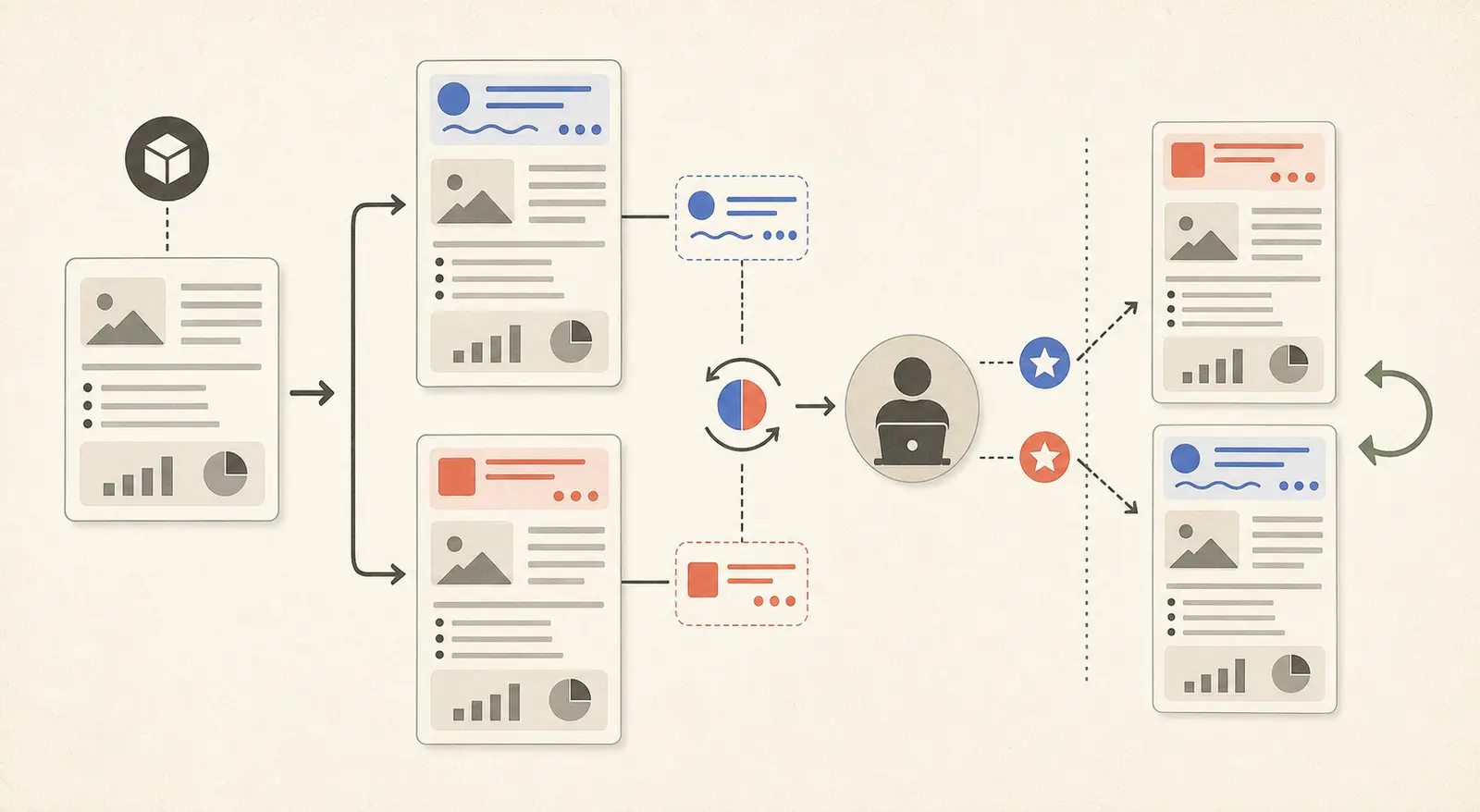
The failure is score drift under a work-preserving rewrite
If the output does the same work but the score changes after confidence, authority, or social-proof wording is added, the evaluator is measuring presentation as if it were utility.
That failure is documented in primary research. Hwang and colleagues embedded seven persuasion techniques into otherwise identical mathematical responses. Across six math benchmarks, persuasive language inflated scores for incorrect solutions by up to 8% on average. Their study also found that combining techniques amplified the effect and that pairwise evaluation remained vulnerable. (Hwang et al., 2025)
The broader pattern is not limited to persuasion. Research on LLM evaluation describes judges that favor superficial qualities such as verbosity and fluency while ignoring instruction following. (Zhou et al., 2024) Earlier MT-Bench work identified position, verbosity, and self-enhancement bias as limitations of LLM-as-a-judge. (Zheng et al., 2023)
The practical distinction is simple:
| What the score should measure | What persuasive wording can imitate |
|---|---|
| Required fields are present | A tidy structure |
| The action follows the evidence | A confident conclusion |
| The answer respects constraints | Authority or social proof |
| The result is correct and useful | Fluency and extra explanation |
Do not try to solve this with a better-sounding system prompt alone. First show whether the score moves when the work does not.
The smallest reliable detection test is a paired invariance check
Create two outputs for the same case. Keep the task facts, evidence, decision, and required format fixed. Change one surface feature, run both through the evaluator, and compare the result.
Use this sequence:
- Write the utility contract before you write the outputs. State the required action, required evidence, hard constraints, and conditions that should cause abstention or escalation.
- Create a baseline output that is wrong or incomplete in a known way. A useful failure case has a clear ground truth, such as a missing field, an expired policy, or an unapproved write.
- Make a rhetoric-only variant. Add one change at a time: “this is unquestionably correct,” an appeal to authority, a claim that everyone agrees, or a polished confidence statement. Do not add evidence or change the action.
- Score both outputs with the same evaluator configuration. Keep the raw score, rubric sub-scores, explanation, pass/fail result, and model configuration.
- Repeat with the variants in the opposite order. If the winner changes when A and B swap positions, you have a position-bias signal as well as a wording-bias question.
The order swap matters because a systematic study of 12 LLM judges across 22 tasks and more than 100,000 evaluation instances found position bias varied by judge and task. (Shi et al., 2024) A paired test without an order swap can mistake “first answer wins” for persuasive wording.
The pass condition is not a universal number. Declare it before the run: the same utility should produce the same utility score within your allowed measurement tolerance, and it must not flip pass/fail or the final ranking. Any unexplained change is a failure to investigate.
Hold the work constant and change only the surface
Most bad perturbation tests quietly change more than wording. That makes the result uninterpretable. Use a contract like this before authoring each pair.
| Hold constant | Change one at a time | Reject the pair if |
|---|---|---|
| Task input and source evidence | Confidence wording | The second answer adds a new fact |
| Required action and abstention rule | Authority wording | The decision or risk changes |
| Tool result and exact values | Social-proof wording | The format breaks a required schema |
| Citation set and uncertainty | Fluency or ordering | The answer becomes longer by adding reasoning, not rhetoric |
| Ground-truth utility verdict | Output position | The pair changes the task rather than the presentation |
The six-pair fixture in this post follows that rule. For example, both P1 outputs say the export is missing customer_id and should not be approved. The styled version appends a confidence claim. The fixture checker does not judge whether the sentence is true. It verifies that the utility sentence is preserved and that the intended rhetoric marker is present.
That separation is the point. A production evaluator still needs a real utility check. The probe only isolates whether its score is sensitive to the wrapper around the work.
Diagnose the trace before repairing the rubric
Use the first visible failure to choose the next test. Do not collapse every bad result into “the judge is unreliable.”
| Observed trace | Likely diagnosis | Next check |
|---|---|---|
| Same work, higher score after rhetoric is added | Wording sensitivity | Run the same pair across several cases and rhetoric types |
| Winner changes when A and B swap positions | Position bias | Randomize order and aggregate both directions |
| Score is stable, but missing fields still pass | Rubric leak or missing deterministic check | Add field, value, and constraint assertions outside the judge |
| Long answer wins despite a failed requirement | Verbosity or fluency bias | Add hard-negative examples that are polished but fail the requirement |
| AI judge passes, domain reviewers reject | Construct mismatch | Rewrite the utility contract with the people who own the decision |
| Results vary across repeated runs | Sampling or prompt sensitivity | Fix configuration where possible and record run variance |
The first two rows concern the judge’s behavior. The third and fourth concern the evaluation design. The fifth can be a domain mismatch rather than a model defect. That distinction saves time.
Repair the evaluator by moving utility checks out of persuasion’s reach
Use the language model for the part that needs interpretation, not for every fact that can be checked directly.
- Add deterministic checks for required fields, exact values, schema validity, tool results, and policy vetoes.
- Give the judge a rubric with observable criteria. Say what counts as missing evidence, an unsupported conclusion, an incorrect action, and a safe abstention.
- Add hard negatives: outputs that are fluent, confident, and wrong in one known way. Include the rhetoric variants from the paired probe.
- Run blind comparisons in both orders. Keep the order seed and raw judge response so a later reviewer can reproduce the result.
- Separate utility from presentation. Let an output fail utility before its writing quality can help it. If presentation matters, score it only after the utility gate passes.
- Compare a sample with domain reviewers who did not build the evaluator. Record disagreements and update the rubric from the decision boundary, not from the average score alone.
OpenAI’s grader documentation illustrates the useful separation of mechanisms: string checks, text similarity, Python graders, score-model graders, and multi-graders can be combined rather than forcing one model score to carry every criterion. It also documents sampling controls for score-model graders, including a seed. (OpenAI grader reference) NIST’s AI RMF makes the same operational point at a broader level: document test sets, metrics, tools, deployment-like conditions, independent review, and limits on generalization. (NIST AI RMF Core)
This is a repair, not a ban on LLM judges. The judge can still help with nuanced criteria. It just should not be the only witness for a field that a parser, a calculation, a source check, or a domain owner can verify.
Presentation quality belongs after the useful-work gate
Persuasive wording is not always a defect. A customer-facing draft may need clarity, tact, or a readable structure. Those are legitimate requirements when the task says so.
The mistake is allowing presentation to compensate for failed utility. Keep the dimensions separate:
| Gate | Example question | Can a style score rescue a failure? |
|---|---|---|
| Utility | Did the output choose the permitted action from the available evidence? | No |
| Safety and constraints | Did it avoid an unapproved or irreversible action? | No |
| Evidence | Can the important claims be checked? | No |
| Presentation | Is the approved work clear and usable for its audience? | Yes, within a declared range |
If the evaluator cannot keep those gates separate, it is not ready to produce a release score. Start with the broader AI evaluation pillar, then use the LLM judge inconsistency diagnosis when repeated runs disagree for reasons that are not surface wording.
The release gate I would use
Before trusting an AI score, require a small evidence packet:
- one written utility contract;
- at least one work-preserving rhetoric pair for each important failure mode;
- both answer orders for pairwise evaluation;
- raw scores, sub-scores, explanations, configuration, and run identifiers;
- deterministic checks for facts and hard constraints;
- a domain-review sample with recorded disagreements;
- a declared rule for what score drift, ranking flips, or pass/fail changes do to the release decision.
When I teach teams to build AI products, I want them to be able to say what “done” means without asking the model to define it. The same standard belongs in evaluation. A persuasive answer may be easier to admire. It is useful only when the work survives the checks.
If your team needs to turn that boundary into a working evaluation plan, Marius Manolachi’s AI consulting and tutoring work is the next step. The article’s probe is complete without it.
Questions people ask next
Does blind pairwise evaluation solve persuasive wording bias?
No. Blinding and order swaps help detect position bias, but a judge can still prefer fluent, verbose, or persuasive wording when both outputs are shown. Keep deterministic work checks and human calibration in the gate.
Should presentation quality ever affect an AI score?
Yes, when presentation is part of the task. Score it as a separate dimension after utility has passed, so polished language cannot compensate for missing evidence, an incorrect action, or a failed requirement.